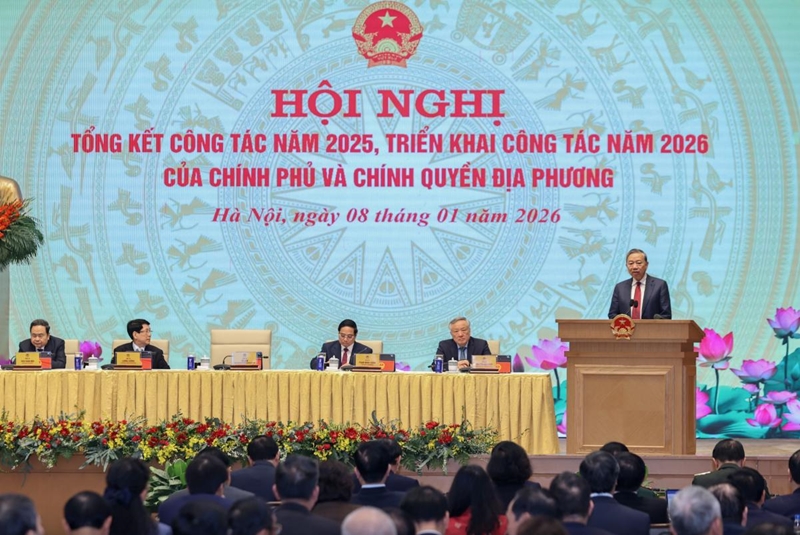
The conference was chaired by the Government and held in a hybrid format connecting the Government Headquarters with all 34 provinces and cities.
General Secretary Lam commended the Government, ministries, local authorities, the business community, and the people at home and abroad for their concerted efforts and achievements in 2025 and throughout the 2021-2025 period. At the same time, he stressed the need to frankly acknowledge persistent shortcomings and newly emerging challenges, many of which reflect deep-rooted structural bottlenecks in the development model and national governance system.
    |
 |
|
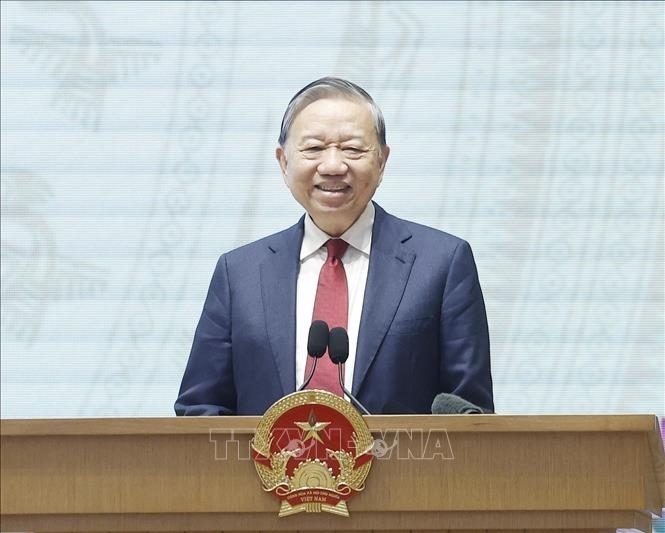
Party General Secretary To Lam addresses the event. (Photo: VNA) |
According to the Party leader, 2026 is a pivotal year that will shape Vietnam’s long-term growth trajectory. Achieving a GDP growth rate of at least 10%, he noted, is highly challenging amid weakening traditional growth drivers and mounting constraints in productivity, competitiveness and growth quality.
Old approaches are no longer fit for new requirements, he said, calling for fundamental reforms in development thinking, governance methods, resource allocation, and a much stronger push for decentralization and delegation of authority, accompanied by deep, decisive and effective reforms.
Regarding orientations and tasks for the upcoming period, the General Secretary highlighted the need to remove institutional bottlenecks to unlock stalled resources; maintain macro-economic stability; control inflation and safeguard major economic balances. Fiscal and monetary policies should be closely coordinated, flexible and technically sound, guided by market principles rather than excessive administrative intervention. Credit, he said, must be restructured towards production, business and priority sectors, while speculative and non-productive activities are curbed.
The top leader also called for substantial improvements in the investment and business environment, including expanded decentralization, streamlined procedures and reduced compliance costs for citizens and enterprises. He firmly rejected the mindset of “banning what cannot be managed,” stressing the necessity to strictly protect property rights and freedom of business, and prevent any abuse of inspections or investigations to harass businesses and the public.
A central strategic direction highlighted in his address was the fundamental transformation of the growth model, placing productivity, high-quality human resources, science and technology, and innovation at the core of development strategy. This, he said, is the key to escaping the middle-income trap and sustaining rapid and inclusive growth. The economy should be restructured along green, digital and circular lines, with science, technology, innovation and digital transformation serving as both new growth engines and catalysts for renewing traditional ones.
General Secretary Lam urged building a modern, integrated system of strategic infrastructure as a foundation for national competitiveness, while calling for the concentration of resources on breakthrough, strategic infrastructure projects, particularly national transport corridors, railways, airports, seaports, energy and digital infrastructure.
He highlighted the imperative of ensuring energy security, especially clean energy, stressing that power shortages must not be allowed to occur. At the same time, he called for the development of next-generation digital infrastructure, including widespread 5G coverage, 6G research, the expansion of data centers, and deeper participation in high-tech value chains, with the goal of launching a semiconductor manufacturing project.
The Party leader also underlined the need for a fundamental overhaul of public investment implementation, positioning it as a driver that leads development, creates spillover effects and mobilizes private-sector resources.
On governance and implementation, the General Secretary stressed the need to strengthen the execution capacity of the state apparatus under conditions of stronger decentralization. Authority must go hand in hand with resources and accountability, while administrative discipline and the responsibility of leaders must be tightened. He proposed designating 2026 as a year to enhance the quality of grassroots-level officials, alongside continued streamlining of the organizational apparatus to make it leaner, more efficient and effective.
|
|
 |
|
At the conference (Photo: VGP) |
The Party General Secretary stressed that education and training must be closely aligned with labor market needs and priority technology- and industry-driven sectors, while raising foundational skills, particularly digital skills, across the workforce.
He underscored the need for balanced and comprehensive development across socio-cultural sectors, with a focus on improving living standards and ensuring social security. Alongside preserving and promoting national cultural values, Vietnam should foster cultural industries, particularly cinema, cultural tourism and performing arts, as a new growth driver. Priority was given to public health improvement under the Politburo’s Resolution No.72, completing more than 110,000 social housing units in 2026, advancing the one-million-unit target by 2028, and finishing 248 inter-level schools in border areas.
The Party chief also called for pro-active climate change adaptation, stronger disaster prevention and environmental protection, with emphasis on early warning and response to extreme weather, floods and landslides. He urged faster development of national land and real estate databases to enhance transparency, decisive action to tackle urban pollution, effective climate adaptation in the Mekong Delta and disaster mitigation in other vulnerable regions, and the sustainable use of rare earth resources in support of emerging industries.
In addition, he stressed the firm consolidation of national defense and security, the maintenance of social order, and the continued pursuit of a foreign policy of independence, self-reliance, and multilateralization and diversification. He highlighted the importance of ensuring absolute security for major political events, particularly the upcoming 14th National Party Congress and the elections of deputies to the 16th National Assembly and the People’s Councils at all levels for the 2026-2031 term, strengthening cybersecurity and digital security, advancing economic and technology diplomacy, preparing thoroughly for APEC 2027, and promoting cultural, people-to-people, and science and technology diplomacy.
General Secretary Lam expressed confidence that Vietnam now has sufficient momentum, capacity and determination to enter a new era of prosperous and sustainable development. He called on the Government, ministries and localities to act with unity, resolve and a heightened sense of responsibility to successfully fulfil the tasks set for 2026 and beyond, turning emerging opportunities into concrete outcomes for national development.
Source: VNA