Deputies said delayed VAT refunds remain a major obstacle for businesses, calling for stronger technical tools and a clearer legal framework to both support production and safeguard the state budget.
    |
 |
|
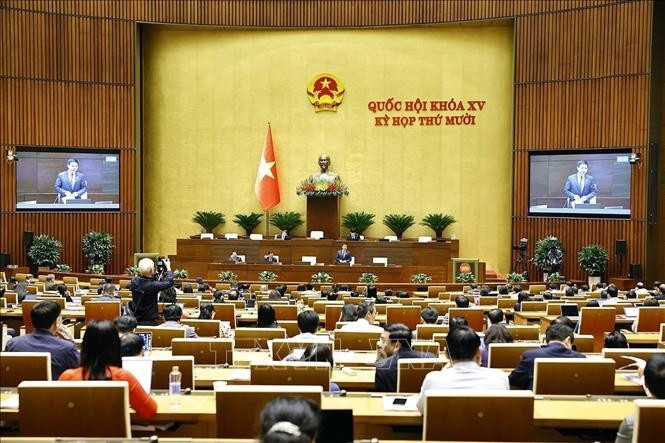
Minister of Finance Nguyen Van Thang clarifies issues raised by lawmakers. |
Supporting the amendment, deputy Ha Sy Dong of Quang Tri province noted that most current problems stem from implementation rather than the law itself, particularly prolonged refund timelines, lack of transparent tracking tools, and inconsistent enforcement. He warned that revising the law too early, while guiding documents remain incomplete, may disrupt business operations.
To fundamentally address refund delays, Dong proposed introducing a risk-based automatic VAT refund mechanism, instead of general commitments to shorten processing time. Compliant enterprises should be refunded within a fixed period, such as 30 days, while high-risk cases would undergo pre-refund inspections. He also called for clear sanctions on tax authorities that cause unjustified delays.
He stressed that the application of big data and artificial intelligence must be regulated in detail, specifying types of connected data, technical standards, data security, and responsibilities of each party to ensure effective risk control.
Deputy Tran Huu Hau of Tay Ninh province underlined that some of the proposed amendments could help exporters save tens of trillions of dong previously tied up in advance tax payments and borrowing costs.
As agricultural products of Vietnam are facing fierce competition in global markets, even just a few percentages of profit increased is also greatly meaningful, helping businesses stay more resilient and develop, he added.
Regarding tax policies on agricultural products, scraps, and by-products, Dong proposed that a detailed list of goods be clearly defined by HS codes in the law or issued by the Ministry of Finance, along with export ratio criteria and mandatory documentation to prevent fraudulent transactions.
For industrial by-products, he called for standardized classification codes and production norm declarations to curb tax manipulation through under-declaration.
Hau highlighted the importance of abolishing the VAT provision applied to certain by-products such as cassava residue, brewery waste, shrimp shells, and molasses, which will enable animal feed producers to cut input expenses, reduce prices, and improve processing efficiency, thus helping address environmental pollution and promote a circular economy.
Source: VNA