In an interview with Vietnam News Agency correspondents in New York, he said the decision to hold the election two months earlier than usual represents not merely a technical adjustment but a historic and well-considered step, reflecting long-term vision in building, consolidating and operating the state apparatus.
    |
 |
|
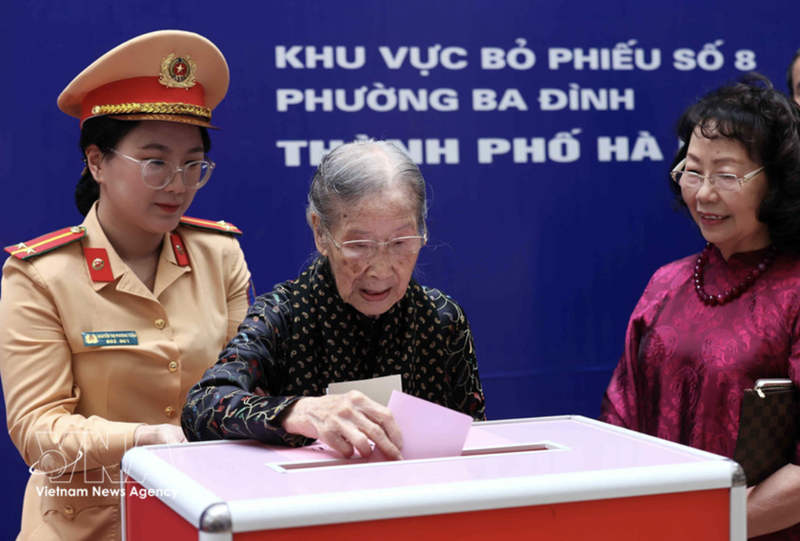
Doan Thi Thuan, a 101-year-old voter, casts her ballot at Polling Station No.8 in Ba Dinh ward, Hanoi, on March 15. |
Thang noted that in recent years, elections, Party congresses at all levels, and the consolidation of the N.A., Government and the Vietnam Fatherland Front have taken place at different times, creating a degree of lag in policy formulation, governance and coordination among central agencies. Bringing the election forward in 2026, he said, is therefore a highly appropriate and rational move to synchronize the operational rhythm of the entire political system.
According to him, aligned terms will enable national policies to be implemented more swiftly and effectively, particularly amid unpredictable global developments in the economy, security and environment. Moving closer to a modern governance model is an inevitable trend to enhance national competitiveness and economic resilience.
He also noted that Vietnam is operating a two-tier local administration model, a major reform aimed at building a modern, streamlined, and efficient system that functions smoothly and serves citizens more effectively. In his view, this model aligns with international trends and reflects a strong determination to clarify decentralization and delegation of authority, thereby encouraging local initiative while strengthening accountability at each level.
The expert emphasized that three key factors are essential for the effective operation of the two-tier system, namely human resources, technology and coordination mechanisms.
As Vietnam enters a phase of accelerated national advancement, he added, the role of N.A. deputies and People’s Council representatives becomes increasingly important. They serve as a trusted bridge between the people and the State, and between social realities and public policy.
Professionalizing the cadre of elected representatives, together with greater application of technology in parliamentary activities, will be crucial to ensuring that the N.A. and People’s Councils truly function as centers of people’s power within Vietnam’s socialist rule-of-law state, Thang recommended.
He also emphasized the growing importance of parliamentary diplomacy. Unlike traditional diplomacy led by governments, this approach, rooted in legislative and people-to-people connections, plays a larger role in international relations by building understanding, trust, and cooperation among lawmakers, civil society, academic circles, and local communities.
The expert stressed that the election is not merely a routine political and legal exercise but a concrete step in realizing the Party’s and State’s strategic vision of building a truly enabling, effective and people-centered socialist rule-of-law state. Vietnam, he said, is making steady progress towards a modern, transparent governance system that serves its citizens and integrates deeply with the world.
Source: VNA