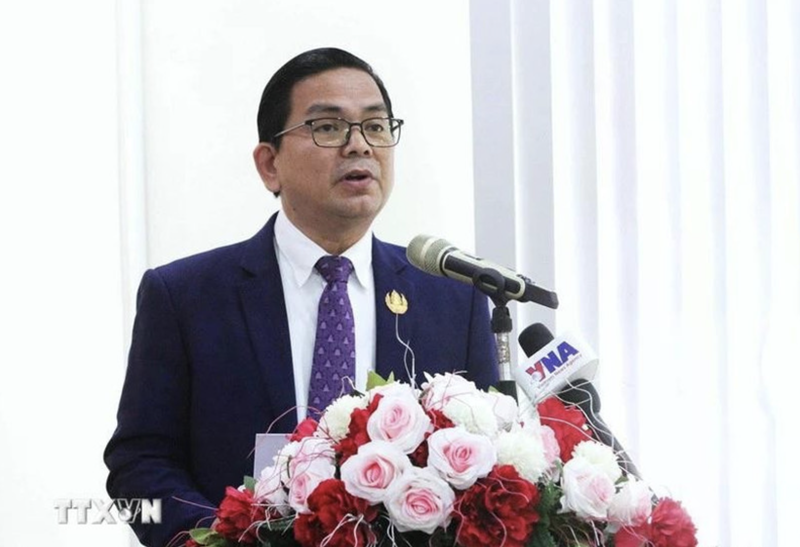
While describing the 14th National Congress of the Communist Party of Vietnam, held from January 19-23, as a historical milestone that carries not only domestic significance but also profound implications for stability in ASEAN, Dr. Kin Phea stressed that Party building is the core of leadership capacity.
    |
 |
|
Dr. Kin Phea, Director of the International Relations Institute under the Royal Academy of Cambodia (RAC) |
In his presentation on “Party building in the new era: enhancing the leadership role and capacity of the Communist Party of Vietnam”, he identified a number of major pillars of Party building in the new development stage. First is steadfast adherence to the ideological foundation while closely linking theory with Vietnam’s reform reality. He noted that while maintaining Marxism–Leninism and Ho Chi Minh Thought, the CPV has emphasized renewal and creativity in implementation, stating that “this approach allows Vietnam to modernize without losing its political orientation”.
He also highlighted the importance of political integrity and internal unity, praising Vietnam’s anti-corruption campaign carried out with the principle of “no forbidden zones, no exceptions,” which has sent a strong message about the determination to build a clean and strong Party. Notably, he commended the shift in focus from anti-corruption to anti-wastefulness, viewing it as a new step in leadership thinking that addresses hidden but dangerous barriers to development.
From a governance perspective, Dr. Kin Phea said the CPV has identified three strategic breakthroughs. The first is institutional reform and effective enforcement, with institutional bottlenecks seen as the biggest obstacle to rapid and sustainable growth. Building a transparent, stable and predictable governance environment, with leaders operating within the Constitution and law, is therefore essential.
The second breakthrough lies in human resources development, particularly a contingent of strategic-level cadres combining both integrity and competence, with political firmness, technological understanding, global vision and close ties to the people.
The third is the development of synchronous, modern infrastructure. Dr. Kin Phea stressed that organizational reform combined with digital transformation will streamline the system, reduce overlap and improve governance efficiency, emphasizing that digital transformation is not merely a technical tool but a data-driven, transparent and people-centered governance philosophy.
Overall, he assessed that at this historic juncture, Party building in the new era is becoming not only a leadership requirement but also a governance advantage for Vietnam. A strong, visionary CPV, he concluded, will underpin a stable Vietnam - an essential pillar for peace, cooperation and prosperity in ASEAN and the wider international community, he concluded.
Source: VNA