Nguyen Thi Thu Huyen, Chief of the Office of the Association of Vietnamese People in Vientiane, said that for OV intellectuals to return and contribute effectively and sustainably to the Fatherland, it is not enough to rely on calls for participation or incentive policies alone. The core issue, she stressed, lies in building transparent working mechanisms, clearly defining authority, and assigning specific responsibilities.
    |
 |
|
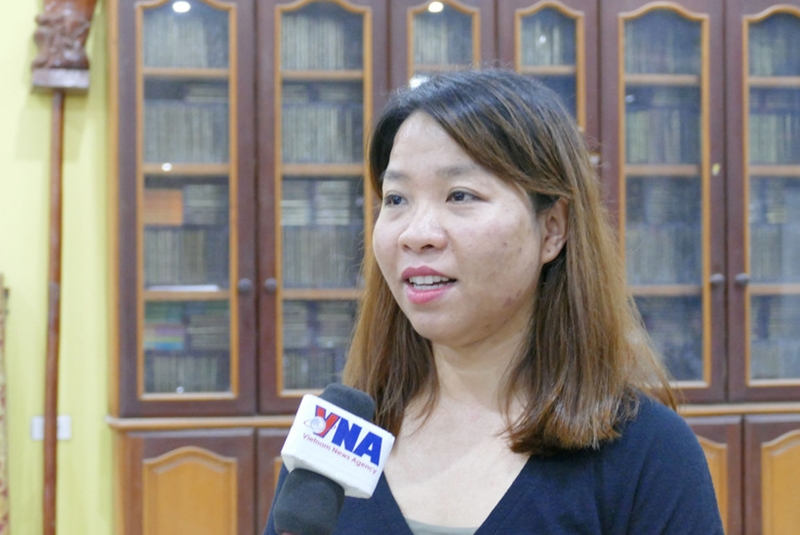
Nguyen Thi Thu Huyen, Chief of the Office of the Association of Vietnamese People in Vientiane, grants an interview to the Vietnam News Agency. |
According to Huyen, it is essential to place the right people in the right positions, in line with their expertise. Many OV intellectuals are trained and work in highly professional international environments. If their contributions at home are limited to symbolic advisory roles without decision-making power or concrete tasks, their potential cannot be fully utilised, she said, stressing the importance of the removal of administrative barriers and the mindset of considering them "guests."
OV intellectuals should be regarded as an integral part of the national knowledge ecosystem, and trusted and assessed based on performance, with authority aligned with accountability, she added.
She also highlighted the need for flexible cooperation mechanisms. Contributions do not necessarily require full-time work in Vietnam, but can take the form of project-based engagement, fixed-term assignments, or cross-border collaboration. What matters most, she emphasised, is their substantive and effective contributions.
To position Vietnam on the global technology map, Huyen proposed the nation clearly identify strategic sectors aligned with national strengths, such as biomedical technology, high-tech agriculture, applied artificial intelligence, semiconductors, clean energy, and digital technologies serving society.
At the same time, Vietnam should strengthen investment in research and development linked to commercialization, and foster an innovation ecosystem in which enterprises play a central role, the State acts as a facilitator, and talent at home and abroad serves as the driving force.
Ahead of the 14th National Party Congress, Huyen expressed her hope that Vietnam will continue to strongly affirm the spirit of great national unity, recognizing overseas Vietnamese as a strategic resource for national development. When trust is reinforced through concrete, consistent, and long-term policies, OVs will feel increasingly connected and ready to contribute more to the homeland.
Sharing the same confidence, Dong Cong Dung, Chairman of the Association of Vietnamese People in Champasak province, described the congress as a particularly important political event, with long-term significance for national development and as a major source of encouragement for OVs to live and work with peace of mind, integrate well into host societies, and continue accompanying and contributing to the homeland.
Similarly, Nguyen Van Binh, Chairman of the Association of Vietnamese People in Attapeu province, expressed his hope that the congress will continue to issue open and favorable policies to enable OVs to contribute their intellect and resources more effectively. He affirmed that the Vietnamese community in Attapeu remains confident in the Party’s leadership, proud of the country’s achievements, and ready to serve as a bridge in further strengthening the great friendship, special solidarity, comprehensive cooperation, and strategic cohesion between Vietnam and Laos.
With these shared expectations, the Vietnamese community in Laos showed their belief that the 14th National Party Congress will usher in a new phase of development in which Vietnamese intellectual strength, both at home and abroad, is fully mobilised and harnessed for the goal of building a strong and prosperous Vietnam.
Source: VNA