The main challenge is how to match overseas Vietnamese experts with domestic needs and utilize their expertise to generate practical results in support of the nation.
Matching talented people with right challenges
The resolution identifies the more than 6.5 million Vietnamese people in over 130 countries and territories as an important strategic resource for enhancing national strength, while acknowledging that their potential has yet to be fully tapped. It asked for better and breakthrough policies to connect, attract, and optimize their resources and expertise, including shaping a sustainable ecosystem linking Vietnamese experts, scientists, intellectuals, entrepreneurs, and young people worldwide.
    |
 |
|
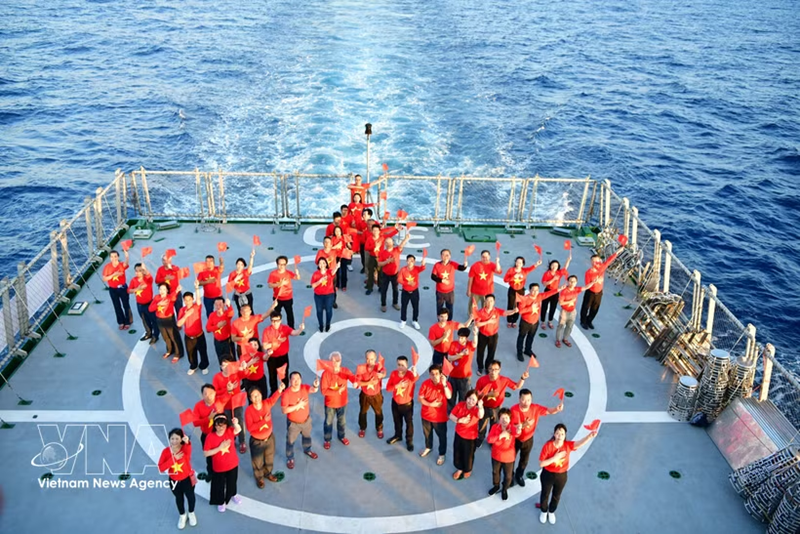
More than 60 overseas Vietnamese from 24 countries and territories worldwide join a delegation visiting soldiers and residents on the Truong Sa (Spratly) Islands and DK1 offshore platforms from April 18 to 26, 2025. |
At the 33rd Diplomatic Conference in August 2026, Prime Minister Le Minh Hung stressed that development diplomacy must deliver tangible results within specific timeframes and for clearly identified beneficiaries. He called for a shift “from attracting resources to translating resources into results,” including by engaging overseas Vietnamese talent in national innovation programs.
He also urged a results-oriented approach and stronger efforts to encourage overseas Vietnamese to transfer knowledge, skills, technology and other resources to support the development of new productive forces at home.
Viet Nam has established expert networks in numerous countries and strategic technology fields, but effective cooperation requires clear tasks, appropriate expertise, sufficient resources and transparent arrangements on responsibilities, benefits and expected outcomes. Administrative procedures, financial mechanisms and intellectual property policies also need to be improved.
From inviting experts home to jointly solving problems
Nguyen Phuc Binh, Chairman of the Viet Nam–Australia Innovation Network (NIC-AU), said the main challenge is matching talented people with problems requiring solutions, rather than a lack of expertise or willingness to contribute.
Many young Vietnamese intellectuals in Australia wish to support their homeland, but administrative barriers and unclear arrangements regarding tasks, responsibilities and benefits can hinder their participation.
NIC-AU therefore prioritizes finding suitable experts for specific assignments based on practical experience, availability and willingness to contribute, Binh noted.
He proposed developing a “problem bank” to connect domestic needs with overseas expertise, expanding joint research and involving expert networks earlier in policymaking and policy review. Network effectiveness, he said, should be measured by actual partnerships rather than membership numbers.
Meanwhile, ministries, localities, research institutes, universities and businesses need to translate their demand for expertise into specific tasks with clear objectives, expected deliverables, resources and coordination mechanisms.
As many overseas Vietnamese scientists have established careers and research facilities abroad, flexible cooperation arrangements can enable them to contribute without relocating permanently to Viet Nam, Binh suggested.
Hanoi University of Science and Technology (HUST) is testing this approach through its HUST Talent scheme.
Dr Ta Anh Son, deputy head of the university’s personnel organization department, said the scheme offers leading experts working abroad opportunities to participate as invited lecturers, advisers or senior experts, alongside full-time positions. The university aims to connect with around 100 leading overseas experts and scientists by 2030.
Since its launch in October 2025, the scheme had received around 50 applications by June 2026. Son said turning initial interest into concrete cooperation remains challenging as identifying specific problems suited to individual experts often requires further consultation.
HUST is developing a task-based mechanism under which it identifies problems, selects suitable experts and establishes cooperation arrangements with defined timelines, key performance indicators (KPIs), expected deliverables and remuneration.
“Experts’ contributions are expected to be assessed based on the value they create rather than primarily on the time they spend at the university,” Son said.
In 2026–2027, the university plans to pilot the approach in some priority areas such as artificial intelligence, semiconductors and new energy, selecting three to five problems in each field with designated lead units, budgets and specific KPIs.
These efforts reflect the need to move beyond attracting overseas experts towards enabling them to address concrete domestic challenges regardless of where they are.
By clarifying needs, connecting the right people with the right tasks and assessing contributions through results, Viet Nam can better turn the intellectual resources of its global Vietnamese community into research, technologies, products, and solutions for national development.
Source: VNA