PANO - Having been determined to wipe out the enemy at the Dien Bien Phu group of fortresses, the Politburo and President Ho Chi Minh closely followed developments on the battlefield and made timely decisions to turn that determination into reality.
When French parachutists landed in Dien Bien Phu in November 1953, Vietnamese troops adopted the strategy “quick attack, quick win”. However, in late January 1954, acknowledging changing in enemy forces, the Party Committee of the Dien Bien Phu Front decided to change that strategy into “slow advance, sure success”.
On January 30th, 1954, General Vo Nguyen Giap sent a letter about a new combat line in Dien Bien Phu to President Ho Chi Minh, General Secretary Truong Chinh and the Politburo. In that letter, the general stressed on boosting key activities and building foundations in Cambodian areas of Stung Treng and Kompong Thom to make a link with the Lower Lao region.
The line focusing on the combination of armed forces of the Indochinese countries was then approved by President Ho Chi Minh, General Secretary Truong Chinh and the Politburo. Thus, from January 30th, 1954, the Vietnam People’s Army cooperated with the revolutionary armed forces of Laos and Cambodia to open a campaign attacking French troops in Lower Laos and Northeastern Cambodia, annihilating more than 1,000 enemy troops and liberating a large area linking guerrilla bases in Northeastern Cambodia with the liberated Lower Laos region.
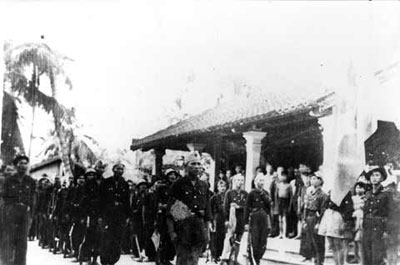 |
| A flag saluting ceremony of the Vietnam-Cambodia alliance in the resistance war against French colonists. A filed photo. |
Victories on Vietnam-Laos-Cambodia battlefields initially foiled the Navarre Plan. To save that plan, American imperialists urged the French colonists to continue their fighting. The Americans clearly stepped up its intervention in the Indochina War after supporting them with money and weapons.
On February 22nd, 1954, the Politburo issued an instruction in which all Vietnamese troops and people were mobilized to defeat the enemy in coming battles, decimating enemy strength and foiling France and the US’s Navarre Plan completely.
Meanwhile, on March 17th, 1954, President of the Khmer National Liberation Committee Son Ngoc Minh read an important report at a conference of the United Issarak Front, confirming that Cambodia was launching a resistance war for national salvation and independence. In that war, they were not alone. “Together with neighbouring countries of Vietnam and Laos, we are creating an alliance with a population of nearly 30 million people and uniting to fight the common enemy. We and brothers Vietnam and Laos are on our way to victory and glory”, Minh said.
In that report, Minh also stressed on the building of a long-term and sustainable people’s alliance of Cambodia-Vietnam-Laos.
Later on, on March 20th, 1954, Foreign Minister of Cambodian Government of Resistance War announced a protest against the US’s intervention in Indochina. The announcement demonstrated the stance and strong solidarity of the government and people of Cambodia with Vietnamese and Lao people.
In the letter sent to President Ho Chi Minh and the United Vietnam National Front, President Son Ngoc Minh affirmed that Cambodia was determined to defeat French colonists and Americans and kept fighting until Cambodia and Vietnam regained their independence, freedom and happiness.
After good preparations, in March 1954, General Vo Nguyen Giap, Commander-in-Chief of the Vietnam People’s Army ordered to mobilize all cadres, troops at all units to open a huge offensive at the Dien Bien Phu group of fortresses.
The general emphasized that the victory of the Dien Bien Phu Campaign would have great impact on Vietnam and other countries and be a deserving contribution to the world’s peace movement to end the war in Vietnam, Cambodia and Laos.
On March 13th, 1954, the Dien Bien Phu Campaign started. During this campaign, Cambodian people teamed up with Vietnamese volunteer troops on the Cambodian battlefield.
In late March 1954, Battalion 436 (Chi Long Battalion) of Regiment 101 of Division 325 worked with Cambodian troops to wipe out the enemy. In early April 1954, from Lower Laos, Chi Hoa Battalion of Regiment 101, while in action in Champasak in Lower Laos, moved along the right bank of the Mekong River to destroy the enemy in eastern Kompong Thom province and then encircled Stung Treng town.
At the same time, Chi Hung Battalion of Regiment 101 surrounded Siem Pang district.
Notably, in early April 1954, full Battalion 302 was assigned to do international obligation in Cambodia, contributing to the victory of the Dien Bien Phu Campaign.
It is said that the victory of the Dien Bien Phu Campaign came from many factors, including the effective operation between Vietnamese and Cambodian people. Grasping thoroughly the two Parties, States’ policies on solidarity in combat, Vietnam and Cambodia’s people were side by side with each other to fight against the common enemy and gained great achievements, contributing to the success of the resistance war against French colonists of each country and of Indochinese people.
Written by Le Van Phong from the Vietnam Military History Institute
Translated by Mai Huong