PANO - The People’s Army Newspaper reporter Tran Cu took notes what General Vo Nguyen Giap said at Muong Phang Headquarters that “There is another general in the campaign together with General Vo Nguyen Giap. That is general of rice, general of logistics”. General Vo Nguyen Giap highly valued logistics work in the Dien Bien Phu Campaign, with three main forces of military supplies, military medicine and transportation.
Recording caught buffalo
Major General Do Van Phuc, the former Vietnamese Military Attaché in the Russian Federation, used to command Company 56 of Regiment 98 of Brigade 316 to launch attack on Hill C1 in the Dien Bien Phu Campaign.
The general held that the logistics work in that world famous historic campaign was “wonderful”. “All efforts were made to ensure transportation, food, care for wounded soldiers despite hardship and extremely difficulties. We got another campaign inside the campaign”, the general stressed.
He recalled at that time, his company had nearly 200 members. At the front, each cadre and troop was provided with 800 grams of rice a day. They often put it on rice belts and brought along the march. The soldiers' main food was salt and they were rarely fed with dried salted fish or dried fish.
To make dishes more nutritious, troops were allowed to barter rice for other vegetables and other food from H’Mong ethnic group. At times, the enemy heavily bombarded the locality, killing many buffalos and many others ran in chaos to forests. Agreed by the locals, the High Command allowed units to catch wandering cattle for food to improve their nutrition. However, the command also asked units to record the number of caught cattle, so that the Government could compensate for the locals when peace was resumed. Phuc’s company had killed a dozen of cattle.
Notably, General Vo Nguyen Giap and commanders of the front requested troops to have cooked rice, boiled water and mosquito nets. Besides, trenches were made long enough for troops to ensure their health for the strategy “Slow advance, certain success” and wounded soldiers were timely carried to the rear for treatment.
Recalling that time, General Phuc could not forget balls of hot rice provided by logistics force while the combat trench was bombarded. “We felt warm at heart. These hot rice balls had make up for our comrades’ efforts”, Phuc said.
Feeding troops with rice seeds
Right after the Dien Bien Phu Campaign Headquarters was established, the General Department of Supply (present General Department of Logistics) decided to set up a frontline general department of supply, led by a deputy director.
The logistics force, including military supplies, military medicine and transportation had well ensured food for troops and timely treatment for wounded soldiers. Well directed, the military medicine and transportation force timely moved wounded soldiers to safer places, reducing causalities from 4.41 per cent in the Hoa Binh Campaign to 1.7 per cent in the Dien Bien Phu Campaign.
To ensure food for troops, logistics sector boosted exploiting on-site food or processing more dried food, bacon and pickled vegetables as provisions for the front.
Logistics of Brigade 316 sent 70 cows from Thanh Hoa and made use of thousands of banana inflorescence as vegetables. Meanwhile, logistics of Engineering-Artillery Brigade 351 provided nearly 100 tonnes of bacon from Phu Tho. Brigade 308 exploited tonnes of yam, vegetables in forest, and fish.
Attentively, Company 65K of Regiment 88 grew bean sprouts on troops’ shoulders along the march from Dien Bien Phu to the rear, ensuring fresh vegetables for troops. Moreover, northwestern people contributed half of produced rice, meat and 100 per cent of vegetables to the campaign. Many villages donated rice seeds to troops.
Pack-bikes defeating aircraft
When the strategy of “quick attack, quick win” was changed into “slow advance, certain success”, demands for military supplies were growing. The logistics sector mobilized all their sources and locals to ensure treatment and food for not only wounded and sick Vietnamese soldiers but also for the wounded enemies. In fact, thousands of tonnes of ammunition, petrol and oil, rice, salt, meat and other necessaries were transported to troops at the front. Despite poverty, people in liberated northwestern region could still contribute food and human sources to partly ease the most difficulties of the campaign.
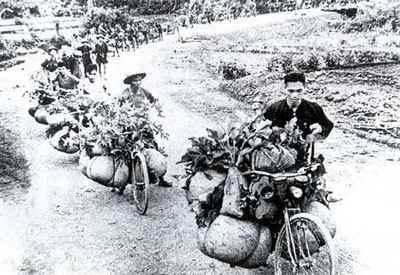 |
| Pack-bikes contribute to the success of the historic victory. |
To transport supplies to the frontline where automobile could not reach, pack-bikes and human strength were mobilized effectively.
French General Henri Navarre had made wrong assessment that each person could carry 20kg of supplies to Dien Bien and he himself had eaten 18kg. The remaining 2kg could not support the troops at the front. However, journalist Giuyn Roa, the former French Colonel had to admit that what defeated General Navarre was not Chinese support but Peugeot bikes. With the handle of people who lacked both food and sleep, each bike could carry up to between 200 to 300 kg of goods. In fact, General Navarre was defeated by his opponents’ intelligence and determination to win.
In his memoirs, General Vo Nguyen Giap wittily said that, in Dien Bien, apart from General Giap, there was another general. It was the general “Rice”.
Notably, one of the charts that General Vo Nguyen Giap paid much attention to every day was the chart of rice supply. This showed the Commander-in-Chief’s concern about logistics work for the campaign.
Reported by Truong Giang and Nguyen Minh
Translated by Mai Huong