Local support sustains the troops
Amidst cold November rains, troops of Regiment 174, Division 316 marched over 80 kilometers across steep, rugged Northwest mountains to reach their combat assembly area. Prolonged rainfall, slippery slopes, and heavy equipment tested soldiers’ physical endurance alongside unit command capabilities.
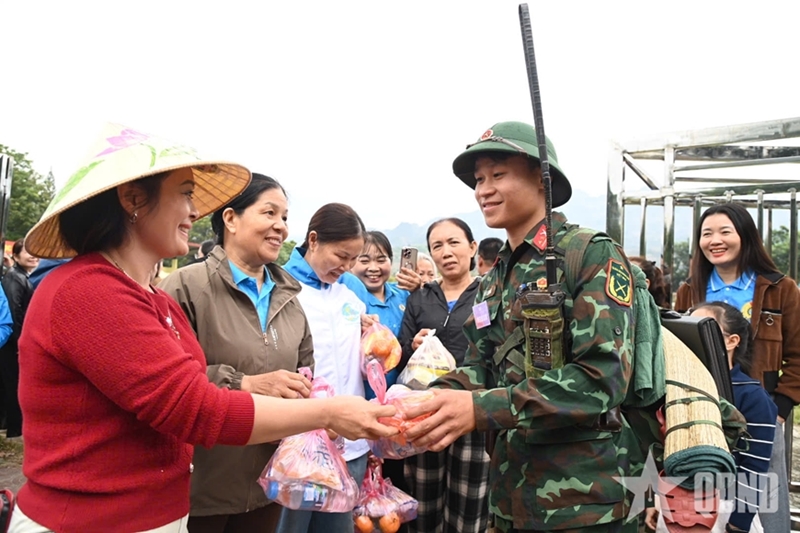
Throughout the march, troops received warm encouragement from local Party committees, authorities, and residents. In Lao Cai province, local leaders and people provided drinking water, bread, fresh milk, and fruit, giving troops added strength and motivation.
    |
 |
|
Residents of Van Chan commune, Lao Cai province, provide refreshments and support for officers and soldiers of Regiment 174, Division 316. |
Among the welcoming crowd at the Van Chan commune stadium, Hoang Thi Luu from Hong Son hamlet shared: “My son serves with Regiment 174. While I sympathize with the hardships of the exercise, I am proud he trains in a heroic unit. Above all, wherever soldiers go, they are embraced by the people.”
Touched by the hospitality, Captain Nguyen Hoang Anh, a personnel officer with Regiment 174, noted: “We are deeply moved by the care of local residents, which inspires our determination to fulfill our mission.”
Beyond refreshments, local authorities and armed forces guided routes and helped units establish camps, fortifications, combat positions, and training grounds, cementing military-civilian solidarity.
A demanding exercise reflecting modern combat conditions
Directed by the Military Region 2 Command under a tight preparation schedule, the exercise featured scenarios matching modern combat against adversaries using high-tech weapons, notably unmanned aerial vehicles (UAVs) and advanced reconnaissance-strike platforms.
|
|
 |
|
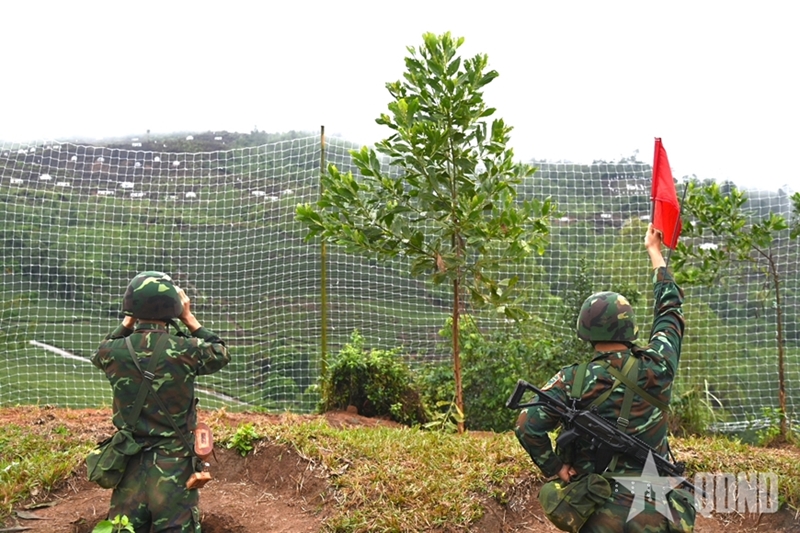
Air defense forces track and monitor enemy UAVs during the exercise. |
Training prioritized command coordination, long-distance maneuvering, field fortifications, and air defense. Incorporating underground facilities, UAV countermeasures, and the "Sustainable Air Defense Dome" concept introduced new requirements for command thinking and military art.
Senior Colonel Le Van Son, Deputy Commander and Chief of Staff of Military Region 2, noted that to meet demanding requirements, Division 316 conducted long-distance marches with heavy gear across difficult terrain in poor weather while ensuring safety.
Units prioritized fortified command posts, including underground shelters, to maintain continuous command during combat, alongside counter-loitering munition defenses, observation posts, and the "Sustainable Air Defense Dome."
At training sites, Division 316 and brigades adapted facilities to local terrain, integrating camouflage and deception with anti-UAV measures, while deploying synchronized surveillance and alert networks to enhance detection.
During live drills, following two opening signal flares, enemy UAV swarms emerged from the mist. Air defense units rapidly deployed, tracking targets and combining electronic warfare with multi-layered firepower to destroy them.
Facing high-tech strikes, units quickly shifted postures, maneuvering flexibly to defend and counterattack. Troops executed tactical plans with reliable communications, while commanders issued accurate, decisive orders under realistic conditions.
Following the exercise, Military Region 2 and participating units reviewed outcomes to refine training programs and operational plans.
The drill highlighted force coordination, troop resilience, and the indispensable support of local communities and authorities, reaffirming the vitality of people’s warfare.
This success bolsters confidence and motivation for Military Region 2 armed forces to fulfill mission demands in the new situation.
Translated by Tran Hoai