In the first half of this year, emulation and commendation activities and the Determined-to-Win emulation movement have been promptly, comprehensively, and synchronously implemented across the military.
The emulation and commendation work has been closely integrated with personnel affairs, policy implementation, and force management, providing timely encouragement and motivation for collectives and individuals to overcome difficulties and strive to successfully fulfill, and in many cases excellently accomplish, their assigned tasks.
    |
 |
|
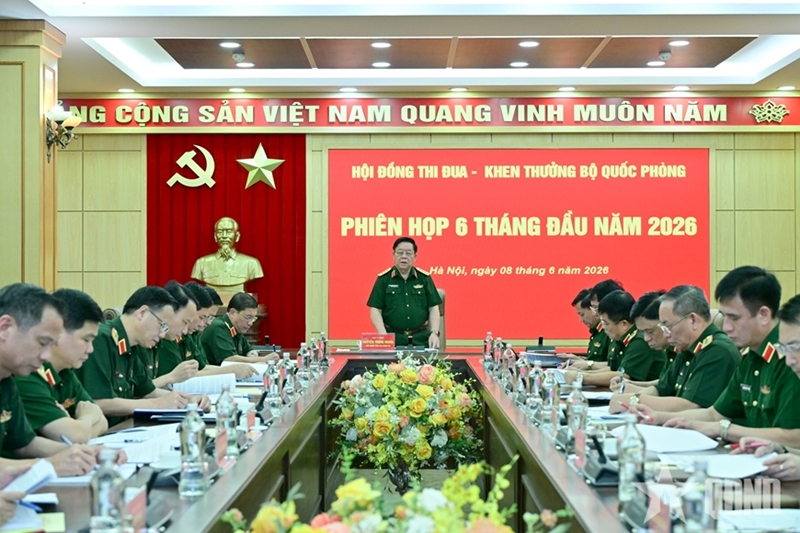
General Nguyen Trong Nghia speaks at the meeting. |
In the reviewed period, the leadership of the Ministry of National Defense commended and submitted recommendations to the Prime Minister and the State President for awards to nearly 41,000 collectives and individuals.
At the meeting, the Council reviewed and voted on nominations and posthumous awards of the title of “Hero of the People’s Armed Forces” in the resistance war and the renewal period, and nominations for the National Emulation Warrior title.
In his concluding speech, Gen. Nghia agreed with the draft report on emulation and commendation work and the Determined-to-Win emulation movement in the first six months of 2026.
He asked the standing body to take notes of comments raised at the meeting, review and complete the report, and ensure consistency with the military-wide six-month review reports so as to comprehensively reflect the outstanding achievements of agencies and units across the military.
Regarding tasks for the remainder of the year, Gen. Nghia directed agencies and units to continue thoroughly implementing resolutions and directives issued by the Party, the Central Military Commission, and the Ministry of National Defense. He emphasized the effective implementation of “two steadfast commitments, two accelerations, two preventions,” and “five steadfast pillars” as directed by the General Secretary, President, and Secretary of the Central Military Commission.
He called for stronger efforts to improve political education, ideological management, and the fight against wrongful and hostile viewpoints in order to safeguard the Party’s ideological foundation within the military.
He also stressed the need to strictly implement Directive No.76 issued by the Minister of National Defense on strengthening political education, ideological management, discipline observance, and safety assurance in the Vietnam People’s Army, considering this one of the key focuses of the Determined-to-Win emulation movement in the coming period.
He laid emphasis on strict compliance with regulations governing conduct in cyberspace; proactive prevention of violations of law and military discipline, and inappropriate behavior in the digital environment; and close integration of these efforts with the military’s digital transformation process.
Other tasks include improvement of leadership capacity and combat strength of Party committees and Party organizations at all levels, personnel work, inspection and supervision; building of a contingent of cadres capable of meeting the requirements of a modern military; promotion of scientific research, innovation, and digital transformation; enhancement of training quality and combat readiness; enhancement of the military’s role in socio-economic development, disaster prevention and response, search and rescue operations, and implementation of national target programs.
Highlighting the need to innovate emulation movements in the new situation, Gen. Nghia stated that they must be comprehensive with focus on major political missions and on areas where shortcomings and limitations remain. He urged each agency and unit to foster unity, discipline, and innovation; build elite, compact, strong organizational structures; and improve the performance of the military’s three core functions as a fighting force, a work force, and a production force, contributing to an environment of peace and stability for national rapid and sustainable development.
Translated by Mai Huong