It can be affirmed that few bilateral relationships in the world are as deep, noble, and enduring as the ties between Vietnam and Laos. As neighboring countries sharing the same socialist system and a tradition of solidarity, Vietnam and Laos have consistently extended to each other valuable, sincere, pure, and effective support throughout the past struggle for national independence as well as in today's cause of national renovation, construction, and development.
    |
 |
|
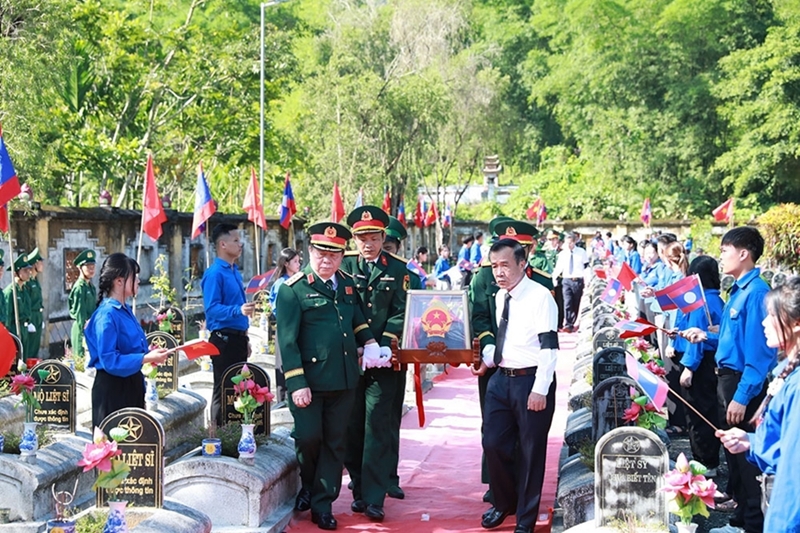
General Nguyen Trong Nghia attends a memorial and burial ceremony for the remains of Vietnamese volunteer soldiers and advisors who sacrificed their lives in Laos, held at Dong Tam International War Cemetery in Thanh Hoa province on May 27. (Photo: VNA) |
The special solidarity between Vietnam and Laos, founded by President Ho Chi Minh, President Kaysone Phomvihane, and President Souphanouvong, and cultivated by generations of leaders of the two parties, states, and peoples, stands as one of the decisive factors behind the victory of the revolutionary cause in each country. It is the most sacred common asset of both countries, a strategic fulcrum for stability, development, and integration, an objective historical law, and a vital source of strength and motivation to be preserved and passed down to future generations.
Over the past years, cooperation between the VPA and the Lao People's Army (LPA) has affirmed its role as a key pillar, making significant contribution to the growth of the great friendship, special solidarity, comprehensive cooperation, and strategic attachment between Vietnam and Laos. Both sides have coordinated closely to provide a solid foundation for one another in responding to increasingly diverse and complex security challenges, maintaining political stability and security in each country.
Building a military that is politically, ideologically, morally, and organizationally strong is recognized by both Vietnam and Laos as a vital task. Within this context, Party and political work serves as the "soul and lifeblood," ensuring that the military of each country remains an absolutely loyal and trustworthy political and combat force for the Party, State, people, and the socialist system.
On this basis, cooperation between the GDPs of the VPA and LPA has consistently kept pace with and made significant contribution to the continued development of relations between the two countries and their militaries. The two sides have worked closely together to effectively promote the great friendship, special solidarity, comprehensive cooperation, and strategic partnership between the two parties, states, militaries, and peoples. Most recently, this cooperation was reflected in the successful organization of the third Vietnam–Laos Border Defense Friendship Exchange.
Agencies and units of both sides have organized many exchange visits, working sessions, refresher courses, and professional experience-sharing programs covering all aspects of Party and political work. Particular attention has also been devoted to the search for, collection, and repatriation of the remains of Vietnamese volunteer soldiers and advisors who laid down their lives in Laos during different periods of war.
Cooperation in human resource development has obtained remarkable results. Notably, the militaries of the two countries have jointly built key institutions, including the Political Theory School and the Ethnic Culture Boarding School of the Lao People's Army. These projects have become symbols of bilateral defense cooperation in general, and cooperation in Party and political work in particular. Meanwhile, friendship exchange and twinning programs have continued to deliver positive outcomes, further strengthening solidarity, friendship, and mutual support between the two militaries and peoples, especially in Vietnam-Lao border areas.
Against this backdrop, the official visit to Laos by General Nguyen Trong Nghia and the high-level VPA political delegation is intended to enhance high-level exchanges and engagements, further consolidate political trust and the close ties between the two countries in general and their militaries in particular, while also providing an opportunity for both militaries to discuss and agree on future directions for cooperation in Party and political work.
Translated by Quynh Oanh