Beyond safeguarding independence and self-reliance, diplomacy must proactively anticipate developments, prevent conflicts, expand cooperation and mobilize external resources to create a peaceful environment for sustainable development and enhance Viet Nam’s international standing.
Recent achievements have demonstrated the effectiveness of this approach. Viet Nam has strengthened ties with traditional partners while establishing and upgrading cooperation frameworks with major countries and economic centers.
    |
 |
|
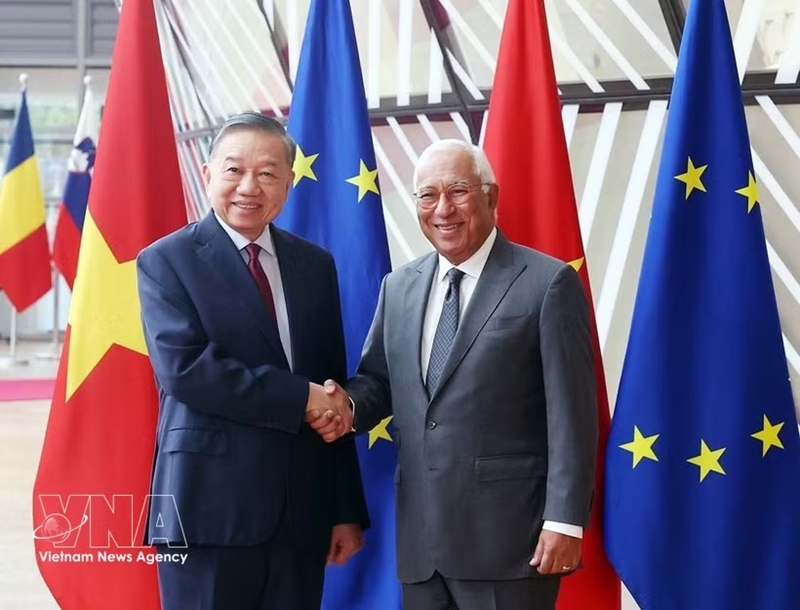
President of the European Council Antonio Costa (right) welcomes General Secretary of the Communist Party of Vietnam Central Committee and State President To Lam in Brussels, Belgium, on October 22, 2026. |
The elevation of Viet Nam-E.U. relations to a Comprehensive Strategic Partnership and the official visit to the E.U. by General Secretary of the Communist Party of Viet Nam Central Committee and President To Lam last month marked important milestones. Cooperation with Japan, France and India has also advanced in strategic areas, while Viet Nam-Laos relations have been further strengthened through practical cooperation programs.
External relations are increasingly being implemented comprehensively through Party diplomacy, State diplomacy and people-to-people exchanges, closely coordinated with defense, security and economic diplomacy.
Notably, external affairs are increasingly being implemented in a coordinated manner across the three pillars of Party diplomacy, State diplomacy and people-to-people diplomacy, closely integrated with defense, security and economic diplomacy. A key measure of diplomatic success is the ability to translate political commitments into tangible benefits for the country and its people. High-level agreements must lead to concrete projects, while partnership frameworks should unlock investment, technology, jobs and added value for the economy.
The November 5 meeting between Vice President of the National Assembly Nguyen Hong Dien and a high-level European business delegation illustrated this direction. Following the upgrade of Viet Nam-E.U. relations, the two sides discussed institutional and legal reforms, investment, healthcare, science and technology, and sustainable development.
European businesses pledged long-term investment and cooperation with Viet Nam in healthcare, pharmaceuticals, intellectual property, technology transfer, aerospace, the circular economy and human resources development.
Meanwhile, Viet Nam called on European partners to accelerate ratification of the E.U.-Viet Nam Investment Protection Agreement (EVIPA), urged the European Commission to lift its “yellow card” warning on Vietnamese seafood over illegal, unreported and unregulated (IUU) fishing, and proposed stronger cooperation under the Just Energy Transition Partnership (JETP).
With Japan, General Secretary and President To Lam’s official visit from November 8-11 is expected to generate fresh momentum in strategic cooperation.
Japanese Ambassador to Viet Nam Ito Naoki said bilateral trade reached 43.7 billion USD in the first nine months of 2026, up 15% year-on-year, and is projected to reach around 58 billion USD for the full year. The two countries aim to raise the figure to 75 billion USD by 2030.
Japan also plans to train 250 Vietnamese semiconductor specialists through doctoral programs. Meanwhile, cooperation between five pairs of universities is underway, with six new joint research projects expected to be announced during the visit.
These initiatives reflect a growing focus on high-tech industries, including semiconductors, artificial intelligence, digital transformation and green transition - areas crucial to Viet Nam’s future competitiveness.
Cooperation with France in digital twins and artificial intelligence offers another example. Dassault Systèmes, in coordination with the Ministry of Finance and the National Innovation Centre, has established a Centre of Excellence (CoE) for digital twins and AI in Hanoi. Deputy Prime Minister Ho Quoc Dung stressed that cooperation should address practical needs in smart manufacturing, transport and urban development, and strengthen data security and domestic technological capacity.
At the local level, cooperation between Can Tho city and Swiss partners demonstrates how diplomatic ties can generate direct benefits for communities. A 10-million-USD non-refundable grant from the Swiss Government has helped improve urban infrastructure and flood resilience, benefiting approximately 442,600 residents across 2,675 hectares. In 2026, the city also approved three grants from Swiss organizations worth more than 448,000 USD for climate adaptation and digital skills development.
Meanwhile, stronger forecasting capacity is essential for responding to geopolitical uncertainties, supply chain disruptions and energy security challenges.
Recent discussions between Minister of Foreign Affairs Le Hoai Trung and National Security Advisor of India Ajit Doval covered not only trade, investment and technology but also energy security, maritime safety and supply chain resilience. With Oman, Viet Nam also discussed opening diplomatic representative offices, mediation efforts in the Middle East and the security of maritime transport routes.
These activities underscore Viet Nam’s consistent policy of cooperation based on respect for independence, sovereignty, equality and mutual benefit, and resolving differences peacefully in accordance with international law and the United Nations Charter. This approach enables the country to mobilize external resources without compromising its strategic autonomy or national interests.
At a meeting with President of the Lao National Assembly Sonexay Siphandone, General Secretary and President Lam stressed the need to translate high-level agreements into concrete programs and projects based on the strengths and needs of both countries.
This message also captures the broader requirement for Viet Nam’s diplomacy today: turning commitments into practical outcomes and making national interests and the well-being of the people the ultimate measures of success.
Source: VNA