In late October 2025, Vietnam - U.K. relations were upgraded to a comprehensive strategic partnership. For the first time in history, Vietnam has established relations at the highest level with all five permanent members of the U.N. Security Council (UNSC), namely the U.S., the U.K., France, Russia, and China, which wield significant influence and play critical roles in maintaining global peace and security. Possessing such a comprehensive network of comprehensive strategic partnerships is something very few countries have achieved.
    |
 |
|
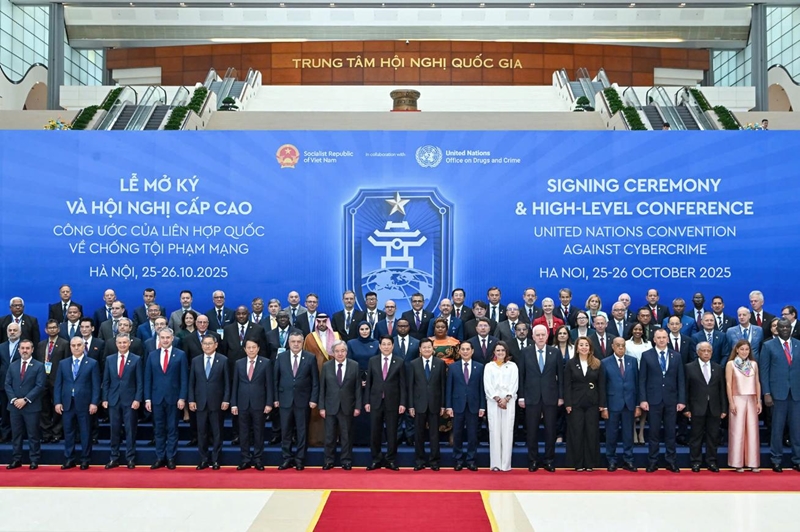
State President Luong Cuong and international delegates attend the opening ceremony for the signing of the U.N. Convention against Cybercrime in Hanoi, October 2025. (Photo: VNA) |
Also during those sunlit days of late autumn, Hanoi hosted a truly global event, the opening for signature of the U.N. Convention against Cybercrime (the Hanoi Convention). For the first time, a global multilateral convention bears the name of a Vietnamese location, the capital city of Hanoi, marking Vietnam’s transformation from a country primarily implementing international conventions into one that actively builds, contributes to, and plays a leading role in international affairs.
Earlier, at U.N. headquarters in New York (the U.S.), Vietnam and Tuvalu established diplomatic relations. Nearly half a century after joining the U.N., Vietnam has completed the process of establishing official cooperative relations with all countries, becoming one of the very few nations in the world to maintain diplomatic relations with all 193 U.N. member states.
These are diplomatic milestones of strategic significance, reflecting Vietnam’s international standing and prestige. They are the outcome of the country’s foreign policy of independence and self-reliance. It can be said that since the founding of the nation, the principle of independence and self-reliance has been the “red thread” running consistently through Vietnam’s external relations. It is both a guiding line and an immutable principle to best safeguard national interests. Independence and self-reliance here mean the ability to make sovereign decisions in formulating and implementing policies, strategies, and actions without external pressure or imposition; the capacity to remain resilient amidst global turbulence; and the spirit of self-reliance and resilience, relying primarily on one’s own resources to protect national interests.
Recalling the harsh and challenging periods following the establishment of the Democratic Republic of Vietnam in 1945, or the intense battles of wits at the Geneva Conference in 1954 and the Paris Conference during the 1968-1973 period, without steadfastly pursuing the goal and principle of independence and self-reliance in diplomacy, Vietnam could not have withstood external pressures to protect its national interests. Learning selectively from experience and drawing upon international support is necessary, but independently thinking, exploring, and formulating policies and measures, firmly rejecting external interference, has been the decisive factor preventing the country from falling into passivity or becoming a “pawn” in political calculations, and enabling it to move confidently toward its ultimate goals.
During the Doi moi (renewal) period, creatively applying the principle of independence and self-reliance in a new situation, Vietnam pursued a policy of multilateralization and diversification of foreign relations, avoiding dependence on any single major power or group of countries. Vietnam pro-actively chose to participate in regional and global mechanisms and forums, both to adapt to global trends and to best serve national interests through major foreign policy decisions such as normalizing relations with China and the U.S., and joining ASEAN and the World Trade Organization (WTO). Vietnam’s “ship” gradually navigated through the “rough seas” of blockade and sanctions, step-by-step integrating into the common flow of humanity.
From a land once unnamed on the world map and ravaged by war, Vietnam has risen to become a symbol of peace, stability, and development, now ranking as the world’s 32nd largest economy, with its position and strength steadily enhanced. From a country once besieged, isolated, and sanctioned, Vietnam today maintains diplomatic relations with 194 countries; has established comprehensive partnership frameworks or higher with 42 countries, including all UNSC permanent members, all G7 members, and 17 of the 20 G20 economies.
On the international stage, Vietnam is a member of most multilateral cooperation and integration mechanisms, from the global to the regional level, and possesses a network of free trade agreements (FTAs) with most of the world’s leading economic and trade centers. Vietnam’s role and standing continue to be affirmed and elevated as it engages in and contributes more substantively to global affairs. From participation, Vietnam has moved toward pro-actively shaping new structures and rules of the game through initiatives, ideas, and contributions in policy, human resources, and finance.
The world is at a crossroads of complex transformations. The global order is changing faster than ever toward multipolarity, multi-center dynamics, multi-layered structures, fragmentation, and sharp polarization. Major powers are intensifying strategic adjustments, building alliances, and consolidating forces, making great-power competition increasingly fierce, even confrontational, drawing many countries into a “vortex” of power politics.
Amidst a myriad of multifaceted, intertwined and overlapping interests and intense competition among major powers, small- and medium-sized countries are facing mounting pressure to “take sides” in international relations. Accepting this means falling under influence and dependence, losing independence and self-reliance, and becoming aligned with one power against another. The reality is that no country sacrifices its own interests for the sake of others. When major powers compete or engage in behind-the-scenes deals for their own benefit, smaller allies can easily become “sacrificial pawns” on the geopolitical chessboard, plunging into instability or even war. This is not a warning. It is a harsh tragedy unfolding before the world.
The difficulties and complexities of the sweeping global “storm” are testing Vietnam’s composure, resilience, and steadfastness in foreign relations. In this context, the 14th National Congress of the Communist Party of Vietnam clearly reaffirmed to consistently implement the foreign policy of independence, self-reliance, peace, friendship, cooperation, and development, multilateralization and diversification of foreign relations; and to develop diplomacy in the new era commensurate with Vietnam’s historical stature, cultural depth, and international position.
Vietnam continues to carry forward Ho Chi Minh’s diplomatic legacy in a new era, firmly safeguarding independence, self-reliance, resilience, and unwavering resolve in all circumstances; building and defending the Fatherland primarily through internal strength. It also means applying skillful and flexible diplomacy, with prudent and adaptive strategies to maintain balanced relations, create interwoven interests, preserve neutrality, avoid being forced to “choose sides,” and prevent becoming a “chess piece” in the hands of major powers or a victim of miscalculations.
In practice, this entails pursuing a “no side-taking” policy in relations with major powers; not centering on any single pole of power, but maintaining balanced and harmonious relations with all partners; and leveraging interlocking interests among major powers to consolidate Vietnam’s strategic position. In particular, Vietnam consistently and resolutely adheres to the “Four No's” defense policy: no military alliances; no alignment with one country against another; no foreign military bases or use of Vietnamese territory to oppose other countries; and no use or threat of using force in international relations.
Depending on situational developments and specific conditions, Vietnam may consider developing appropriate levels of defense and military cooperation based on mutual respect for independence, sovereignty, unity, and territorial integrity, as well as fundamental principles of international law, mutual benefit, and shared interests of the region and international community. Vietnam does not accept defense cooperation under any imposed conditions or external pressure.
|
|
|
|
|
An overview of the plenary session to elect members of the U.N. Human Rights Council for the 2026-2028 term, including Vietnam, October 2025 (Photo: VNA) |
On sensitive international issues, Vietnam does not choose sides but chooses justice, fairness, and righteousness based on international law and the U.N. Charter. Accordingly, between independence and dependence, Vietnam chooses independence; between negotiation and confrontation, Vietnam chooses negotiation; between dialogue and conflict, Vietnam chooses dialogue; between peace and war, Vietnam chooses peace; between cooperation and competition, Vietnam chooses cooperation and competition must be healthy, fair, and respectful of each other’s legitimate rights and interests.
Independence and self-reliance do not mean isolation or disengagement from the world, nor standing outside the process of international integration. In the context of globalization and international integration, independence and self-reliance must go hand in hand with pro-active expansion of international cooperation and the proper, balanced handling of national and global interests. Independence and self-reliance serve as the “anchor” determining the scope, depth, and direction of international integration, and as the prerequisite for integration itself. Conversely, international integration promotes development and helps safeguard independence and self-reliance.
Through a diversified and multilateral foreign policy, expanding relations with all countries regardless of socio-political systems, Vietnam has created a broad, multi-dimensional space of choices, avoiding dependence on a limited number of partners or markets. The more friends of political trust, effective military, defense and security cooperation, and expanded economic and trade relations Vietnam has, the more these positive relationships converge to create an environment of peace, cooperation and development.
Moreover, to maintain independence and self-reliance, Vietnam must possess sufficient strength to withstand external pressure, meaning robust national capacity. Alongside socio-political, economic, and scientific-technological potential, strengthening defense and military capabilities remains a key and regular task. This is the decisive factor forming a solid foundation for Vietnam’s strategic autonomy, contributing to national defense under all circumstances, and enabling the consistent implementation of the foreign policy of independence, self-reliance, multilateralization and diversification of foreign relations without external dependence.
Never before has Vietnam enjoyed such extensive foreign relations and a favorable international environment; never before have its international status and prestige been confirmed and enhanced. Challenges remain, but independence and self-reliance will continue to be the guiding compass helping Vietnam weather the global “storm” and enter a new era of national development.
Translated by Mai Huong