Looking back, one of the Party’s most significant achievements is to break through isolation and embargoes, and gradually normalize and expand relations with all countries, transforming Vietnam from a marginalized state into a nation with a broad diplomatic network spanning most regions of the world. Today, Vietnam maintains diplomatic relations with 194 countries and territories, and holds strategic or comprehensive partnerships with 38 nations, including the five permanent members of the U.N. Security Council, G7 countries, and most G20 economies.
    |
 |
|
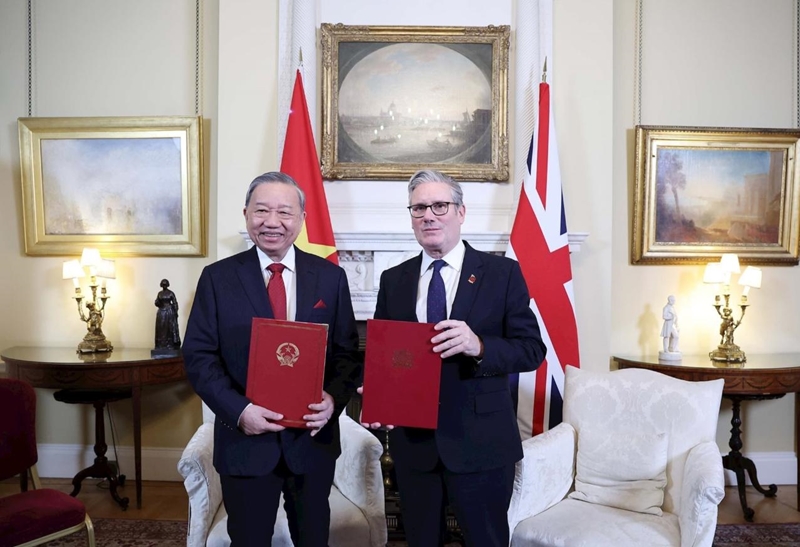
Party General Secretary To Lam and U.K. Prime Minister Keir Starmer exchange a joint statement on upgrading the Vietnam - U.K. relations to a comprehensive strategic partnership on October 29, 2025. |
In an interview granted to the Vietnam News Agency (VNA) on the occasion of the New Year 2026, and the second year of the two countries' comprehensive strategic partnership, U.S. Ambassador to Vietnam Marc Knapper affirmed that they have made remarkable progress in bilateral cooperation, not only in trade, investment, education, cultural exchange, and humanitarian work, but also in security and defense. The diplomat expressed confidence that the bilateral relationship will continue to advance significantly in the future.
So far, the CPV has established relations with 253 political parties across 115 countries around the world. The National Assembly has engaged with parliaments of over 140 nations, while the Vietnam Fatherland Front (VFF), mass organizations, and people’s organizations have forged external ties with 1,200 international partners. These form an important foundation for Vietnam to increasingly deepen its participation in regional and global cooperation frameworks.
In an early-2026 interview with the VNA, Secretary General of the United Left Movement (MIU) of the Dominican Republic Miguel Mejia, said that under the leadership of the CPV, Vietnam has undertaken far-reaching reforms across multiple fields, successfully overcoming the post-war stagnation that once weighed on its economy, and opening a path of intensive integration into the world. These efforts, he said, have enabled Vietnam not only to secure a stronger regional standing but also emerge as a key player on the global stage.
Vietnam has also made significant strides in multilateral diplomacy. The country has served twice as a non-permanent member of the U.N. Security Council, acted as one of the Vice Presidents of the U.N. General Assembly's 77th session, and been elected three times to the U.N. Human Rights Council, including the two consecutive terms of 2023–2025 and 2026–2028. It is a member of the International Law Commission for 2023–2027 and actively participates in key mechanisms of ASEAN, UNESCO, the Inter-Parliamentary Union (IPU), the ASEAN Inter-Parliamentary Assembly (AIPA), the Asia-Pacific Economic Cooperation (APEC) forum, and other global forums.
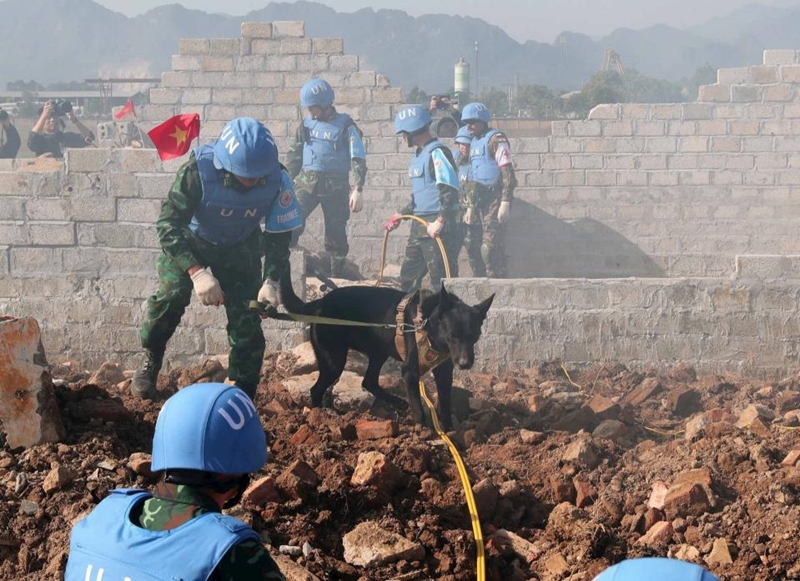
These roles not only reflect the international community’s trust in Vietnam but also affirm the country’s sense of responsibility in addressing global challenges, from peacekeeping, food security, and climate change response to sustainable development promotion. Notably, Vietnam’s deployment of over 1,100 military and police personnel to U.N. peacekeeping missions in hotspots such as South Sudan, the Central African Republic, and the Abyei area demonstrates its commitment to peace and readiness to contribute to collective efforts of humankind.
In multiple interactions with Vietnam, U.N. Under-Secretary General Jean-Pierre Lacroix has praised the capability and professionalism of Vietnam’s U.N. peacekeeping force, expressing his belief that the country will continue to make effective contributions and expand its engagement in common missions. During his most recent visit to Vietnam in June 2025, Lacroix stated that Vietnam is a model in peacekeeping and in addressing the legacy of unexploded ordnance.
Foreign relations also play a vital role in Vietnam’s development and international integration. The country now maintains trade links with 224 markets, joins over 500 bilateral and multilateral cooperation agreements across various fields, and acts as key node in regional supply chains. The rising attraction of foreign direct investment (FDI), official development assistance (ODA), and high-tech investment has placed Vietnam among the world’s most attractive economies for international capital.
During the COVID-19 pandemic, vaccine diplomacy became a highlight, enabling Vietnam to access critical vaccine supplies from many partners, helping control the outbreak and support rapid economic recovery.
|
|
 |
|
Soldiers perform tasks in the Vietnam - India Bilateral Exercise 2025 (VINBAX 2025), a U.N. peacekeeping drill, on November 27, 2025. |
These achievements demonstrate that foreign affairs not only extend the reach of development policy but also directly create new growth drivers for the country.
Looking ahead, effective diplomacy will help Vietnam achieve ambitious goals such as becoming a high-income economy by 2045, transitioning to a green economy by 2050, developing a digital economy, expanding its high-tech workforce, and attracting more high-tech investment.
At a press briefing at late August last year, Chinese Ambassador to Vietnam He Wei praised Vietnam’s reform process, noting that since mid-2024, under the leadership of General Secretary To Lam, the CPV has guided the people in promoting innovation and openness. It has issued four major resolutions to advance innovation, international integration, lawmaking and enforcement, and private economic sector development while vigorously streamlining the political apparatus and merging localities to achieve enormous results.
The overseas Vietnamese (OV) affairs and citizen protection have seen considerable progress. The over 6 million-strong Vietnamese community across more than 130 countries and territories worldwide has grown increasingly connected to their homeland. By the end of 2025, OVs had invested 1.729 billion USD in 457 projects across 26 of 34 provinces and cities nationwide. Each year, they remit around 15 billion USD, supporting their families and making a significant contribution to the country’s development.
On December 25, 2025, while chairing the national conference reviewing the implementation of Resolution No.36-NQ/TW on OV affairs and related directives of the Politburo and the Secretariat, Prime Minister Pham Minh Chinh acknowledged the active and large contributions by the Vietnamese community abroad across areas, which have helped advance the country’s achievements.
He stated, “The OV community is a crucial resource for the cause of national construction and defense. The Party and State place great expectations on the support and joint efforts by all people, both at home and abroad, to help realize the country’s two strategic centenary goals and advance Vietnam confidently into a new era.”
At the same time, the external relations information and cultural diplomacy have continued to leave a strong mark, promoting Vietnam as a peaceful and friendly country rich in cultural heritage while effectively countering misinformation and safeguarding the Party’s ideological foundation.
|
|
 |
|
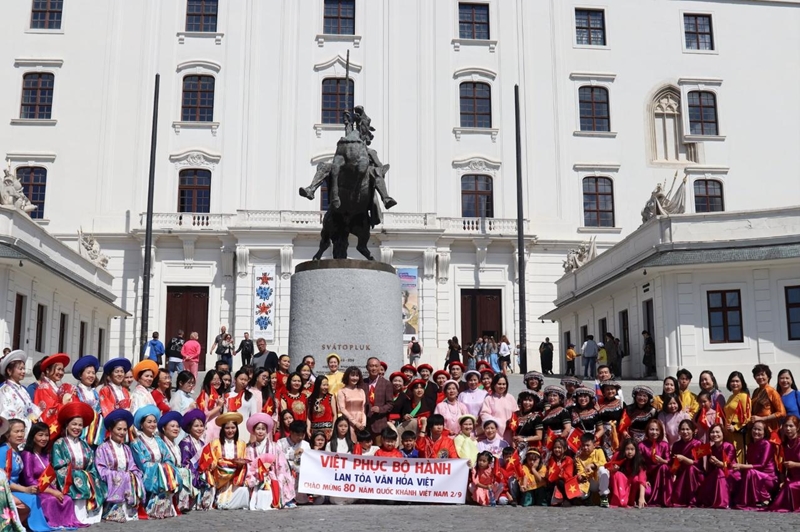
Vietnamese Ambassador to Slovakia Pham Truong Giang and overseas Vietnamese and children at an event in front of Bratislava Castle |
Creating new breakthroughs in foreign affairs in new development era
As the world enters a period of intensified strategic competition among major powers, non-traditional security challenges such as cybersecurity, climate change, disease outbreaks, and energy and financial crises are increasingly complex, directly affecting Vietnam’s development environment.
In this context, the upcoming 14th National Party Congress, scheduled to kick off on January 19, 2026, is expected to provide an opportunity for the Party to chart a course for steadfastly pursuing a "foreign policy of independence, self-reliance, ensuring strategic autonomy, multilateralizing and diversifying international relations; actively and pro-actively promoting comprehensive, deep, and effective integration into the world; maintaining a peaceful and stable environment, and unceasingly enhancing Vietnam’s standing and role in the international arena."
The Party will continue to uphold the pioneering role of foreign affairs in establishing and maintaining a peaceful and stable environment, mobilizing external resources for national development, and continuously reinforcing Vietnam’s capacity, role, stature, and prestige in the world.
In addition, the Party will keep developing bilateral relations in a more substantive, stable, and sustainable manner, leverage the Party diplomacy to strategically guide these relationships, and elevate multilateral diplomacy in close coordination with bilateral diplomacy. Vietnam will also continue to play an active and responsible role in the international community while proactively engaging in regional and global multilateral mechanisms.
The country aims to build a comprehensive and modern diplomacy based on three pillars, namely Party diplomacy, state diplomacy, and people-to-people diplomacy.
Reflecting on 40 years of Doi moi, Vietnam’s foreign affairs have achieved remarkable progress, marking historic milestones in the country’s integration and development process. Renewed mindset, the resolve of independence and self-reliance, and steadfast commitment to peace and cooperation have enabled Vietnam to overcome challenges, seize opportunities, and secure an increasing stature in the international arena.
Source: VNA