Taking place on September 3, 2016 during Indian Prime Minister Narendra Modi’s official visit to Viet Nam, the upgrade marked an important milestone, ushering in a new chapter in the ties between the two countries.
    |
 |
|
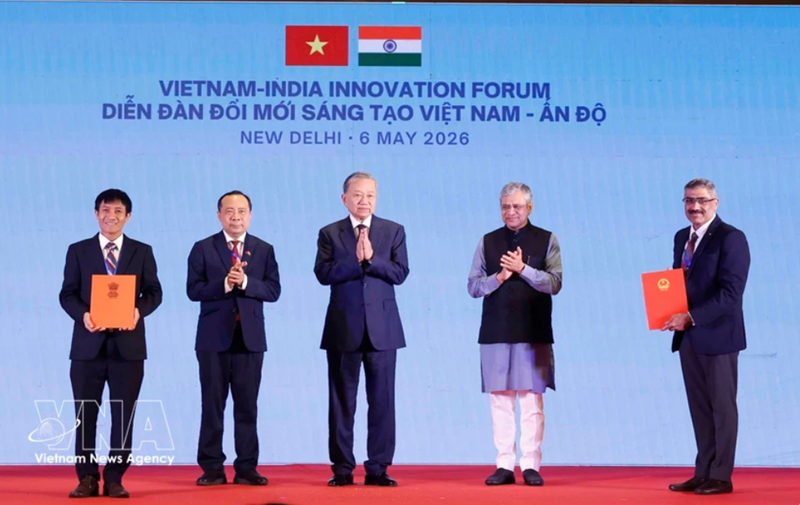
General Secretary of the Communist Party of Viet Nam Central Committee and President To Lam (center) and officials at the Viet Nam-India Innovation Forum in New Delhi on May 6, 2026 |
Viet Nam and India established diplomatic relations on January 7, 1972, during Viet Nam’s resistance war for national reunification. Their ties have been nurtured by successive generations of leaders and strengthened by shared values and close people-to-people connections.
The friendship between President Ho Chi Minh and Indian Prime Minister Jawaharlal Nehru laid an important foundation for bilateral relations. The two countries supported each other during their respective struggles for national independence and have continued to cooperate in national reconstruction and socio-economic development.
The two sides first established a comprehensive cooperation framework in May, 2003, upgraded relations to a strategic partnership in July, 2007 and then to a comprehensive strategic partnership in September, 2016.
Over the past decade, political trust has continued to deepen, while defense and security cooperation has become a strategic pillar. Economic, trade and investment ties have also expanded.
India is now Viet Nam’s eighth-largest trading partner, while Viet Nam ranks 21st among India’s trading partners and fourth in ASEAN. Bilateral trade rose to 16.46 billion USD in 2025 from 5.43 billion USD in 2016, and reached 11.78 billion USD in the first seven months of 2026.
As of March, Indian investors had 503 valid projects in Viet Nam with total registered capital of 1.117 billion USD, ranking 26th among 154 countries and territories investing in the country. Viet Nam, meanwhile, had 30 investment projects in India worth nearly 150.5 million USD, including a VinGroup project to build an electric vehicle manufacturing plant in Tamil Nadu.
People-to-people exchanges remain a bright spot. Nearly 800,000 Indian tourists visited Viet Nam in 2025, four times the 2019 figure. The two countries now have 80 direct flights a week, and have expanded cooperation in aviation and maritime connectivity. India has also supported the restoration of the Cham tower groups at the My Son UNESCO World Heritage Site in Da Nang.
Cooperation in science and technology is gaining new momentum, particularly in innovation, robotics, startups, biotechnology, information technology, artificial intelligence and semiconductors. The two sides are also working together in peaceful nuclear energy and critical minerals.
At multilateral forums, Viet Nam and India continue to coordinate closely and support each other, particularly at the United Nations and in ASEAN-led regional mechanisms.
New momentum for upgraded partnership
The state visit to India by General Secretary and President To Lam in May gave fresh momentum to bilateral relations. During the visit, the two countries issued a 52-point Joint Statement on an Enhanced Comprehensive Strategic Partnership, under the theme of “Shared vision, strategic convergence, substantive cooperation.”
The two sides agreed to strive for bilateral trade of 25 billion USD by 2030 in a balanced and sustainable manner and work to remove market-access barriers.
They also identified science and technology, innovation and digital transformation as key drivers for the new phase of relations, with greater cooperation in semiconductors, AI, information technology, 6G, healthcare, critical minerals and peaceful nuclear energy.
Vietnamese Deputy Minister of Foreign Affairs Nguyen Manh Cuong said Viet Nam and India share ambitions for national development, and a vision for a peaceful, equitable and rules-based international order. He highlighted three important “transformations," namely turning political trust into capacity for joint action; translating the upgraded partnership into substantive cooperation that strengthens each country’s autonomy and resilience; and turning strategic proximity into a space for peace and prosperity linking Southeast Asia with South Asia and the Pacific with the Indian Ocean.
On August 26, Prime Minister Le Minh Hung received Indian Minister of State for External Affairs Pabitra Margherita, who was visiting Viet Nam for activities marking the 10th anniversary of the Comprehensive Strategic Partnership.
At the meeting, PM Le Minh Hung affirmed that Viet Nam always supports India in playing an increasingly important role in the international arena, including as the host of the BRICS in 2026. Meanwhile, Margherita stressed that Viet Nam is one of the most important partners in India’s “Act East” policy and its Indo-Pacific vision, as well as a key partner in ASEAN.
They agreed that Viet Nam and India share many similarities in their visions and development aspirations. Viet Nam aims to become a developed country by 2045, while India has set a target of achieving developed-country status by 2047. The elevation of bilateral ties to an “Enhanced Comprehensive Strategic Partnership” has opened up many opportunities for the two countries to accompany, cooperate with and support each other.
The two sides agreed to remove market-access bottlenecks, work toward the 25 billion USD trade target, double two-way investment, strengthen science-technology cooperation and develop high-quality human resources.
Viet Nam also encouraged major Indian technology groups to invest in the country, particularly in technology, infrastructure, energy and pharmaceuticals, while the two sides will study increasing direct flight frequencies to meet growing travel, trade and tourism demand.
Source: VNA