Addressing the event, the Vietnamese leader stressed that this is an opportune time to set higher expectations for economic cooperation between Viet Nam and Europe, as well as between Viet Nam and Belgium.
    |
 |
|
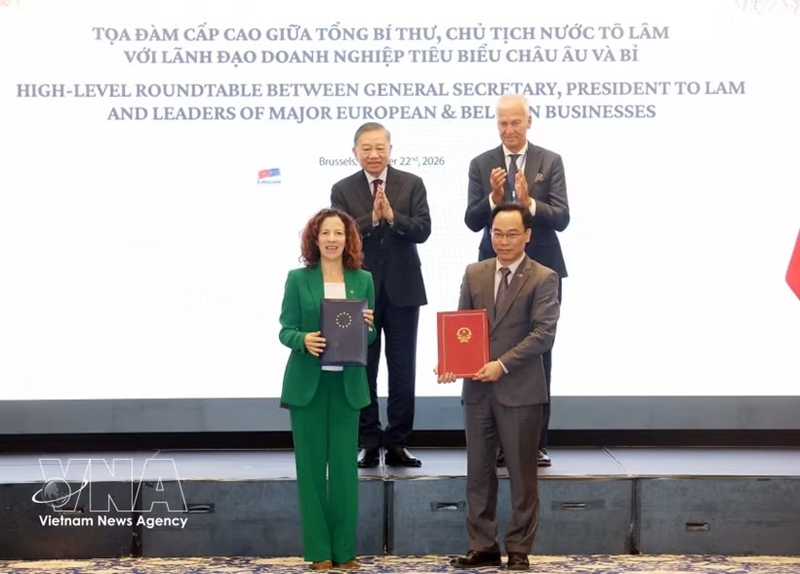
General Secretary of the Communist Party of Viet Nam Central Committee and President To Lam witnesses the exchange of cooperation agreements. |
Cooperation should go beyond expanding trade and investment to improving its quality, increasing technological content, raising development standards and competitiveness, and strengthening the position of businesses from both sides in global value chains, he said.
Despite continued global uncertainties and complex developments, Viet Nam’s economy has maintained strong growth, demonstrating resilience, adaptability and positive development prospects, he noted.
The Vietnamese Government pledges to work alongside investors, listen to their concerns and address difficulties and obstacles, while creating a transparent, stable and favorable investment environment so that international investors can do long-term investment with confidence and join Viet Nam in pursuing rapid and sustainable development, he affirmed.
General Secretary and President To Lam highlighted new opportunities for advancing Viet Nam’s relations with the E.U. and Belgium. He expressed Viet Nam’s hope that both sides will make more effective use of the advantages offered by the E.U.-Viet Nam Free Trade Agreement (EVFTA) while accelerating the completion of ratification of the E.U.-Viet Nam Investment Protection Agreement (EVIPA), thereby establishing a more favorable legal framework for stable, long-term and sustainable investment.
He proposed focusing on three major areas of cooperation. First, the two sides should work together to develop strategic infrastructure, logistics, seaports, clean energy and the circular economy. Viet Nam has substantial demand for transport infrastructure, seaports, logistics, energy, power grids, digital infrastructure and green industrial parks. Europe has strengths in planning, technology, engineering, project management, environmental standards, green finance, the circular economy and sustainable development models. Viet Nam hopes European businesses will go beyond supplying equipment or acting as contractors to become partners in project design, investment, risk management, technology transfer and long-term value creation.
Second, the two sides should promote high technology, digital transformation, artificial intelligence, semiconductors, healthcare, pharmaceuticals, biotechnology and high-tech agriculture. Viet Nam identifies science and technology, innovation, digital transformation and green transition as key drivers of a new growth model. Europe is home to many world-leading companies in industrial technology, semiconductors, automation, AI, pharmaceuticals, medical equipment, biotechnology, precision agriculture and food processing. Viet Nam wants to become a technology development partner where European companies can work with Vietnamese businesses, research institutes, universities and localities to build new capabilities. A successful technology project in Viet Nam should not be measured solely by the amount of investments, but also by the number of Vietnamese engineers trained, the number of domestic businesses joining supply chains and the new competitive advantages it creates.
Third, the two sides should upgrade trade relations into high-standard, sustainable and responsible value chains. The EVFTA has facilitated market access for goods from both sides, but the next stage should deepen links in capital, technology, business, standards and supply chains. Viet Nam aims to increase the share of exports to Europe that have higher technological content and greater value added through processing, design and branding. At the same time, it has substantial demand for European machinery, equipment, pharmaceuticals, technology, materials, green solutions and high-quality services.
To support this process, the Vietnamese top leader expressed his hope that European partners will help Vietnamese businesses improve their governance, quality, safety, environmental performance, digitization and supply chain responsibility, enabling them to participate more deeply in global value chains.
To turn these goals into reality, he affirmed that Viet Nam will continue building a stable, transparent, competitive and predictable investment and business environment. The country will improve project preparation, ensure transparent information and create better conditions for investors to assess, mobilize capital for and implement long-term projects. It will also address legitimate difficulties faced by businesses with clear points of contact, responsibilities, timelines and results.
Vietnam will continue to implement the EVFTA effectively and work with the E.U. to complete the ratification of the EVIPA so that it can be fully implemented when conditions permit. Ministries, sectors and localities will support high-quality projects that bring advanced technology, generate wider benefits and align with Viet Nam's development priorities.
European business associations are expected to strengthen their role as bridges between businesses and policymakers, European standards and Viet Nam's production capacity, and cooperation proposals and projects with implementation potential.
General Secretary and President To Lam expressed his belief that the new strategic vision for Viet Nam-E.U. and Viet Nam-Belgium relations, combined with the capabilities of European and Belgian businesses and Viet Nam's development goals, will open a new chapter of cooperation that is closer, more modern, sustainable, balanced and beneficial to people on both sides.
Andries Gryffroy, First Vice-President of the Belgian Senate, affirmed that Viet Nam, Belgium and Europe have established effective economic cooperation. The dialogue offers an opportunity to further deepen these ties and promote growth.
The EVFTA has opened up numerous new opportunities and would continue to lay the groundwork for an increasingly deep and enduring partnership. Viet Nam remains a reliable partner for both the E.U. and Belgium, with its resilient economy, strong commitment to openness and open market making it an attractive destination for European businesses.
The dialogue is an opportunity to promote cross-border economic cooperation, share opportunities arising from the EVFTA, and foster entrepreneurship, business development and economic collaboration, he said.
According to Gryffroy, Viet Nam is emerging as one of the region’s leading economies in technological capabilities, digital transformation and green transition. Combining Viet Nam’s strengths with Belgium and Europe’s economic and technological advantages will generate significant momentum, particularly in seaports and logistics, creating new opportunities for businesses on both sides.
Roxana Minzatu, Executive Vice-President of the European Commission (E.C.) for Social Rights and Skills, Quality Jobs and Preparedness, said Viet Nam’s economic dynamism and development goals, combined with the E.U.’s research and technological capabilities, will offer significant opportunities to create shared value in clean energy, semiconductors, artificial intelligence (AI), healthcare, manufacturing modernization and the expansion of local supply chains.
Such cooperation will also generate quality jobs in both economies, she said, reaffirming the E.U.’s long-term commitment to Viet Nam through investment connectivity, innovation and quality employment for mutual benefit.
At the dialogue, executives from European and Belgian corporations and businesses shared their views and proposed future cooperation priorities in infrastructure, logistics, high technology, digital transformation, the green economy, healthcare, pharmaceuticals, high-tech agriculture and food processing. Their remarks reflected growing interest in, confidence in and high expectations for Viet Nam among the European business community as the country enters a new stage of development.
At the event, General Secretary and President To Lam and other delegates witnessed an exchange of cooperation agreements.
The agreements included one between the Ministry of Education and Training and the E.U. on education and training; one between the Hanoi People's Committee, Aquitara Impact Fund and 512 Capital to conduct research, surveys and prepare an investment proposal for an eco-industrial and high-tech park at Ha Bang Industrial Park in Hanoi; and one between the Viet Nam National Chemical Group and Air Liquide Group on improving energy efficiency, industrial safety and energy transition.
Vietnam Airlines and APG Inc also agreed to cooperate in sustainable market development and brand promotion.
The European Chamber of Commerce in Viet Nam (EuroCham) and Aquitara Impact Fund agreed to implement the An Vui Mart program under the Aquitara Charity Fund as part of EuroCham's Give Back to Viet Nam program.
Meanwhile, Vietravel Tourism Joint Stock Company and HiSEAS International Tourism Group signed a strategic cooperation agreement to develop tourism products.
Source: VNA