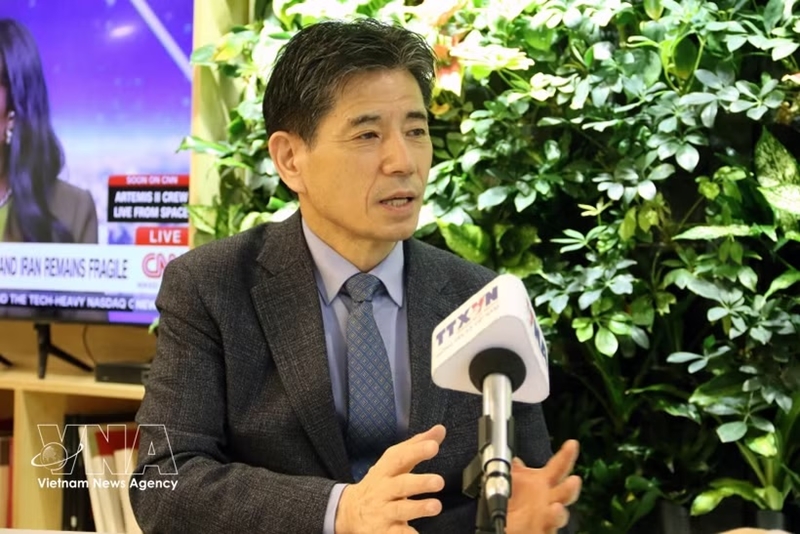
In an interview recently granted to the Vietnam News Agency, Kwon said the visit from April 21 to 24 aims to review the implementation of the agreements reached during the high-level meeting in Seoul last August, translate them into substantive economic outcomes, and promote collaboration in future-oriented industries.
    |
 |
|
Kwon Sung Taek, Vice Chairman of the Korea – Vietnam Economic and Cultural Association |
The trip follows General Secretary Lam’s visit to the RoK in August 2025, the first by a Vietnamese head of state to the Northeast Asian country in 11 years, which laid the groundwork for deeper ties.
Discussions during the upcoming visit are to focus on energy security, including nuclear power, high-speed rail, new urban projects and large-scale infrastructure, alongside supply chain resilience and high-tech cooperation. The two sides are also likely to outline steps toward the 150 billion USD bilateral trade target by 2030, marking a shift from traditional manufacturing cooperation to a broader technology and innovation-driven partnership.
Both leaders are seen as pragmatic, focused on public welfare and national interests, while supporting regional peace. That alignment is expected to underpin the Comprehensive Strategic Partnership for expanded ties across politics, diplomacy, people-to-people exchanges, culture, national defense and security, potentially marking a turning point in bilateral ties, he said.
On cultural ties, Kwon said the relationship is evolving beyond economics toward a “cultural community”. The two countries have agreed to deepen collaboration in culture, sports, tourism and people-to-people connections, including exchanges of art troupes, expertise sharing in the entertainment industry and the building of cultural development strategies. The RoK’s Hallyu wave in Vietnam has transcended trend status to become deeply embedded in daily life, he noted.
Cooperation is also shifting from content consumption to co-production, combining Korean creative capabilities with Vietnam’s production strengths. Kwon proposed developing the K-pop training model in Vietnam to nurture V-pop artists with distinct identities, while combining Vietnam’s cultural assets with Korean storytelling techniques to target global markets. The model, he said, rests on “Vietnamese content, Korean creativity and global distribution".
Economically, Kwon noted that over the past three decades, ties have been driven largely by major conglomerates such as Samsung, LG, Hyosung and Hyundai Motor. Over the next 30 years, however, cooperation is expected to broaden horizontally, with small- and medium-sized enterprises (SMEs) from both countries playing a far bigger role, thus creating a stepping stone for more healthy and quality growth in economic relations.
According to him, SME collaboration could extend beyond supply chains into technology transfer, joint ventures and digital transformation. Potential gains include enabling Korean SMEs to localize and upgrade supply chains through partnerships with Vietnamese firms, while helping Vietnamese companies gain greater self-reliance and competitiveness.
Joint research and development could also assist potential companies to become global unicorn startups by blending Korean planning expertise with Vietnam’s workforce base.
Kwon also pointed to opportunities for Korean SME brands, particularly in cosmetics and food, to tap Vietnam’s fast-growing e-commerce market. To facilitate this, he called for Government measures such as dedicated business-to-business platforms, expanded joint funds and guarantees, streamlined certification processes and enhanced tax incentives.
In particular, the involvement of Korean IT companies in digital transformation among Vietnamese SMEs is seen as the most effective model. More broadly, he opined, SME collaboration could serve as a major pillar in shifting Vietnam – RoK ties from quantitative expansion toward higher-quality development.
In human capital, he cited statistics as showing that Vietnam now ranks first in the number of international students in the RoK, many of whom are pursuing sci-tech fields, reflecting strong demand for accessing the RoK's technology and knowledge. As global competition for talent heats up, Kwon said bilateral ties should move beyond labor supply toward a comprehensive strategy for jointly developing and sharing high-quality human resources.
He proposed building a joint education ecosystem linking universities and businesses of both sides, including a potential “RoK – Vietnam High Technology University” model, as well as leveraging the R&D centers of Korean firms in Vietnam to facilitate knowledge exchange among post-graduate-level talent. Such initiatives could promote a “brain circulation” model rather than "brain drain," helping retain talent through a shared circular system between the two countries.
Source: VNA