In an interview with the press following the conclusion of the visit from April 14–17, Trung said that the trip, made at the invitation of General Secretary of the Communist Party of China Central Committee and President of China Xi Jinping, is the first overseas trip by General Secretary and President Lam following the consolidation of key State leadership positions by the 16th National Assembly (N.A.), built on the success of the 14th National Party Congress and the election of deputies to the 16th N.A. and People’s Councils at all levels for the 2026–2031 term.
    |
 |
|
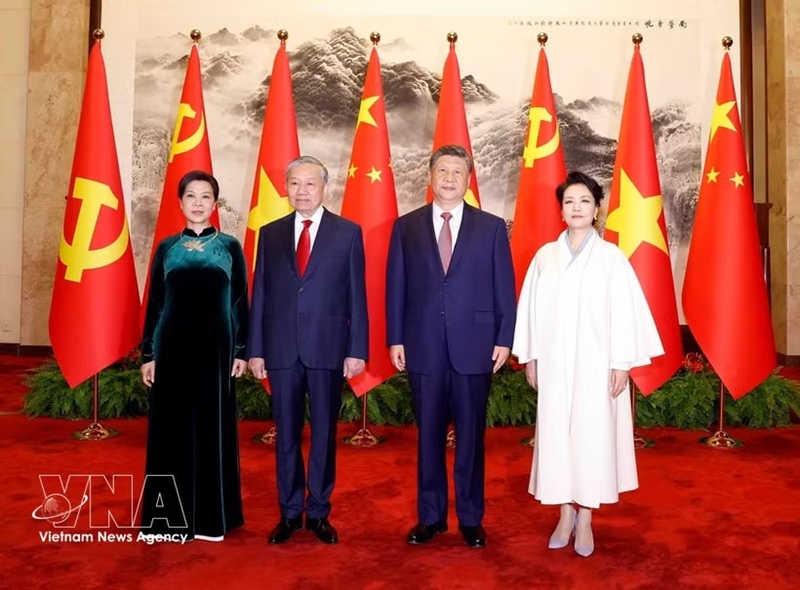
Party General Secretary and State President To Lam, his Chinese counterpart Xi Jinping and their spouses in a joint photo in Beijing on April 15, 2026 |
It was viewed as the most significant diplomatic activity between the two countries in 2026, taking place as both nations enter a new phase of development, with Vietnam implementing the outcomes of its 14th National Party Congress and China beginning its 15th five-year socio-economic development plan, he said, adding that the visit also conveyed Vietnam’s consistent foreign policy of independence, self-reliance, and diversification and multilateralization of external relations.
According to the minister, the visit witnessed a wide range of high-level engagements and substantive activities that reflected deep political trust and comprehensive cooperation between the two Parties and countries. The two top leaders of Vietnam and China held in-depth strategic talks, exchanged views on domestic and international issues, and witnessed the signing of numerous cooperation agreements across various sectors. The Vietnamese leader also met with key Chinese leaders, interacted with young people, and delivered a policy address at Tsinghua University.
He added that the visit extended beyond Beijing to other localities such as Guangxi, highlighting historical and people-to-people ties. Activities by the accompanying delegation and spouse-level exchanges were also seen as reinforcing cultural and social connections between the two nations.
Summarizing the outcomes, Trung noted that both sides have reaffirmed the high priority they attach to the bilateral ties as well as their desires to elevate the relations to a new level in the evolving context. Vietnam continues to regard its relations with China as a strategic requirement and a top strategic choice in its foreign policy, while China considers Vietnam as a key partner in its neighborhood diplomacy.
The two top leaders held frank and in-depth discussions on the situation of each Party and country, as well as on regional and international developments, while conducting a comprehensive review of the bilateral relations. General Secretary and President Lam put forward a range of concrete proposals aimed at strengthening connectivity in key areas such as economy, investment, development policy coordination, infrastructure, science and technology, education and training, people-to-people exchanges and tourism. He also emphasized the need to expand collaboration in emerging fields where Vietnam has a growing demand, and China possesses strong capabilities.
The minister observed that the two top leaders reached important common perceptions on major directions for future cooperation, emphasizing stronger political trust, more frequent high-level exchanges and more effective use of existing cooperation mechanisms via Party, Government and legislative channels. Economic cooperation was identified as a central pillar, with both sides agreeing to enhance connectivity between their economies, expand trade and investment, and promote infrastructure collaboration, including transport links and improved customs facilitation.
In addition, both sides underscored the importance of closer coordination at multilateral forums, contributing to a favorable environment for peace, stability and development in each country.
Looking ahead, the minister suggested that the outcomes of the visit will be translated into concrete actions through close coordination at all levels. Priority should be given to advancing key projects in infrastructure, logistics and cross-border connectivity, including railways, expressways and smart border gates, aimed at facilitating trade flows, investment and energy security, Trung stressed, encouraging stakeholders to develop detailed action plans to maximize cooperation potential.
He added that both sides should continue to maintain close coordination and communication to implement signed agreements, noting that China has expressed readiness to work with Vietnam in developing specific measures and plans to ensure timely and substantive progress.
Source: VNA