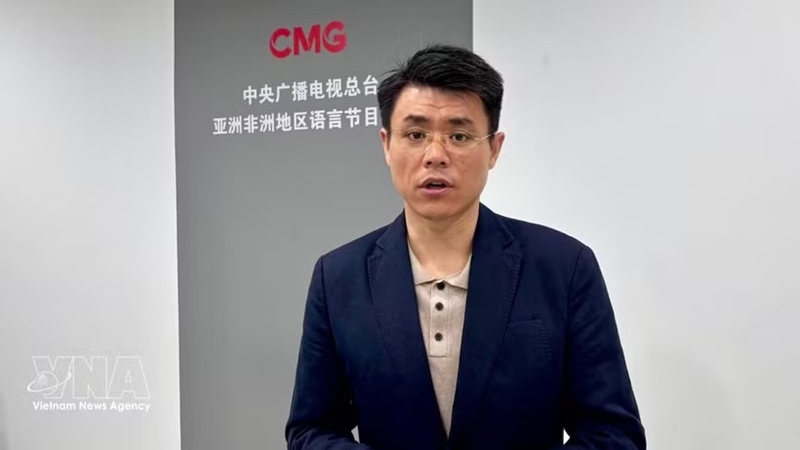
In an interview given Vietnam News Agency correspondents in Beijing, Wei Wei, a researcher on Vietnam and head of the Vietnamese-language service at the China Media Group, said that the Vietnamese leader visited the Xiong'an New Area, met with youth representatives of both countries together with his Chinese counterpart Xi Jinping, and experienced high-speed rail travel.
    |
 |
|
Wei Wei, a researcher on Vietnam and head of the Vietnamese-language service at the China Media Group, grants an interview to the Vietnam News Agency. |
Wei noted that the visit to Xiong’an – which has attracted over 1 trillion CNY (about 146.4 billion USD) in investment and developed across 215 kilometers in nine years – demonstrates Vietnam’s strong interest in China’s experience in urban development. The trip offered practical insights into how China integrates smart, green, and innovative technologies throughout urban planning and development, providing valuable lessons for Vietnam.
The meeting with youth representatives reflected high expectations from both leaders for the future of bilateral ties. The “Red Journey” program for Vietnamese youth in China, jointly initiated by the two General Secretaries in April 2025, has already brought over 1,000 young Vietnamese people to China within a year for study and exchange activities across more than 10 provinces and cities. The youth is seen as the future of bilateral friendship.
Wei noted that during the four-day visit, General Secretary and President Lam took high-speed trains twice: from Beijing to Xiong’an and from Beijing to Nanning. The Beijing – Nanning route spans more than 2,400 km and takes about 10 hours, crossing multiple regions. Beyond the experience itself, the leader’s visit to the driver’s cabin highlighted Vietnam’s growing interest in developing railway and high-speed rail systems.
Commenting on General Secretary and President Lam’s article published on the People's Daily, the expert stressed three key points.
First, Vietnam's top leader underscored the foundational role of traditional friendship and revolutionary comradeship in bilateral relations.
Second, he stressed that the unceasing enhancement of the strategic cohesion is rooted in the fundamental and long-term interests of both countries. High-level exchanges remain frequent and effective while cooperation mechanisms between the two sides' Party, government and legislative bodies, as well as ministries are deepening. Notably, the first ministerial-level “3+3” strategic dialogue on foreign affairs, national defense, and public security held in March marked a new step forward.
Meanwhile, trade and investment ties continue to expand: China has been Vietnam’s largest trading partner for over 20 consecutive years and also its second-largest source of investment. Meanwhile, Vietnam is China’s largest trading partner in ASEAN and fourth globally. Cross-border railway and smart border gate projects are also promoting connectivity, alongside growing people-to-people links. In 2025, Chinese visitors to Vietnam reached 5.28 million, accounting for 25% of total international arrivals.
Finally, General Secretary and President Lam stressed that joint efforts to build a Vietnam – China community with a shared future that carries strategic significance will open new development space in the new era. In recent years, the two countries’ development interests have been increasingly intertwined, with similar development paths focused on high-quality growth, technological innovation, and emerging sectors. Their cooperation not only brings tangible benefits to both Parties, countries and peoples but also contributes to peace, stability, cooperation, and development in the region and beyond, according to Wei.
Source: VNA