In the penultimate month of the year, a series of key macroeconomic indicators pointed to sustained improvement. Industrial production, exports, domestic consumption and business formation all advanced, underscoring the economy’s capacity to withstand disruptions caused by unprecedented natural disasters. The recent phenomenon of “storm upon storm, flood upon flood” inflicted heavy damage across multiple localities, affecting livelihoods and production, yet the economy still delivered what Minister of Finance Nguyen Van Thang called “important and comprehensive results.”
    |
 |
|
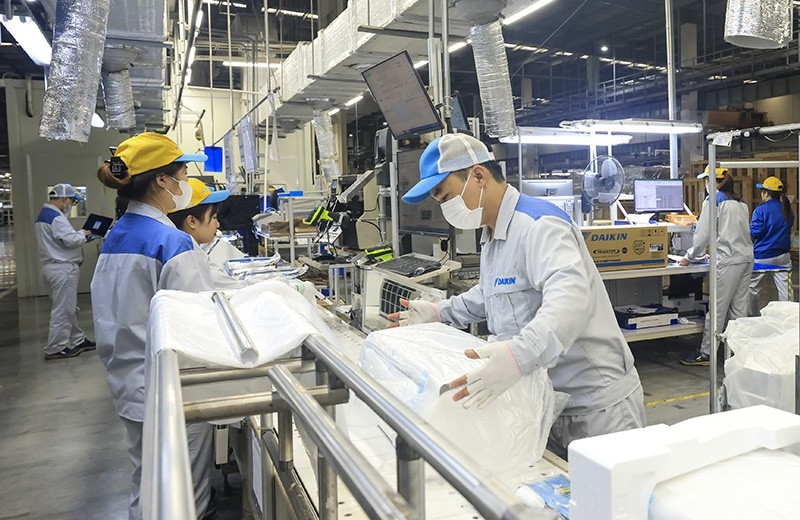
(Photo for illustration: baodautu.vn) |
At the Government’s November meeting, Prime Minister Pham Minh Chinh emphasized that socio-economic conditions showed steady improvement, with month-on-month gains and 11-month results outpacing the same period last year in most sectors.
Industrial production remained a key driver. The Index of Industrial Production (IIP) in November rose an estimated 2.3% month-on-month and 10.8% year-on-year. For the 11 months, the IIP increased 9.3%, led by a robust 10.6% expansion in manufacturing and processing as firms ramped up output to meet year-end domestic and export demand.
Exports regained strong momentum, with turnover in the 11-month period hitting 430.14 billion USD, up 16.1% year-on-year, a performance the Ministry of Finance described as “a solid double-digit recovery.” Domestic consumption also showed renewed strength, with total retail sales of goods and services up 9.1% year-on-year, or 6.8% after adjusting for price factors, compared to 5.8% in the same period of 2024.
Business dynamism improved notably, with 275,592 enterprises entering or re-entering the market, up 26.1%. This reflects “strengthened business confidence,” according to the Ministry of Finance.
Targets achievable
Vietnam’s economy has also earned positive assessments internationally. S&P Global’s Purchasing Managers’ Index (PMI) for November reached 53.8 points, signaling continued expansion despite weather-related supply chain disruptions. Growth has the potential to continue in the coming months as firms catch up on delayed orders, said Andrew Harker, Director at S&P Global Market Intelligence.
Yet challenges remain. Minister Thang said that the target of 8% growth is possible to get but he also acknowledged that achieving higher growth in the final month of the year will require great effort.
Public investment disbursement, a critical growth driver, reached only 60.6% of the annual plan in 11 months. Several major projects have been delayed due to landslides and prolonged flooding.
Private investment has not fully recovered, and the attraction of large-scale FDI projects faces bottlenecks. External uncertainties, including global market volatility and US tariff policies, continue to pose risks.
To close the gap, the Government is pushing to accelerate key drivers such as investment, consumption and exports. Many targets are performing well, for instance, e-commerce growth has already reached 25% - 27%, exceeding the annual goal of 20% - 22%, while export growth has surpassed its 12% target. However, others require stronger action, particularly public investment disbursement, international arrivals, and industrial output.
In this context, the Prime Minister issued Directive No. 237/CD-TTg calling for urgent acceleration of public investment disbursement in the final weeks of 2025, a crucial step to sustaining momentum and ensuring the economy finishes the year on its strongest footing.
Source: VNA