To keep pace with this emerging trend, Vietnam must continue to perfect its legal framework, invest more in research and manufacturing, and build a national-level ecosystem for low-altitude aerial platforms.
The low-altitude economy, a relatively new concept, encompasses economic activities occurring below 1,000 meters, and in some cases extended to under 5,000 meters depending on national needs. It leverages manned and unmanned aviation technologies and low-altitude intelligent networks to develop infrastructure, manufacture aerial vehicles, develop air services, and flight-safety systems, with a core focus on unmanned aerial vehicles (UAVs) and related technologies.
Recent events in Vietnam have shown the power of UAVs in emergency situations. Successive historic floods left many areas isolated. When land access became nearly impossible, civilian drones deployed by individuals and organizations emerged as an essential force for delivering supplies, medicines, necessities, and conducting rescue operations.
    |
 |
|
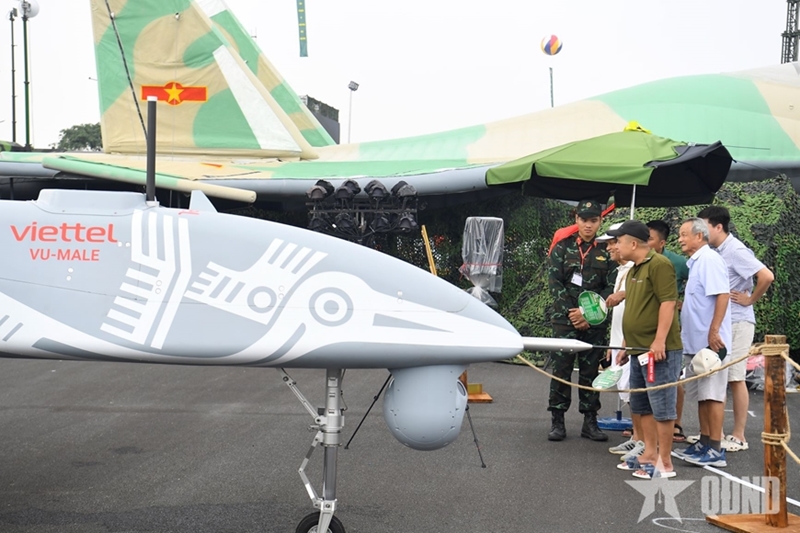
Visitors observe a long-range multi-role UAV (VU-MALE) developed by Viettel Group at the National Achievements Exhibition, September 2025. (Photo: Tuan Huy) |
In agriculture, which accounts for 12% - 14% of national GDP and employs 40% of the workforce, UAVs are enabling leaps in automation, from pesticide spraying, precision irrigation, seeding, and fertilization to crop monitoring. In arts, UAVs are breathing new life with spectacular aerial shots which used to require massive budgets; in major events, thousands of drones performing synchronized light shows have captivated audiences.
From lifesaving flood missions to widespread applications across agriculture, industry, and services, UAVs have proven their strategic role in the modern era, demonstrating their ability to replace humans in hazardous, toxic, or inaccessible environments. Globally, the low-altitude aviation sector alone is projected to earmark USD 700 billion by 2035. In Vietnam, the potential value of the low-altitude economy is estimated at USD 10 billion.
The low-altitude economy is giving rise to a new global industry. Many countries have already classified aerospace and UAV technologies as strategic. With breakthroughs in aviation, space, and UAV systems, this new economic model, specifically the low-altitude economy, is emerging as a prominent global development trend. The UAV, UAM (urban air mobility), and eVTOL (electric vertical take-off and landing aircraft) ecosystems are receiving multi-billion-dollar investments, cultivating a highly dynamic and competitive innovation landscape.
Vietnam has all the advantages to become a hub for the low-altitude economy, including geographical location and political stability, capacity for mastering core technologies (software, AI, and UTM systems), hardware manufacturing capabilities, and a mature supporting industrial ecosystem. Highlighting the potential of the low-altitude economy, Chief Technology Officer of FPT Corporation Vu Anh Tu noted that companies participating in this field do not solely manufacture UAVs, but also develop components, chips, sensors, flight-management platforms, 3D digital mapping, operation services, insurance, training, and applications in agriculture and other industries. “This is the intersection of the digital economy, green economy, and knowledge economy. Every UAV flight combines data, AI, clean energy, and the technical expertise of Vietnamese engineers. Investing in the low-altitude economy is investing in the three new pillars of Vietnam’s scientific development,” he stressed.
Vietnam is believed to be able to capitalize on this opportunity by focusing on small UAV segments suitable to domestic enterprise capabilities, while building a fitting technology and policy ecosystem. In the short term, Vietnam should conduct controlled pilot programs in areas such as UAV and eVTOL delivery in major cities; UAV-based precision agriculture in the Red River Delta and Mekong Delta; maritime search-and-rescue UAV operations; and UAV applications in national defense and security.
To accelerate the development of the low-altitude economy, Vietnam is to build a legal corridor, invest in R&D centers, develop low-altitude industrial zones, train high-quality human resources, establish a comprehensive connected ecosystem, and expand international cooperation. It is also suggested that the Government direct the formulation of a “National UAV Development Plan for 2025-2030 period”; issue a new decree on UAVs to replace Decree No.36/2008/ND-CP on the management of unmanned aircraft and ultralight flying vehicles; finalize a nationwide UAV airspace plan; and develop national technical standards for civilian and industrial UAVs.
The low-altitude economy is far more than just aircraft. It represents a strategic shift to open low-altitude airspace as a new business domain, driving economic growth through technological innovation. Rapid policy completion will pave the way for Vietnam to build an autonomous UAV industry, move toward export capacity, and integrate deeply into the global low-altitude economy.
Translated by Mai Huong