Amidst Vietnam’s push to meet its greenhouse gas reduction commitments, DEPP3 has emerged as a key lever, providing technical and policy support through VAS. The practical model of cooperation between government agencies and businesses encouraged voluntary emissions reductions, helping enterprises transition to energy-efficient production and contribute to national energy security.
    |
 |
|
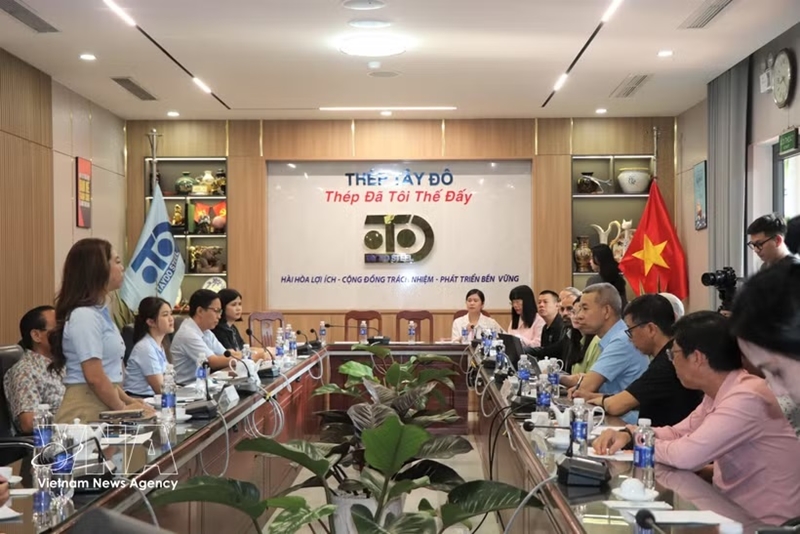
Participants at the meeting reviewing the Voluntary Agreement Scheme at the Tay Do Steel Co., Ltd in Can Tho city on April 17 |
Case studies from Tay Do Steel Co., Ltd. and NTSF Seafoods JSC highlighted measurable improvements in cost optimization and carbon reduction.
At Tay Do Steel Co., Ltd., one of the region’s largest electricity consumers with monthly usage of around 15,000 MWh, energy efficiency has become a strategic priority. With technical support from DEPP3/VAS, the company invested in advanced Q91-125000 cutting and PSX-1500 shredding systems. These upgrades have increased material density and shortened the melting time from 106 minutes to 90 minutes.
The improvements are expected to save approximately 5.2 million kWh of electricity and reduce 3,451 tons of CO₂ annually. The company is also installing a 2 MWp rooftop solar system and electrifying its forklift fleet, targeting a 9% reduction in energy consumption by 2026.
Similarly, NTSF Seafoods JSC, a major exporter of Tra fish and shrimp in Can Tho city, has leveraged VAS support to modernize its processing operations. The firm replaced a decades-old piston compressor system with a high-efficiency screw compressor integrated with variable speed drives at its largest workshop.
According to Vice Director of NTSF Seafoods JSC Pham Bao Quoc, after upgrading half of its freezing system, electricity consumption fell by 10–12%.
These changes are expected to save around 1.7 billion VND (64,500 USD) annually in operating costs while improving workplace conditions by reducing noise levels.
Funded by non-refundable ODA from the Danish government, DEPP3 aims to help Vietnam develop a low-carbon development roadmap for its energy sector aligned with the country’s Nationally Determined Contribution (NDC).
According to Nethe Veje Laursen, Energy Counsellor at the Danish Embassy in Vietnam, energy efficiency not only lowers costs and boosts productivity for businesses but also plays a crucial role in ensuring national energy security.
The program focuses on three pillars - strengthening long-term energy planning capacity, improving the regulatory framework to integrate renewable energy, and promoting industrial energy efficiency through incentive mechanisms. The VAS is a flagship cooperation model between state management agencies and businesses, aimed at promoting voluntary efforts to reduce emissions.
To date, VAS has supported 21 enterprises across key sectors, including steel, textiles, seafood, paper, thermal power, and fertilizer. A total of 236 energy efficiency projects have been implemented, with estimated annual savings of about 315.1 GWh and emissions reductions of 134,651 tons of CO₂. If scaled up, these solutions could generate energy cost savings of up to 6 million USD, with an average payback period of just over three years.
Beyond technological support, DEPP3 also invests in human capacity. The program has trained around 55 certified energy auditors and over 95 technical staff in accordance to international standards under the guidance of Danish experts.
According to Hoang Van Tam from the Agency for Innovation, Green Transition and Industry Promotion under the Ministry of Industry and Trade, sharing success stories from pioneering firms will help shift businesses from symbolic actions to genuine, self-driven energy-saving practices. The results achieved under DEPP3 underscore the value of international cooperation in advancing Vietnam’s sustainable development and emissions reduction goals.
Source: VNA