At a recent workshop on policies and solutions to promote Vietnam’s semiconductor industry, co-organized by the Ministry of Science and Technology and the Department of Science and Technology of Ho Chi Minh City, Deputy Minister of Science and Technology Bui Hoang Phuong said the legal framework for the semiconductor industry is being steadily refined through the Law on Digital Technology Industry, and the strategy for developing Vietnam's semiconductor industry by 2030, with a vision to 2050.
    |
 |
|
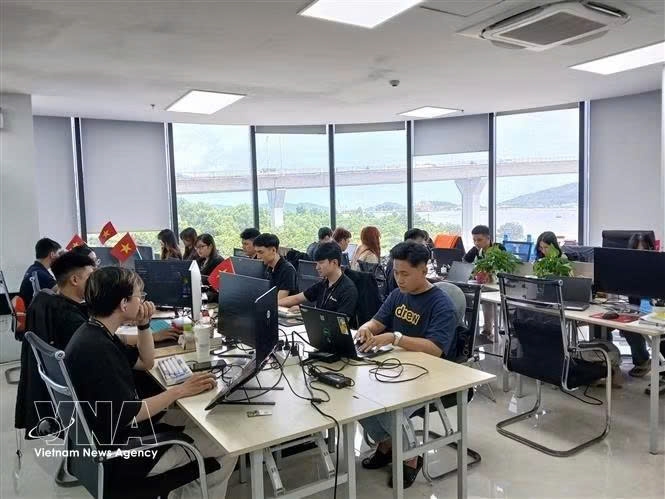
Startups in the semiconductor and AI sectors are being provided with workspace at the Concentrated IT Park in Da Nang Software Park No.2. |
Building on this foundation, Vietnam aims to capitalize on the global supply chain shift by focusing on specialized chips and science-technology human resources, gradually mastering stages from research, design to packaging and testing.
Alongside institutional reforms, workforce development is being accelerated. Vietnam has so far attracted more than 170 foreign-invested projects in the semiconductor sector. In chip design alone, over 50 foreign firms and around 10 domestic companies are operating, supported by a workforce of approximately 7,000 engineers.
Concrete steps are also emerging from major corporations. The Military Industry-Telecoms Group (Viettel) is constructing Vietnam’s first semiconductor fabrication plant at the Hoa Lac Hi-Tech Park in Hanoi. Spanning 27 ha, the facility is expected to serve key industries such as aerospace, telecommunications, Internet of Things (IoT), automotive manufacturing, medical devices, and automation.
Meanwhile, FPT Group has launched an advanced chip packaging and testing plant to help strengthen value chain connectivity in Vietnam, contributing to the country’s broader push to master core and sovereign technologies.
These moves underscore increasingly tangible efforts by businesses to translate policy directions into reality.
According to Tran Dang Hoa, Chairman of FPT IS under FPT Group, global strategic competition is increasingly centered on hi-tech supply chains, from AI, and cloud computing to 5G/6G and electric vehicles, and defense systems, all of which rely on semiconductor chips as a core foundation.
Aligned with the State’s policy direction, FPT has pledged to work alongside partners to foster alliances within the domestic semiconductor ecosystem, accelerate chip research and development, a strategic national technology, thus supporting Vietnam’s deeper integration into global value chains.
Ho Chi Minh City is emerging as a key hub in this strategy, adopting a coordinated development model that integrates research, manufacturing, and logistics, laying a groundwork for deeper participation in the semiconductor value chain.
Under this approach, the city focuses on R&D and high-quality workforce training, large-scale production; and international logistics, towards optimizing resources and strengthening linkages across the semiconductor value chain.
Organizing development space through functional linkage and role-based specialization is seen as a suitable approach, as the semiconductor industry simultaneously requires strong R&D capacity, large-scale industrial production, and robust supply chain connectivity.
Nguyen Huu Yen, Deputy Director of the municipal Department of Science and Technology, said the city is pursuing a focused approach to semiconductor development, strengthening linkages and proactively creating policy space for experimentation rather than spreading resources thinly. Policies, he noted, are closely aligned with practical demands and remain flexible during implementation to ensure effectiveness and sustainability.
Under its 2026 implementation plan, the southern metropolis aims not only to attract investment but also to build a comprehensive ecosystem encompassing R&D, training, innovation, and startups. The city is seeking partnerships with global tech giants such as AMD, NVIDIA, and Qualcomm to facilitate technology transfer and improve chip design capabilities.
The city set to attract at least four new FDI projects in semiconductors, prioritizing high value-added and environmentally friendly projects. Infrastructure plans include an international-standard semiconductor research center, microchip laboratories at universities, a national shared laboratory system at Vietnam National University–Ho Chi Minh City, an upgraded high-performance computing facility at Quang Trung Software Park.
Meanwhile, the Saigon Hi-Tech Park will be expanded into a full-fledged high-tech urban zone, within which a large-scale semiconductor industrial complex will be developed.
Source: VNA