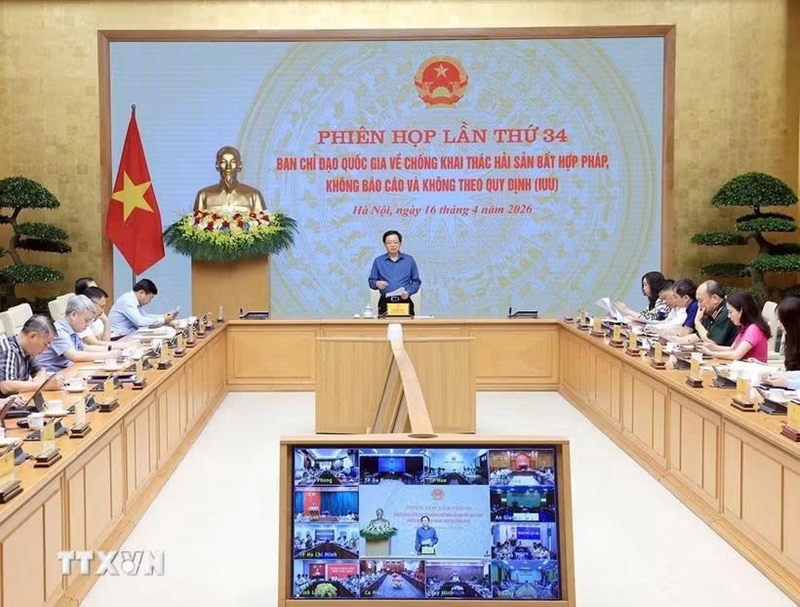
The meeting connected online with 21 coastal cities and provinces, drawing leaders of ministries and agencies.
Legal framework and monitoring systems largely in place
Deputy Minister of Agriculture and Environment Nguyen Hoang Hiep reported that after more than eight years of sustained efforts to combat IUU fishing and respond to E.C. recommendations, Vietnam has delivered important progress.
    |
 |
|
Deputy Prime Minister Ho Quoc Dung chairs the 34th meeting of the National Steering Committee on combating IUU fishing in Hanoi on April 16. |
The country has largely completed its legal framework and put in place fisheries management, vessel monitoring, and traceability systems that meet international standards while fitting domestic conditions.
A comprehensive fisheries database, including the national VNfishbase, vessel monitoring system, electronic catch documentation and traceability (ECDT), and administrative sanctions database, has been fully interconnected from central to local levels and linked with the national population database via VNeID.
As of April 14, more than 80,350 fishing vessels of 6m or longer have been registered and updated in VNfishbase, with over 76,700 holding valid fishing licenses.
On traceability, 86 fishing ports have been approved for operation, including 72 for offshore vessels and 51 certified to verify the origin of harvested seafood.
The ECDT system and electronic logbooks are now deployed nationwide, enabling transparent traceability and connectivity with E.U. and Food and Agriculture Organization (FAO) systems.
Law enforcement efforts have also produced results, with a sharp decline in Vietnamese vessels violating foreign waters since 2017. Between 2024 and April 15, 2026, only 101 vessels were detained by foreign authorities.
Persistent shortcomings hinder progress
Despite these gains, the E.C.’s fifth inspection mission from March 9–19 identified several unresolved issues still blocking the lifting of the yellow card.
Key problems include incomplete vessel marking and registration, weak control over vessels entering and leaving ports, and insufficient monitoring of catch volumes unloaded at ports.
Traceability of imported seafood transported by container ships also remains inconsistent across enterprises, processors, and exporters.
Enforcement has been slow and uneven, with incomplete data updates failing to satisfy E.C. demands.
The Ministry of Agriculture and Environment (MAE) attributed the shortcomings to limited local enforcement capacity, uneven leadership and resource allocation, gaps in data integration and monitoring technology, inadequate port infrastructure, and limited access by fishermen to technology and alternative livelihoods.
Stepping up enforcement to have “yellow card” lifted
Concluding the meeting, Deputy PM Dung stressed that the regulatory framework is already in place, and the main issue lies in compliance. He ordered ministries, agencies, and localities to assign responsibilities and ramp up inspections and oversight.
The MAE, as the standing body of the Steering Committee, was instructed to consolidate its organizational structure and propose the establishment of an inter-agency task force to conduct regular on-site inspections instead of relying solely on periodic meetings.
The ministry was also asked to finalize a new decree replacing the Government’s Decree 38/2024/ND-CP on administrative sanctions in the fisheries sector, with stricter penalties to strengthen deterrence - a core E.C. requirement.
Dung further called for a comprehensive review of legal frameworks and management processes related to fleet control, traceability, and seafood imports, with swift action to close existing loopholes.
Other specific tasks were also assigned to relevant ministries and localities.
Source: VNA