At a recent meeting held by the Ministry of Industry and Trade (MoIT), big retailers warned that price pressures are intensifying. A representative of a retail chain with thousands of outlets nationwide said that 70–80% of suppliers have proposed price increases, the highest level seen in recent years.
The primary driver is the sharp rise in input costs, particularly fuel, raw materials and logistics. Disruptions in global supply chains, compounded by geopolitical tensions, have simultaneously driven up transportation, production and material costs.
    |
 |
|
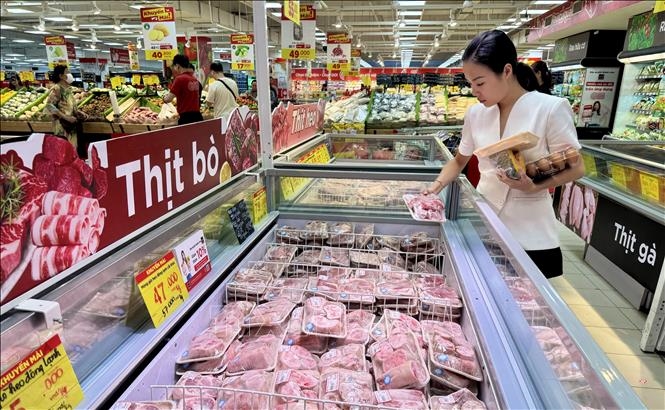
Ho Chi Minh City will continue market stabilization programs, support trade promotion activities and help businesses share costs to sustain stable price levels. |
In response, retailers are engaged in tough negotiations to limit price increases. However, their ability to keep prices stable is narrowing, with some suppliers even suspending deliveries pending price adjustments. If this trend persists, retail prices of many goods could rise by 5–20% in the time to come.
The ripple effects are also being felt beyond modern retail systems, spreading rapidly to traditional markets, which are often the most sensitive to cost fluctuations. Surveys in Hanoi and Ho Chi Minh City show that prices of food, dining services, vegetables and other essentials are edging up in line with higher transport costs.
In Hanoi, prices at markets such as Cong Vi, Nghia Tan and Ngoc Thuy have begun to inch up, particularly for fresh food. Pork prices, for instance, have risen by around 30,000 VND (1.14 USD) per kilogram compared to previous levels, mainly due to higher transport and input costs linked to fuel price increases.
In addition, prices of budget dining services in Hanoi have begun to climb, with many eateries and coffee shops raising prices by 3,000–10,000 VND per serving or drink to offset higher ingredient and transportation costs.
Amid mounting pressure, the MoIT and local authorities are accelerating measures to stabilize the market. Management agencies stressed that the biggest risk is not only rising prices but also potential supply disruptions amid global uncertainties.
Key solutions include closely monitoring supply-demand developments, supporting businesses in connecting with logistics and e-commerce platforms to optimize costs, and maintaining market stabilization programs to prolong price stability.
At the local level, Nguyen Nguyen Phuong, Deputy Director of the Ho Chi Minh City Department of Industry and Trade, said the city will continue market stabilization programs, support trade promotion activities and help businesses share costs to sustain stable price levels.
Vinh Thanh Dat Food JSC, one of the leading producers and suppliers of clean poultry eggs in the southern region, has pledged to keep egg prices stable despite rising input costs, while rolling out promotional programs.
Retailers are also taking proactive steps. Many large distribution systems have introduced price-lock programs, large-scale promotions and expanded sourcing of domestic goods to ease cost pressures.
Saigon Co.op, for instance, has worked with suppliers to maintain reasonable prices for essential goods. From now until March 25, its supermarket network is offering discounts of up to 50% on around 1,000 products for daily consumption.
Similarly, MM Mega Market is implementing a price-lock program for about 300 essential items through late March to minimize the impact of rising input costs on consumers.
Meanwhile, GO! hypermarkets are running a promotion campaign from March 12 to 25, offering discounts of up to 30% on fresh produce and meat, up to 27% on dairy and nutritional products, and up to 23% on ready-to-eat meals, alongside various buy-one-get-one and bulk discount offers.
Source: VNA