The adjustment was approved on August 24 at the first extraordinary session of the 16th National Assembly, following the Government's proposal to revise the project's investment policy.
The railway was initially approved in February 2025 with an estimated investment of 203.2 trillion VND. The higher figure reflects more detailed calculations at the feasibility study stage, updated construction costs, material prices and compensation and resettlement policies through 2026.
    |
 |
|
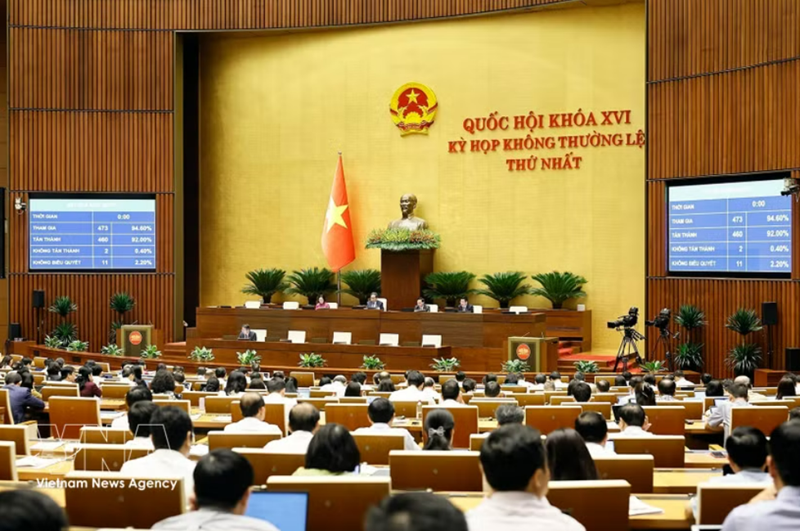
National Assembly deputies vote to approve the resolution adjusting the investment policy for the Lao Cai - Hanoi - Hai Phong railway project. |
Construction and equipment costs account for the largest increase, rising by 51.21 trillion VND, while compensation, support and resettlement costs rise by around 34.85 trillion VND. Project management, consultancy and other costs increase by around 163 billion VND, while contingency costs fall by 114 billion VND. Construction is targeted for substantial completion by 2030.
The project will stretch about 363km from the cross-border rail connection in Lao Cai to Nam Hai Phong Station, with another 63km of branch lines. The route will run through six provinces and cities - Lao Cai, Phu Tho, Hanoi, Bac Ninh, Hung Yen and Hai Phong.
The railway will use a 1,435mm standard gauge and carry both passengers and freight. Designed speeds will reach 160km per hour on the Lao Cai - Nam Hai Phong section, 120km per hour through the Hanoi metropolitan area and 80km per hour on other sections.
Double tracks will be built from Bac Hong Station to Nam Hai Phong and from Yen Vien to Gia Lam, while other sections will be a single track.
Electric traction will power the main line and the Yen Vien-Gia Lam branch. Branches serving seaports will initially use diesel traction, with a planned transition to clean-energy locomotives.
In its resolution, the National Assembly also requires the Hai Phong municipal People's Committee to mobilize funding and ensure efficient investment in the branch linking Nam Hai Phong and Nam Do Son, in coordination with development of the Nam Do Son port area.
Minister of Construction Tran Hong Minh said the project is exceptionally large and technologically complex, marking the first railway project of this scale and technological requirements in Vietnam. He stressed that updated policies and new factors had prompted the Government to seek adjustments to ensure the project's objectives are met.
The National Assembly received 62 comments from lawmakers on the proposed adjustments. They focused on the rationale and effectiveness of the changes, implementation progress, transparency and safety, as well as the feasibility and balance of funding sources.
The Government incorporated lawmakers' recommendations before the revised investment-policy resolution was submitted for approval.
Source: VNA