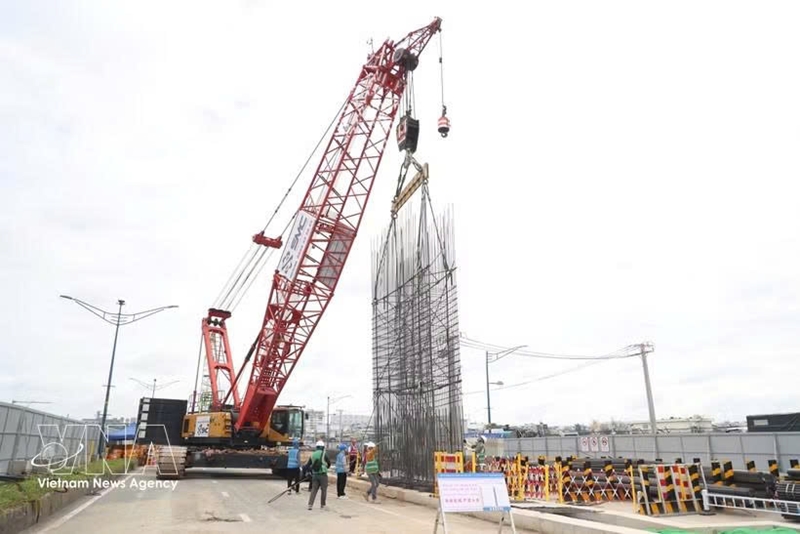
The first construction activity involves lowering a reinforced steel cage for the diaphragm wall at the underground ST10 (Pham Van Bach) station, one of the line's key stations. Diaphragm walls are deep reinforced concrete structures that support excavation and form the outer walls of underground stations.
    |
 |
|
A reinforced steel cage is lowered for the diaphragm wall at the underground ST10 (Pham Van Bach) station on July 2. |
The ceremony, organized by the city's Management Authority for Urban Railways (MAUR), coincided with the 50th anniversary of Saigon–Gia Dinh officially named after President Ho Chi Minh (July 2, 1976–2026).
In his remarks, MAUR Director Phan Cong Bang described the event as an important step for both Metro Line No.2 and the city's urban transport system.
He said that nearly three months after the engineering, procurement and construction (EPC) contract was signed on April 8, the project investor and the EPC consortium had completed key legal, technical and preparatory work despite various challenges, paving the way for construction to begin.
According to Bang, additional geological surveys along the route have largely been completed to support detailed engineering design. Technical solutions have also been finalized for the two most critical underground stations – ST5 (Le Thi Rieng) and ST10 (Pham Van Bach).
The contractor has established a material quality control system, selected qualified subcontractors for diaphragm wall construction, and coordinated with local authorities to widen sections of Cach Mang Thang Tam and Truong Chinh roads to facilitate traffic diversions during construction.
The official urged the EPC consortium to accelerate construction while ensuring absolute safety, particularly when handling oversized and heavy structural components. He also called for construction methods that minimize traffic congestion, dust and disruption to nearby residents.
Representing the EPC consortium, Director of the Metro Line No.2 project Long Quoc Tuan said ST10 is one of the most technically challenging stations on the route because it is located close to the controlled airspace of Tan Son Nhat International Airport, where construction height is limited to 18 meters.
Despite those constraints, he said the consortium will adhere to the principles of "safety first, quality as the foundation and standards as the lodestar" while complying with both Vietnamese regulations and European technical standards.
According to MAUR, ST10 and ST5 will serve as the launch sites for two tunnel boring machines (TBMs) that will excavate the underground section of the metro line.
Construction of the 534-metre diaphragm wall at ST10 is expected to take around six months. Work is also underway at ST5. Meanwhile, construction at the remaining stations is scheduled to begin in July and August after traffic diversion plans and site preparation are completed.
Once operational, Metro Line No.2 is expected to help improve public transport capacity, ease road congestion and support transit-oriented urban development in Ho Chi Minh City.
Source: VNA