The conference was jointly held by Viet Nam Women Entrepreneurs Council (VWEC) in cooperation with U.N. Women and IPPG under a project funded by the Australian Government through the Mekong-Australia Partnership and implemented by U.N. Women.
Nguyen Kim Lan, Manager of U.N. Women Viet Nam’s Women’s Economic Empowerment Program, said export markets are imposing increasingly stringent requirements on businesses to demonstrate their commitment to sustainable development, including environmental, labor, social responsibility, corporate governance and gender equality standards.
    |
 |
|
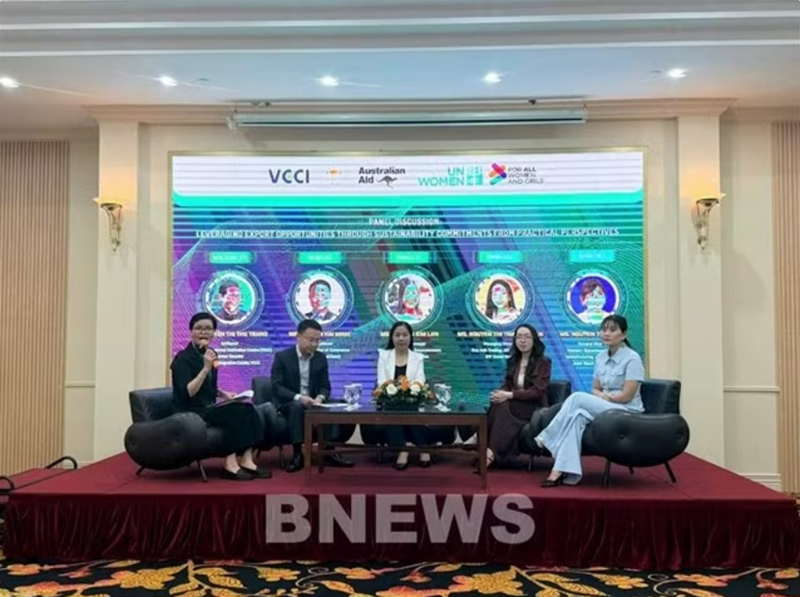
The panel discussion at the conference on sustainable trade practices for effective exports by women-owned and gender-responsive enterprises in Hanoi on August 27 |
These trends are reshaping the way businesses access and participate in global supply chains, she said, adding that U.N. Women is working with partners to help women-owned and gender-responsive businesses improve competitiveness, access markets and participate more deeply in domestic and international supply chains.
The VWEC’s Deputy Chairwoman Mai Thi Dieu Huyen said that more than 20% of small- and medium-sized enterprises (SMEs) in Viet Nam are women-owned, while women account for 51% of enterprise ownership structures.
However, many women-led businesses still face barriers in accessing international markets, information on new standards, business networks and trade connections, she said.
Businesses need to standardise production processes, improve traceability, working conditions and environmental management, while strengthening transparency and gender-responsive practices, Huyen said.
They can also make greater use of the free trade agreement (FTA) ecosystem to access preferential financing, technical support, standards advice and connections with larger supply chains, she added.
At the event, experts analysed the opportunities offered by next-generation FTAs and clarified the impacts of commitments regarding sustainable development, labour, social responsibility, environmental, social and governance (ESG) standards, and gender equality on export activities.
Discussions highlighted that, when accessing demanding export markets, businesses need to look beyond trade preferences and proactively understand and comply with the increasingly diverse standards and requirements set by markets and buyers. Meeting requirements on labor, gender equality, social responsibility and corporate governance can provide a foundation for businesses to enhance their reputation, strengthen ties with partners and improve their ability to participate in supply chains.
Through the conference, U.N. Women and the VWEC reaffirmed their continued support for women-owned and gender-responsive businesses in promoting responsible business practices, capitalizing on opportunities from international economic integration and strengthening their position in global value chains.
Source: VNA