The conference drew more than 600 policymakers, technology experts, businesses and domestic and international organizations. The event was jointly organized by the Vietnam Software and IT Services Association (VINASA), the Hanoi People’s Committee, the city’s Department of Science and Technology and relevant agencies.
    |
 |
|
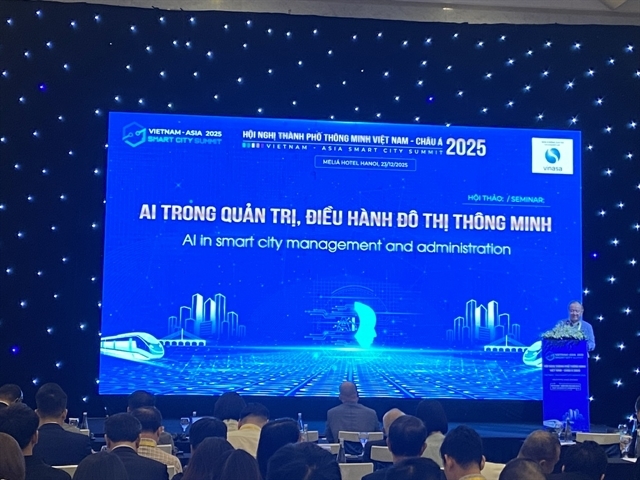
The conference draws more than 600 policymakers, technology experts, businesses and domestic and international organizations. |
Against the backdrop of mounting urban pressures, including infrastructure overload, environmental pollution, population growth and rising expectations for quality of life, AI is no longer viewed as a supporting tool but as the 'new brain' of smart cities, enabling data-driven governance, operations and decision-making.
Throughout the discussions, participants agreed that smart cities are not simply about digitizing infrastructure or deploying isolated technologies. Instead, they require a comprehensive restructuring of urban governance systems based on big data and intelligent algorithms, with AI connecting fragmented systems into a unified whole.
The one-day program included a plenary session and five thematic workshops focusing on AI-based solutions for smart urban development, ranging from intelligent transport and environmental monitoring to energy optimization and online public services.
Vice Chairman of the Hanoi People’s Committee Truong Viet Dung told conference attendees that Hanoi has identified science, technology and innovation as key drivers of growth in the next few years.
“Our goal is to build Hanoi into a leading innovation hub,” he said, adding that the city is committed to working closely with the Ministry of Science and Technology and relevant agencies to organize major events that help spread the spirit of innovation and start-up activities across the community.
He noted that hosting the summit is particularly significant as Hanoi accelerates implementation of the revised Capital Law and the Politburo's Resolution 57 on breakthroughs in science, technology, innovation and national digital transformation.
The event also offered an opportunity to promote Hanoi as a smart, innovative and globally connected city capable of attracting investment, skilled workers and new development momentum.
AI at the heart
A recurring theme across sessions was AI’s growing role in urban management, from traffic control and environmental supervision to energy efficiency, public security and policy support.
Experts said AI allows city governments to move from reactive administration to more proactive governance, helping leaders respond faster and more accurately to emerging issues while improving transparency and service quality.
These perspectives were echoed by VINASA Chairman Nguyen Van Khoa, who shared insights drawn from submissions to the Vietnam Smart City Awards 2025, announced within the framework of the summit.
“Through the lens of this year’s award dossiers, we see that AI has begun to enter every corner of daily life in Vietnam, from public services to public security and order,” Khoa said.
He noted that 2025 marked a pivotal year for smart cities, as Vietnam enters the implementation phase of Decree 269 on smart urban development and steps up efforts to achieve net zero targets.
“The awards are a source of motivation, but the journey ahead remains long. We expect closer cooperation between authorities and businesses to replicate effective models,” he said.
According to Khoa, the new definition of a smart city places people at the center, with government acting as a facilitator, businesses as the driving force and technology as a tool to optimize governance, enhance quality of life, foster sustainable economic growth and protect the environment.
“A smart city is not about having more sensors or software, but about connectivity between government, enterprises, citizens and communities, and interoperability across data, processes, policies and resources,” he said.
At the specialized workshop 'AI in Smart Urban Governance and Operations,' participants shared practical experiences and technological solutions already being deployed across Vietnam.
Pham Quang Nhat Minh, Director of the AI Research and Development Center at FPT IS, said cities are facing a growing 'decision overload' problem as data volumes expand rapidly, while analytical tools remain limited.
“AI helps authorities gradually shift from reactive management to a more proactive approach,” Minh said. He explained that AI can support leaders in analyzing big data, simulating policy scenarios and detecting potential risks early in urban management.
According to Minh, AI has been applied in the public sector across three main layers: strategic decision support, operational optimization and citizen experience enhancement.
“AI systems can automate high-volume processes, forecast infrastructure demand, monitor traffic, the environment and security, and personalize public services, while humans still retain the final decision-making role,” he said.
From the perspective of a digital infrastructure provider, Phan Thi Thanh Ngoc, Deputy Director of AI Application Consulting at VNPT AI, said smart cities are moving decisively from basic digitization to data- and AI-driven operations.
“AI is considered the ‘brain’ of smart cities,” Ngoc said. “It enables authorities to analyze real-time data, forecast risks, coordinate traffic, manage infrastructure and improve oversight of public services.”
She also highlighted the importance of shared data platforms, intelligent operation centers and AI assistants in helping leaders monitor socio-economic conditions, process administrative procedures and strengthen two-way interaction with citizens.
Tran Ngoc Thach from the Da Nang Department of Science and Technology said the central city has pursued smart city development since 2018, with data as its foundation and AI gradually integrated into monitoring, early warning and decision support systems.
“Da Nang has built an open data portal with more than 1,500 datasets serving government agencies, businesses and the community,” Thach said.
AI has been applied in administrative procedure monitoring, flood and rainfall tracking, traffic management, environmental supervision, public security and disaster prevention, helping reduce overdue dossiers and improve service quality.
Within the summit framework, VINASA also announced the Vietnam Smart City Awards 2025. From 75 nominations, 18 awards were selected, including eight for cities and 10 for technology solutions.
Da Nang was named the most outstanding city, winning awards for smart governance and operations, green and sustainable development, and an attractive start-up ecosystem, marking its sixth consecutive year of recognition.
Hanoi was also honored in the category of smart city operations and management in public services, reflecting progress in AI-powered citizen engagement through its 24/7 hotline, virtual assistant and iHanoi digital citizen app.
One highlight of the awards was a nationwide public vote for the title of 'Most Livable City,' reinforcing the message that technology, no matter how advanced, is ultimately a means to an end.
A VINASA representative said the awards would continue to evolve “to promptly recognize outstanding achievements and strong transformations by cities, while selecting, introducing and connecting outstanding technology products for urban development and daily life, contributing to smart and sustainable cities for the happiness of people and economic growth.”
As discussions concluded, participants agreed that AI is opening new pathways for urban governance, but its success depends on robust data infrastructure, inter-agency coordination and a clear roadmap that ensures transparency, effectiveness and a people-centered approach.
Source: VNA