A vibrant and innovative Shenzhen
In mid-November, Shenzhen became the gathering point for the 21 APEC member economies during the 33rd APEC Economic Leaders’ Week. From a small fishing village just over four decades ago, the city has risen to become one of the world’s leading technology and innovation hubs, widely known as the “cradle of China’s reform and opening-up.”
It is no exaggeration to say that China, as the host, made every effort to ensure that APEC Economic Leaders’ Week would leave a lasting impression. At night, a light show at the Civic Center connected 43 skyscrapers in a 270-degree arc, displaying synchronized images of a “roc spreading its wings to fly out into the world” across the buildings, creating a unique and captivating spectacle.
    |
 |
|
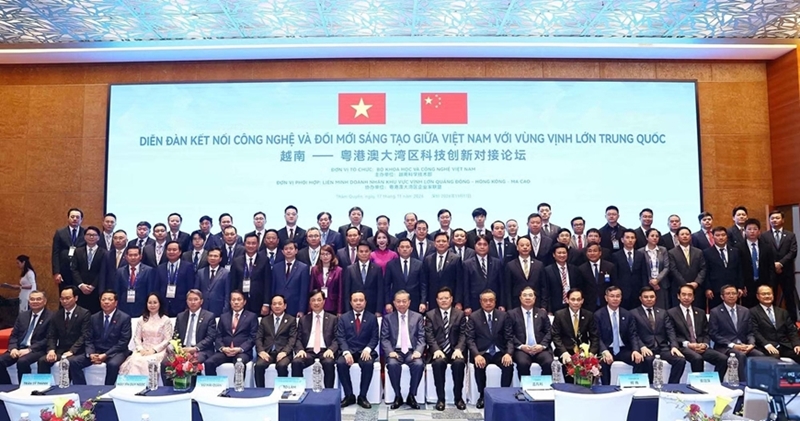
Party General Secretary and President To Lam and delegates at the Viet Nam-China Greater Bay Area Technology and Innovation Connectivity Forum |
Correspondents based in China told us that, ahead of APEC’s opening, Shenzhen also made its mark with a performance by 151 robots that set a new Guinness World Record. Led by the T800 humanoid robot, which can perform complex maneuvers such as punching, kicking and somersaulting, the showcase highlighted China’s technological achievements and spirit of innovation.
This marked the third time China had hosted APEC, 12 years after the Beijing summit in 2014. With high standards set for the event’s organization, Shenzhen completed its preparations with a focus on three key areas: green development, the promotion of cultural values and the application of technology.
The extensive preparations alone demonstrated the importance China attached to hosting APEC. For us, however, one of the most impressive features was the APEC 2026 Press Center, located in Hall 2 of the Shenzhen Convention and Exhibition Center, which served nearly 5,000 domestic and international journalists.
Its main workspace covered more than 2,500 square meters, with approximately 700 seats and a giant four-sided screen surrounding the area. AI-powered interpretation headsets were readily available, while each workstation featured network connectivity and a multi-channel audio-sharing system.
Perhaps the most striking feature was the presence of humanoid robots serving as special “colleagues” behind counters, making coffee, ice cream and juice, or standing ready to bring water and candy directly to reporters.
Nigerian journalist Mark Dayil Longyen shared that he had traveled all the way from Africa to witness these new developments firsthand, noting the rapid advancement of China’s artificial intelligence (AI) technology and robotics industry.
It is understandable why China invested so heavily in and paid such close attention to the APEC event, given the global significance of decisions made at its high-level meetings. The forum comprises 21 member economies, including major global economies such as the U.S., China, and Japan, which together account for roughly 37% of the world’s population, 62% of global GDP and nearly 50% of global trade.
Moreover, APEC Economic Leaders’ Week 2026 took place against the backdrop of the Asia-Pacific region undergoing profound transformations, marked by intertwined opportunities and major challenges. As APEC represents efforts to bridge differences, strengthen connectivity, promote dialogue and foster cooperation for shared prosperity, decisions made at the forum have a significant impact on regional and global developments while creating fresh momentum for a more prosperous future.
Under the theme “Building an Asia-Pacific Community for Shared Prosperity,” APEC 2026 aimed to build a more connected region where economies share development opportunities and outcomes through three priorities: openness, innovation, and cooperation.
Openness seeks to advance trade, investment and connectivity while upholding a rules-based multilateral trading system with the World Trade Organization (WTO) at its core. Innovation focuses on accelerating digital transformation, AI application, structural reform and productivity gains. Cooperation aims to jointly address shared challenges, work toward sustainable and inclusive growth, and expand opportunities for women, youth, and small- and medium-sized enterprises.
Viet Nam’s imprint
According to Nguyen Minh Vu, Permanent Deputy Minister of Foreign Affairs, Party General Secretary and President To Lam’s working trip was of great significance to promoting regional economic integration, preparing for Viet Nam’s role as APEC 2027 host, and creating new momentum for Viet Nam-China relations.
As one of the region’s fast-growing economies, with an increasingly important international role and standing, Viet Nam made significant contributions to this major forum while preparing to assume a new responsibility.
In Shenzhen, following warm receptions, successive talks and meetings with Chinese leaders, Guangdong provincial authorities and APEC leaders, including leaders of economies that are comprehensive strategic partners and strategic partners of Viet Nam, Party General Secretary and President To Lam and the high-ranking Vietnamese delegation embarked on a packed schedule of major APEC 2026 activities.
It was the first time the Vietnamese leader had addressed representatives of all 21 APEC member economies as the representative of the following year’s host economy.
Across sessions and speeches, Party General Secretary and President To Lam put forward a number of strategic and groundbreaking proposals, reflecting a strong spirit of innovation, to further enhance APEC’s role and standing in international economic cooperation and integration and in addressing challenges facing the international community and the Asia-Pacific region.
Highlights included his addresses at the APEC Economic Leaders’ Meeting and the APEC CEO Summit, where he emphasized the need to take the lead in promoting an open trade and investment environment, generating fresh impetus for economic integration and connectivity, opening up new strategic development spaces and creating new growth drivers, while fostering dialogue and cooperation to build trust and maintain stability for development.
The Vietnamese leader conveyed to the international community the image of a dynamic, deeply integrated Viet Nam that is steadily becoming an increasingly important partner in manufacturing, trade and investment in the global economy. Drawing on 40 years of Doi Moi (renewal), he drew three key lessons: renewal drives development, opening-up creates opportunities, and integration enables economies to grow together.
Entering a new era, Viet Nam has chosen a self-reliant, creative, humane, sustainable and integrated development model, promoting growth driven by science, technology, innovation and digital transformation, with people at its center.
Viet Nam remains steadfast in its foreign policy of independence, self-reliance, multilateralization and diversification, placing importance on dialogue, trust-building and cooperation.
While inviting international businesses to establish long-term strategic partnerships, Viet Nam also pledged to protect investors’ legitimate rights and interests and maintain a stable, transparent and predictable business environment, underscoring that “the success of businesses is also the success of Viet Nam.”
Notably, upon accepting the responsibility of hosting APEC 2027, Party General Secretary and President To Lam drew on the image of rivers flowing into the vast ocean in Vietnamese and Chinese poetry to illustrate the spirit of regional cooperation.
Tang Dynasty poet Zhang Ruoxu wrote, “The spring river’s tidal waters meet the level sea / Over the sea, the bright moon rises with the tide.”
Viet Nam’s King Le Thanh Tong also portrayed the ocean in verse, “Receiving the waters of a hundred rivers, waves roll full / Mountains arrayed like a chessboard, emerald green touching the clouds.”
Both images evoke the Eastern philosophy of convergence, where distinct currents merge into the vast ocean.
Drawing on this shared imagery, the Vietnamese leader conveyed a message to the APEC community: much like rivers flowing into the Pacific Ocean, the 21 APEC economies come from diverse backgrounds and possess distinct identities, yet all converge within a shared APEC space.
Just as the waters of a hundred rivers create the greatness of the ocean, with solidarity, and determination, we will together build a peaceful, prosperous, and enduringly developing Asia-Pacific for our shared future.
Translated by Minh Anh