Speaking at a seminar organized by Cong Thuong (Industry and Trade) Magazine on September 28, Ngo Chung Khanh, deputy director of the Multilateral Trade Policy Department under the Ministry of Industry and Trade, said changing trade policies are prompting countries and companies to reassess established supply chains.
“Relationships that were once considered very stable are becoming less so,” Khanh said, adding that differences in policies and trade positions were encouraging countries to seek alternative sources of supply.
    |
 |
|
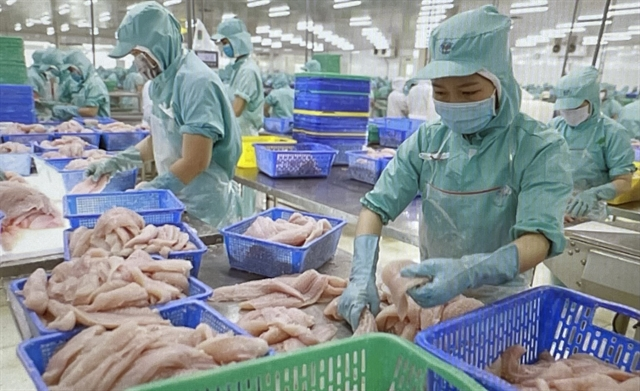
Tra fish processed for export. Viet Nam’s trade with CPTPP members still accounts for a modest share of their overall import demand, indicating significant room for expansion. |
Viet Nam, with its position as a manufacturing hub in the region, could benefit from this shift as international companies look to diversify suppliers, he said.
The CPTPP, which currently comprises 12 economies, provides Vietnamese businesses with a broader framework for participating in those supply chains, Khanh said. The bloc is also expanding its reach, with countries Costa Rica and Uruguay seeking for membership, while other have expressed interest in joining.
Viet Nam’s trade with CPTPP members still accounts for a modest share of their overall import demand, indicating significant room for expansion, Khanh said.
The opportunity extends beyond exports, he said. Companies can use CPTPP markets to source inputs, diversify suppliers and reorganize production networks to reduce dependence on a single source.
“CPTPP is not simply a consumer market. It is also a supply chain,” he said.
Market diversification is not simply shifting from one market to another but requires market research, relationship building and adaptation to individual markets’ standards and regulations, he said.
He urged businesses to strengthen their capacity to comply with rules of origin, labor and environmental requirements in order to qualify for preferential treatment, he said.
At the same time, diversification should not mean abandoning traditional markets, Khanh stressed, urging companies to pursue a balanced strategy with a clear roadmap for developing new markets while maintaining existing ones.
The government is also working to strengthen the implementation of free trade agreements, Khanh said, describing FTAs as an asset for the economy. The focus is on providing information, assessing implementation results and building an ecosystem that connects resources to help businesses make better use of FTAs, he said.
Khanh hoped Viet Nam could raise its share of the CPTPP market from currently 1% to around 4-5%.
Nguyen Thi Trang, trade counsellor at the Viet Nam Trade Office in Mexico, described market diversification as a long-term strategy, while stressing the importance of businesses developing their own capacity to research and build markets.
Do Thi Thuy Huong, deputy chairwoman the Viet Nam Electronic Industries Association, pointed out major challenges includes access to market information, technical standards and the ability to build resilient supply chains.
Huong urged firms to adopt a more proactive approach with focus not only on responding to market demand but on actively developing markets, seeking customers and strengthening production capacity.
Such an approach would help companies turn CPTPP opportunities into sustainable export growth while building the capacity needed to participate more deeply in regional and global supply chains, she said.
Source: VNA