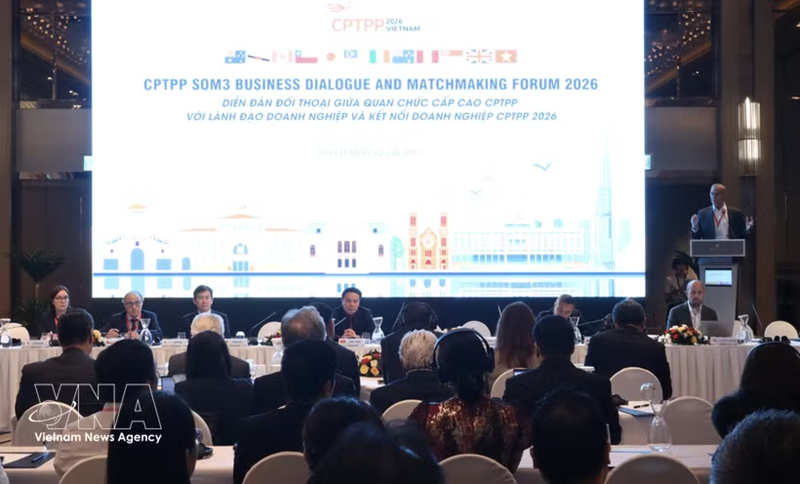
The message was highlighted at a dialogue and business networking forum between CPTPP senior officials and business leaders in Ho Chi Minh City on July 22, part of the 2026 CPTPP Senior Officials' Meeting (SOM3) hosted by Vietnam.
    |
 |
|
The dialogue and business networking forum between CPTPP senior officials and business leaders is held in Ho Chi Minh City on July 22, as part of the 2026 CPTPP Senior Officials' Meeting (SOM3) hosted by Vietnam. |
Ngo Chung Khanh, Deputy Director of the Multilateral Trade Policy Department under the Ministry of Industry and Trade, said Vietnam, as CPTPP Chair in 2026, aims to bring policymakers and businesses closer together to improve implementation and shape future economic cooperation.
He stressed that the CPTPP has evolved beyond tariff reductions into a broad framework covering goods, services, investment and digital trade. Its success, however, ultimately depends on businesses' ability to turn commitments into new investment, stronger supply chains and innovative business models.
Japan's representative Kenichi Kobayashi said trade between Japan and other CPTPP members grew 41% between 2018 and 2025, outpacing Japan's overall global trade growth. He said members are working to simplify customs procedures, cut business costs and expand cooperation in emerging areas such as artificial intelligence, digital identity, electronic payments and cybersecurity.
Representatives from New Zealand and the UK also stressed that regular engagement with businesses is essential to ensuring trade policies deliver tangible results and do not create unnecessary burdens.
Discussions focused particularly on helping small and medium-sized enterprises (SMEs) better access CPTPP benefits. A Deloitte Vietnam representative noted that many smaller businesses lack resources to keep track of complex trade rules and available preferences, calling for stronger support mechanisms.
Vietnam has established an online portal for guidance on free trade agreements, including rules of origin and tariff preferences, while Japan has introduced advanced trade information systems to help businesses prepare for import-export procedures.
Representatives from Mexico, Peru and Singapore highlighted digitalization as another priority. While digital tools can reduce costs and improve cross-border trade, many SMEs still lack awareness of opportunities beyond tariff cuts, particularly in digital trade and services.
Participants agreed that deeper public-private dialogue, better access to information and stronger digital support are crucial to narrowing the gap between CPTPP commitments and their practical benefits for businesses.
As global trade faces growing uncertainties, closer cooperation between governments and businesses will be essential to keeping the CPTPP responsive, resilient and relevant to the evolving global economy.
Source: VNA