Recognizing this, the Party and State have issued Resolution No.80-NQ/TW on the development of Vietnamese culture, emphasizing the task of building an advanced culture deeply imbued with the national identity to serve as a firm spiritual cornerstone of society.
The year 2026 marks the first phase of its implementation, alongside the national target program on Vietnamese cultural development for 2025–2035 and a range of other approved strategies and projects. This is widely seen as a significant starting point for harnessing culture as an intrinsic source of national strength and reinforcing society’s spiritual foundation.
Culture in face of digital-age challenges
Amid globalization and rapid technological advancement, the cultural fabric of society faces both opportunities and challenges. Cultural exchange broadens horizons and introduces new values; however, without careful selection, traditional values risk gradual erosion.
    |
 |
|
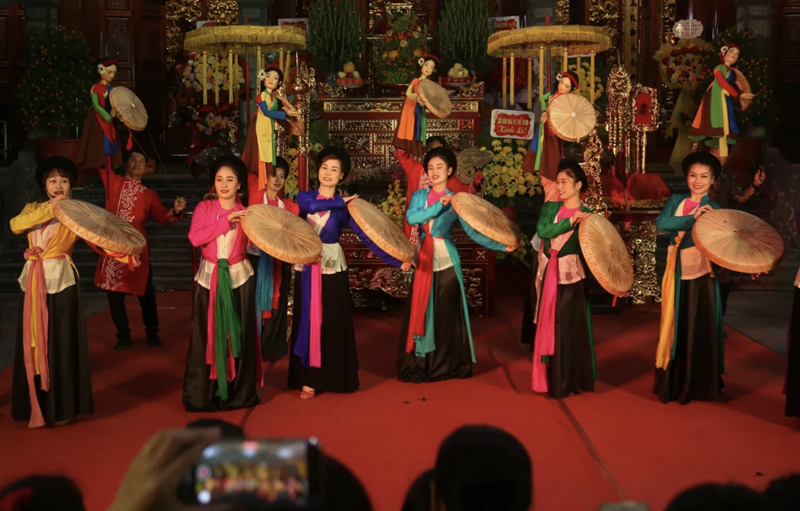
A performance by the Hai Phong Puppet Theatre Troupe at Truc Cat Communal House in Hai Phong city |
The rise of social media platforms, such as TikTok, Facebook, and Instagram has profoundly influenced the lifestyles of young people. Many are drawn to fleeting online trends that prioritize fame, material success, and outward appearance, sometimes at the expense of deeper spiritual and ethical values.
Yet, when guided constructively, technology can completely become a powerful tool for spreading fine cultural values. Increasingly, young Vietnamese are using social media to showcase traditional ao dai attire, national cuisine, scenic landscapes, and heritage sites such as Ha Long Bay to international audiences. These vibrant images and stories are helping to project a positive image of the country and its people across the globe.
Cultural preservation linked with economic development
Today, safeguarding culture goes beyond preserving traditions; it is increasingly tied to economic development. Many traditional craft villages, once facing disintegration, are experiencing a revival.
A great example is Hanoi's Bat Trang pottery village, which faced tough times as handmade ceramics had to compete with industrially produced items. Thanks to preservation efforts, active promotion, and hands-on tourism experiences, the craft has gradually come back to life. Numerous households now operate workshops and showrooms while offering visitors hands-on pottery-making experiences, helping uphold traditional techniques, create jobs, and improve income for local residents.
Similarly, Van Phuc silk village, also located in the capital city, has witnessed strong revitalization of traditional silk weaving, fueled by craft-village tourism and branding. Visitors not only shop for beautiful silk products but also get to explore the age-old manual weaving techniques.
Meanwhile, the Dong Ho painting village in Bac Ninh province is also striving to keep its distinctive folk woodblock prints through exhibition spaces and interactive printing experiences for tourists and students. Such models, combining cultural preservation with economic development, help traditional values continue to thrive in modern life.
Vietnamese culture spreads through contemporary arts
Vietnamese culture goes beyond heritage sites and craft villages as young people and artists are blending traditional elements into contemporary arts to connect with audiences around the world.
A prominent example is singer Duc Phuc, who won the Intervision 2025 with the song "Phu Dong Thien Vuong" – a blend of contemporary music and Vietnam’s epic themes. The performance introduced international audiences to Vietnamese history, unity, and aspirations.
Commenting on the achievement, Deputy Minister of Culture, Sports and Tourism Ta Quang Dong described the victory as a shared source of pride for Vietnamese music, reflecting not only individual talent but also systematic preparation, training, and support for young artists to reach the world. He affirmed that the ministry will continue creating opportunities for local performers to shine on major global stages.
Harnessing cultural strength in new era
Culture not only preserves identity and tradition but also provides an inner strength that helps societies overcome challenges and look towards the future. When cultural values are respected and nurtured, development becomes more balanced, and people tend to live with greater compassion and sense of responsibility.
Resolution No.80-NQ/TW underscores the importance of strengthening society’s spiritual foundations in this new phase of development. It serves not merely as a policy direction but also as a call to preserve and promote the nation’s finest cultural values.
In recent years, Vietnam has gradually refined its policies and legal framework on culture, heritage, arts, and education. Numerous tangible and intangible cultural heritages have been preserved, honored, and widely promoted. Education on history, traditions, ethics, and national identity has been fostered both in schools and across society. Grassroots cultural movements such as “family of culture” and “village of culture” initiatives have been implemented nationwide.
At the same time, the country has actively pursued international cultural integration, absorbing global cultural quintessence while safeguarding its own identity. Investment in artistic creativity, cultural industries, media, and digital transformation is also helping to disseminate Vietnamese values, enhance soft power, and reinforce national cultural mettle.
Source: VNA