The decision was adopted on July 23 during the committee's 48th session in the Republic of Korea. Chair of the Committee Lee Byong Hyun formally approved Decision 48 COM 7B.25 on the vision for the restoration and conservation of the central axis of the Thang Long Imperial Citadel, endorsing Vietnam's strategic framework for preserving the site.
    |
 |
|
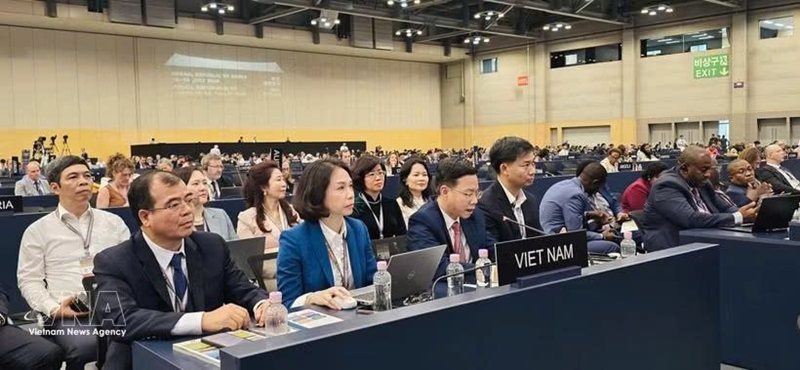
Deputy Minister of Foreign Affairs Ngo Le Van, Chairman of the Vietnam National Commission for UNESCO, addresses the session. |
The committee commended Vietnam for fulfilling the commitments it has made since the citadel was inscribed on the UNESCO World Heritage List in 2010, as well as for implementing recommendations from the committee and its advisory bodies. It also praised the country's efforts to preserve the site's cultural, historical and social values, transforming the imperial citadel into a space for public engagement, cultural exchange and historical education. The committee further welcomed the long-term vision as an important basis for the proposed restoration of Kinh Thien Palace in line with the approved conservation strategy.
Deputy Minister of Foreign Affairs Ngo Le Van, Chairman of the Vietnam National Commission for UNESCO, described the committee's decision as an important milestone. He said members had highly valued Vietnam's responsible cooperation with the UNESCO World Heritage Centre and the International Council on Monuments and Sites (ICOMOS), noting that the country had complied with the World Heritage Convention, honored its commitments and continued to promote the site's outstanding universal value.
Lazare Eloundou Assomo, Director of the UNESCO World Heritage Centre, said the approved dossier was significant not only for Vietnam but also for the wider international heritage community. He described it as a model of cooperation between a State Party, UNESCO and its advisory bodies, offering valuable experience for other countries while demonstrating new approaches to heritage conservation and promotion.
The Thang Long Imperial Citadel served as Vietnam's political center for 13 consecutive centuries and remains one of the nation's most important historical symbols. Approval of the conservation vision clears the way for continued restoration of the site's central axis, helping revive its historical landscape, strengthen awareness of Vietnam's cultural heritage and meet the aspirations of both present and future generations.
|
|
 |
|
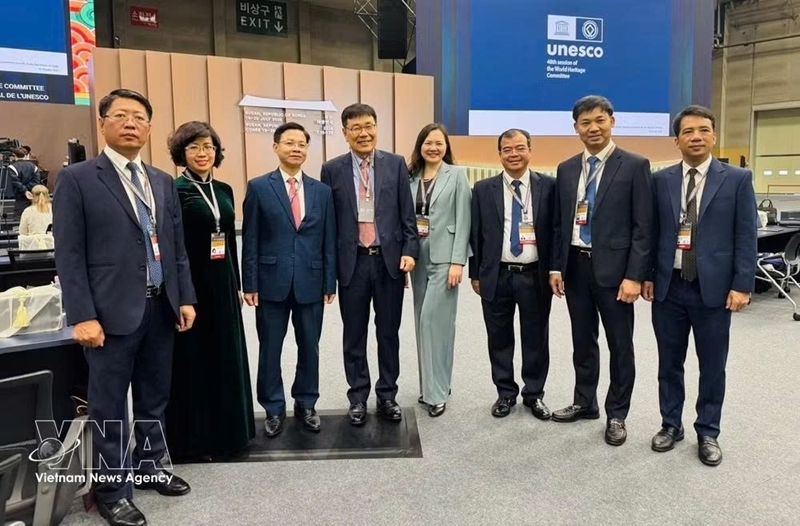
Deputy Minister of Foreign Affairs Ngo Le Van (third from left), Committee Chair Lee Byong Hyun and representatives of Vietnamese localities pose together during the session. |
On the sidelines of the committee session, Ngo Le Van met UNESCO Director-General Khaled El-Enany, UNESCO Assistant Director-General for Culture Nayef H. Al-Fayez, World Heritage Centre Director Lazare Eloundou Assomo, ICOMOS President Teresa Patricio, ICOMOS Director-General Céline Noguès-Weber, and Tim Badman, Head of the World Heritage Program at the International Union for Conservation of Nature (IUCN). The meetings focused on strengthening multilateral cooperation and advancing Vietnam's heritage nomination and conservation dossiers.
During the meetings, leaders of UNESCO, ICOMOS and IUCN praised Vietnam's active contributions to the organizations' governing mechanisms and its responsible implementation of the World Heritage Convention. They reaffirmed their readiness to continue supporting Vietnam in conserving and promoting its World Heritage sites and welcomed the country's plan to host the Asia-Pacific Dialogue on Heritage and Authenticity in Hanoi in September 2026 as a platform for sharing conservation experience.
Vice Chairwoman of the Hanoi People's Committee Vu Thu Ha thanked UNESCO and ICOMOS for their support during the preparation of the Thang Long Imperial Citadel conservation dossier. She emphasized the importance of constructive dialogue and mutual trust, expressing hope for continued cooperation in preserving and promoting the site's heritage values.
Vice Chairman of the Hai Phong People's Committee Nguyen Minh Hung and Vice Chairman of the Quang Ninh People's Committee Nguyen Van Cong also reaffirmed their commitment to conserving Vietnam's two trans-provincial heritage sites – the Yen Tu–Vinh Nghiem–Con Son, Kiep Bac Complex of Monuments and Landscapes, and Ha Long Bay–Cat Ba Archipelago. They pledged to fully implement the World Heritage Committee's recommendations and continue working closely with ICOMOS and IUCN to balance heritage conservation with sustainable development.
Source: VNA