The dance also embodies the moral tradition of gratitude to ancestors, strengthens bonds between generations, and reflects the working people’s belief in the harmony between humans and nature.
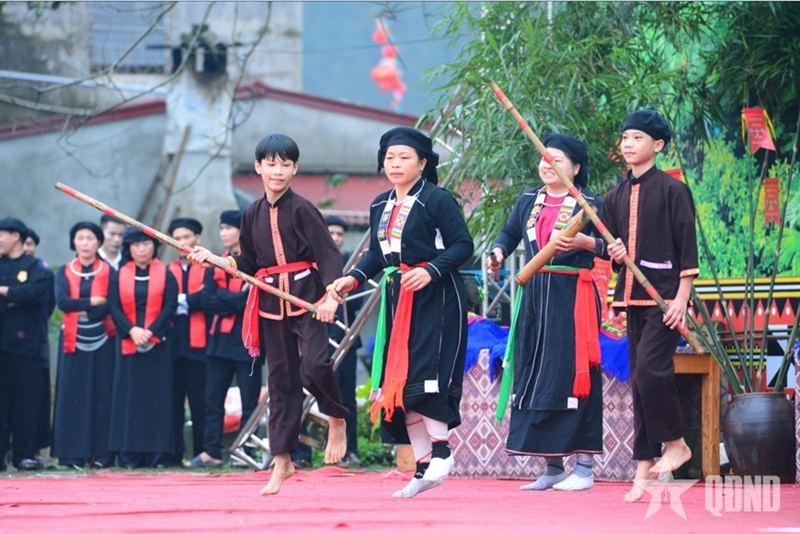
Tac xinh is a unique form of folk performing art closely tied to the production life of the San Chay ethnic community. The dance consists of nine basic movements, including pathfinding, village founding, ritual gestures, knife sharpening, clearing fields, sowing seeds, gathering, celebrating the harvest, and the Streptopelia chinensis movement.
    |
 |
|
People of Phu Dinh commune perform the Tac xinh dance. |
Each movement simulates familiar labor activities, such as clearing land, planting seeds, fishing, and driving away animals. From these everyday tasks, people have creatively stylized into simple but meaningful dance movements that reflect daily life and the community’s spirit of solidarity. Over a long period of preservation and development, the Tac xinh dance has been safeguarded and passed down through many generations of the San Chay people.
At Phu Dinh Secondary School, incorporating the Tac xinh dance into extracurricular activities has become a familiar practice. After the first class of the week, students gather at the arts club to learn the dance and sing traditional folk melodies taught by local artisans.
Nguyen Thi Tuyet Le, the school principal, shared: “The Tac xinh dance of the San Chay people is a ritual to give thanks to deities after each harvest, while also praying for a favorable new year and abundant crops. Though the movements are simple, they carry profound philosophies. We hope students will understand and appreciate these traditional cultural values.”
In a conversation with us, Le Ngoc Linh, Party Secretary and Chairman of the People’s Council of Phu Dinh commune, affirmed that though rustic, the Tac xinh dance holds sacred significance and is regarded by the community as a bridge connecting heaven and earth, the past and the present, and different generations.
According to the official, in the coming time, the locality will continue to preserve and promote the value of this dance in connection with the development of local cultural tourism.
Translated by Chung Anh