Under the Politburo’s Resolution No.80-NQ/TW on the development of Vietnamese culture, Hanoi has been given fresh opportunities to leverage its cultural, historical, tourism and creative assets. The city’s recently approved project on developing the night-time economy for 2026–2030, with a vision to 2045, is expected to create momentum for cultural industry growth while enhancing Hanoi’s standing as a creative and modern city with a distinctive identity.
    |
 |
|
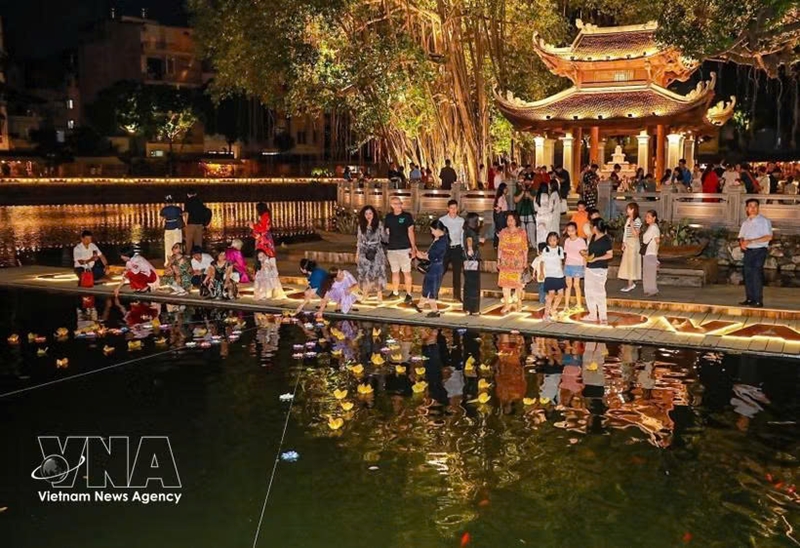
People join the “Ho Van Lantern Festival Night” program at the special national relic site of the Van Mieu - Quoc Tu Giam (Temple of Literature - First National University) in Hanoi. |
For Hanoi, cultural industries can become a high-value-added economic sector, contributing to the city’s competitiveness and sustainable development. Beyond preserving heritage, Hanoi needs to build a vibrant cultural marketplace where cultural products can reach wider audiences and generate stable revenues.
The night-time economy provides an ideal platform for the commercialization of cultural products and services. Music, cinema, performing arts, creative design, handicrafts, fashion, cuisine and cultural tourism can all benefit from a dynamic evening economy. As more visitors participate in night-time activities, demand for artistic performances, creative products and cultural experiences is expected to increase.
This also opens new opportunities for artists, designers, creative enterprises and event organizers. Instead of relying on occasional programs, they can become part of a regular chain of cultural activities, creating sustainable income streams and encouraging innovation.
As a member of the UNESCO Creative Cities Network, Hanoi enjoys a significant advantage in building a more dynamic creative ecosystem.
According to Dr. Tran Viet Dung, Dean of the Faculty of Creative Management and Economy under the University of Social Sciences and Humanities and Arts of the Vietnam National University-Hanoi, the capital possesses favorable conditions for developing the night-time economy, including its rich cultural heritage, high concentration of historical sites and strong appeal to international visitors.
He said the city is well suited to developing a model centered on cultural markets and creative services.
Assoc. Prof., Dr. Bui Hoai Son, a full-time member of the National Assembly’s Committee for Culture and Social Affairs, noted that Hanoi’s thousand-year history and diverse heritage resources provide abundant material for cultural storytelling. Every street, bridge and architectural landmark contributes to the unique appeal of the capital, offering valuable assets for night-time cultural activities.
One example is Ho Van (Literature Lake), part of the special national relic site of the Van Mieu - Quoc Tu Giam (Temple of Literature - First National University). In recent years, creative cultural activities, exhibitions and music performances held there have attracted growing interest from both domestic and international visitors.
The “Ho Van Lantern Festival Night” program has emerged as a new night-time tourism product that combines art, cuisine and Vietnamese cultural traditions. Running from 5 p.m. to 9 p.m. on weekdays, the program allows visitors not only to explore the heritage site but also to interact directly with cultural experiences.
Nguyen Lien Huong, Deputy Director of the Van Mieu - Quoc Tu Giam Center for Cultural and Scientific Activities, said plans are underway to develop Ho Van into a representative creative cultural space and eventually a cultural industry hub of Hanoi. The center aims to expand cooperation with artists and tourism businesses while introducing contemporary cultural products into the heritage space.
Source: VNA