Expanding traditional festivals
From sacred rituals to vibrant community parades, festivals across Lam Dong are expanding in scope and appeal.
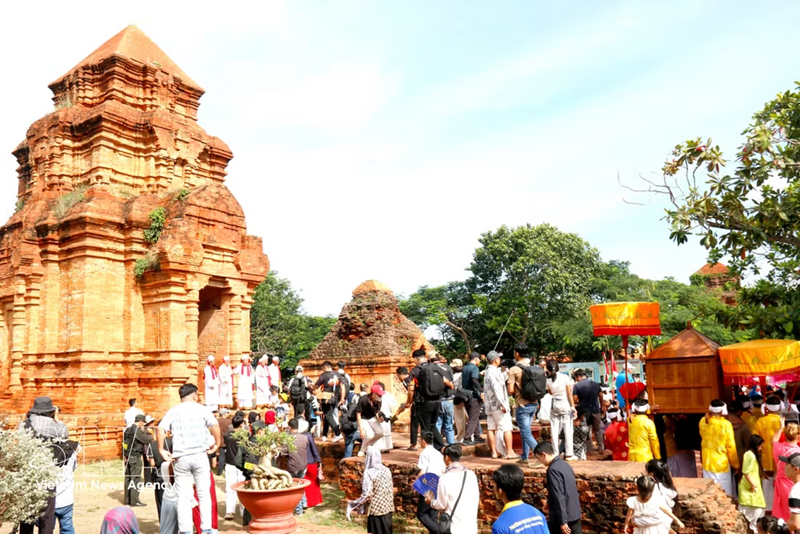
Celebrated annually in October by the Cham community, the Kate Festival offers a window into indigenous beliefs and customs. Beyond sacred ceremonies, visitors could immerse themselves in traditional craft workshops, textile weaving, and folk music featuring the Saranai trumpet and Ginang drum.
    |
 |
|
The procession of Goddess Po-Sah-Inu’s ceremonial attire to the main tower during the 2026 Kate Festival on October 10 |
At the Po-Sah-Inu Tower national monument complex in Phu Thuy ward, tourists have continued to admire ancient 10th-to-18th-century artifacts long after official festivities ended.
To broaden the festival’s reach, local authorities recently digitized the Po Nit Temple complex via dulichbacbinh.vn, bringing sacred sites directly to digital travelers.
Coastal heritage plays an equally prominent role in the province’s identity. The Cau Ngu (Whale Worshiping) Festival serves as both a sacred spiritual tradition and a living historical record of Viet Nam’s maritime sovereignty.
This year’s event featured a lantern floating ceremony, over 300 exhibition stalls, and a grand stage showcasing the bai choi chanting, hat boi singing, folk games and musical performances.
Huynh Giac, head of the Thuy Tu Temple management board, noted that while whale worshiping rituals were once known only to local fishermen, bringing these cultural practices to the stage allows tourists to gain a deeper appreciation of coastal folk culture.
In September, the Mid-Autumn Festival was elevated to a provincial-scale event, adding to Lam Dong’s appeal on the national tourism map.
During the celebrations at the Lam Dong Culture and Arts Exhibition Center, 27 giant lanterns alongside more than 2,160 smaller hand-held lanterns from 19 localities paraded through major streets in a vibrant display.
Preserving heritage for sustainable future
The expansion of these festivities relies heavily on rigorous preservation.
Venerable Thich Thong Minh Toan, Vice Chairman of the provincial Brahmanical dignitaries’ council, said state-backed restoration efforts have revitalized historical landmarks, including the Po Nit, Po Klaong Manai, and Po Dam temples.
The Cham Cultural Exhibition Center, housing over 1,500 artifacts, has become a core destination. Meanwhile, attendance at the recent Kate Festival, held at the Po-Sah-Inu Tower complex, doubled from last year to over 7,000 visitors, he noted.
However, industry experts emphasized that international outreach must catch up with Lam Dong’s potential.
To convert cultural assets into global attractions, they advised local authorities to publish festival calendars well in advance. This enables travel operators to design tour itineraries and conduct familiarization trips for foreign partners.
Nguyen Linh Vu, Deputy Director of the Lam Dong Investment, Trade, and Tourism Promotion Center, highlighted the importance of experiential travel. He urged agencies to build seasonal products combining relic site visits, folk arts, traditional cuisine, and hands-on craft workshops, helping travelers actively participate rather than remain passive spectators.
In an effort to implement the Politburo’s Resolution No.80-NQ/TW on Vietnamese culture development, Ton Thien San, Director of the provincial Department of Culture, Sports, and Tourism, noted that the department has continuously fostered local heritage by promoting relic conservation, festival support, the teaching of folk traditions, and the preservation of traditional crafts – all tied to sustainable tourism development and local livelihood improvement.
Today, he added, festivals are widely publicized through diverse and modern channels, harnessing digital technology and media platforms for maximum reach.
By leveraging its natural scenery and living traditions, Lam Dong is crafting authentic, high-value tourism offerings. In doing so, the province ensures its rich cultural legacy remains protected while serving as a catalyst for sustainable socio-economic development.
Source: VNA