It was spotlighted by experts at an ASEAN–China dialogue on AI and digital education hosted by the Viet Nam National University-Ha Noi’s University of Education on November 2.
The dialogue opened the Global MOOC & Online Education Conference (GMC) 2026, themed “Reallocating Intelligence: Transforming Education for a Human-AI Future”, co-hosted by VNU-Ha Noi and China’s Tsinghua University in Ha Noi from November 2 to 4.
    |
 |
|
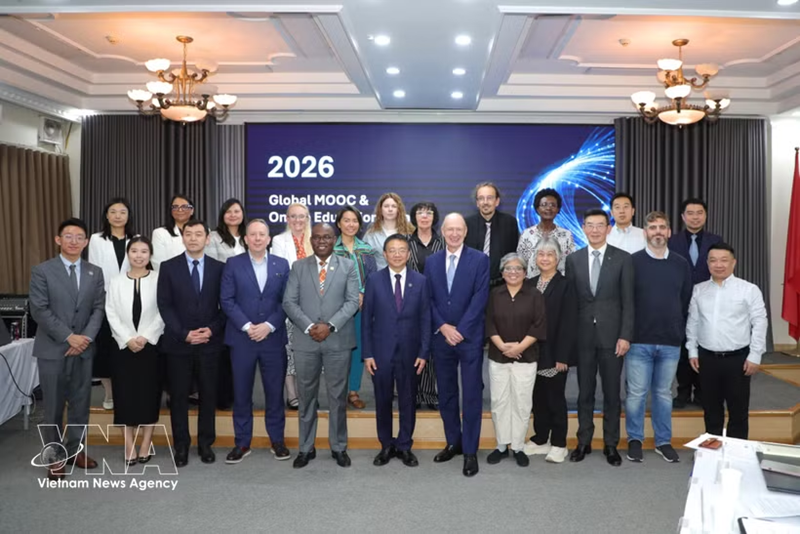
Participants pose for a group photo at the ASEAN–China dialogue on AI and digital education on November 2, 2026. |
It drew experts, scientists, universities and research groups from China, ASEAN and beyond to share experience, pool resources and look for new models in digital education and AI application.
President of the VNU-Ha Noi’s University of Education Assoc. Prof., Dr. Tran Thanh Nam said the event lets the school widen its international academic network, boost expert exchanges, step up joint research and training, and take a deeper role in global education-science and technology forums.
He said the school hopes to push practical Viet Nam–China–ASEAN cooperation and build an open, creative, inclusive and responsible digital education ecosystem.
A representative from the UNESCO Institute for Information Technologies in Education (UNESCO IITE) said teachers remain central to pedagogical decisions. Technology can help with data analysis, lesson design, personalized learning and workload, but cannot replace teachers in guiding, organizing learning and supporting holistic development of students.
Meanwhile, students need more than tool skills; they must understand and judge AI with critical thinking, spot opportunities, risks and limits, and use it responsibly, the UNESCO IITE representative noted.
Discussions ran across three topics: AI-based innovation in future teaching and learning, AI in professional education and specialized practice, and digital transformation and regional cooperation ecosystems.
On professional training, participants shared ways to fold AI into curricula and practice in medicine, chemistry, biology, education science and education management. The focus was on building professional competence and training quality amid fast-changing digital workplaces.
Another focus was digital education ecosystems, open learning infrastructure and resources, knowledge sharing among universities and cross-border cooperation. Sharing resources, experience and practical fixes helps countries and universities learn from one another and adapt global technological and educational trends to local economic, social, cultural and educational conditions.
At the Global MOOC and Online Education Alliance (GMA)’s Executive Board meeting on November 2, Nam proposed four cooperation initiatives, including a working group on teachers’ AI competence, with the VNU-Ha Noi ready to co-chair work toward a common framework and practical training; multilingual smart courses, starting with 2–5 pilot ones in Vietnamese and English on AI in education, digital teaching and learning assessment.
He also suggested a GMA scholar exchange and a joint research on AI in education, and urged that multilingual education and teacher competence should be priorities in the Global Digital Higher Education Development Report 2027.
The VNU-Ha Noi is ready to help build a Southeast Asia chapter and share regional experience and practical issues, he added.
Source: VNA