Addressing the meeting, Trung shared the Association of Southeast Asian Nations (ASEAN)’s common position on the conflict in the Middle East, opposing the use of force and underscoring the principles of respect for sovereignty and territorial integrity, adherence to international law and the United Nations (U.N.) Charter, peaceful settlement of differences, and the obligation of all parties to protect civilians and civilian infrastructure.
    |
 |
|
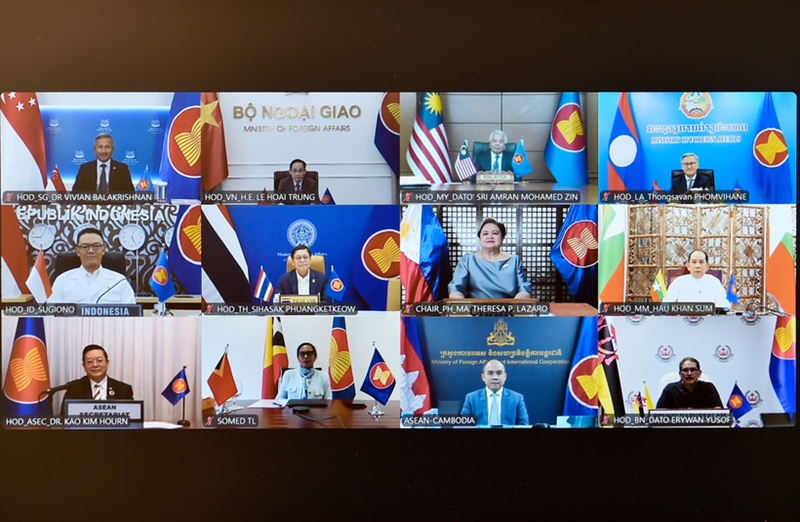
The special ASEAN foreign ministers’ meeting on the Middle East situation is held online on March 13. (Photo: Vietnamese Ministry of Foreign Affairs) |
He also commended ASEAN’s timely consultations, joint position building, and emergency meetings to discuss coordination measures.
Amid the conflict’s serious and far-reaching impacts on the Middle East, Trung stressed the importance of unity and solidarity, calling on the bloc to further strengthen cohesion, promote a culture of dialogue, resolve differences peacefully, and uphold international law, the U.N. Charter, as well as the principles and norms set out in the ASEAN Charter and the Treaty of Amity and Cooperation in Southeast Asia (TAC).
At international forums, including the U.N., ASEAN should enhance coordination, maintain a unified stance, and uphold international law and multilateralism, he said.
On the economic front, the Vietnamese minister emphasised resilience and sustainability as key factors. The bloc should effectively implement the agreed commitments and measures, deepen intra-regional economic integration, strengthen infrastructure connectivity, and ensure energy security, including accelerating major cooperative projects such as the ASEAN Power Grid and the Trans-ASEAN Gas Pipeline, while considering and staying ready to activate emergency support mechanisms under the ASEAN Petroleum Security Agreement.
He stressed that bloc member states should prioritise maintaining energy supplies for one another, particularly oil and gas, and make effective use of cooperation agreements with partners, including Gulf Cooperation Council (GCC) countries, to diversify energy sources.
Regarding consular protection, Trung called on ASEAN countries to continue close coordination and mutual support for one another's citizens.
During the discussion, the participating ministers continued to voice deep concern over the escalating conflict, which has had wide-ranging repercussions for the global economy, particularly by destabilising energy markets and disrupting key maritime routes and supply chains, thereby adversely affecting ASEAN’s economic prospects and community-building efforts.
They agreed that the bloc should make full use of the existing cooperation mechanisms, including the ASEAN Petroleum Security Agreement, the ASEAN Power Grid and the Trans-ASEAN Gas Pipeline, while strengthening partnerships to diversify supply sources and reinforce logistics chains.
The ministers also stressed the need for ASEAN to further bolster solidarity and cooperation, prioritising intra-bloc trade and investment, safeguarding energy and food security, and coordinating efforts to maintain macroeconomic stability.
They further agreed that ASEAN countries will continue to coordinate closely and stand ready to assist one another’s citizens in emergencies or crises in the Middle East, in accordance with the agreed rules and procedures.
The officials also concurred on enhancing coordination across economic and socio-cultural channels to adopt a general and cross-sectoral approach to emerging challenges.
At the conclusion of the meeting, the Philippines, ASEAN Chair for this year, issued a chairman’s statement summarising the discussions and key outcomes.
Source: VNA