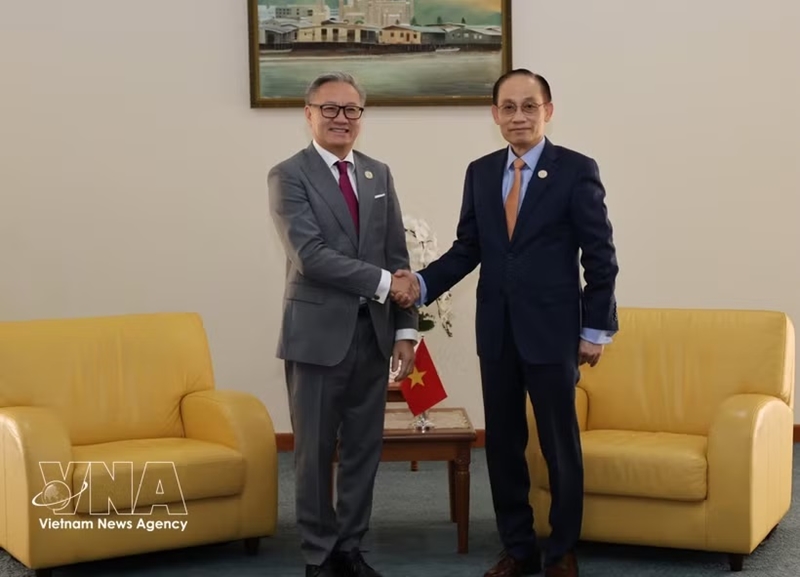
In a meeting with Lao Deputy Prime Minister and Foreign Minister Thongsavan Phomvihane, both sides expressed their satisfaction with the substantive progress in bilateral relations and agreed to further operationalize the strategic connectivity across key sectors. They pledged to effectively implement the 2026–2030 cooperation agreement between the two foreign ministries, maintain regular coordination mechanisms, and continue mutual support at international forums.
    |
 |
|
Minister of Foreign Affairs Le Hoai Trung (right) meets with Lao Deputy Prime Minister and Minister of Foreign Affairs Thongsavan Phomvihane on the sidelines of the 25th ASEAN - E.U. Foreign Ministers’ Meeting on April 28. |
Preparations will also begin early for activities marking the Vietnam - Laos and Laos - Vietnam Friendship and Solidarity Year in 2027. The two ministers reaffirmed close coordination within trilateral Vietnam - Laos - Cambodia cooperation frameworks, as well as preparations for multilateral and subregional conferences to be hosted by Vietnam in 2026.
Meeting with Thai Deputy Prime Minister and Foreign Minister Sihasak Phuangketkeow, Trung highlighted the importance both countries attach to their comprehensive strategic partnership. The two sides discussed concrete measures to prepare for celebrations marking the 50th anniversary of diplomatic relations in 2026, including high-level visits and exchanges. They also agreed to finalize and adopt a 2026–2030 action program to ensure effective and substantive implementation of the partnership.
During these exchanges, the ministers also discussed regional and international developments of mutual concern, emphasizing the need to maintain peace, stability, security and safety in the region. They underscored the importance of strengthening ASEAN unity and centrality, and coordinating positions on strategic issues.
On the same day, the Vietnamese minister held meetings with a wide range of European partners, including European Commission (E.C.) Vice President and E.U. High Representative for Foreign Affairs and Security Policy Kaja Kallas, Slovenian Deputy Prime Minister and Minister of Foreign and European Affairs Tanja Fajon, Czech Deputy Prime Minister and Foreign Minister Petr Macinka, Cypriot Foreign Minister Constantinos Kombos, Lithuanian Foreign Minister Kęstutis Budrys, Austrian State Secretary for Foreign Affairs Josef Schellhorn, Minister of State at the Federal Foreign Office of German Florian Hahn, and Polish State Secretary Wladyslaw Teofil Bartoszewski.
Trung briefed his counterparts on the outcomes of the 14th National Congress of the Communist Party of Vietnam and the country’s major development orientations in a new era. He reaffirmed that Vietnam remains a reliable partner ready to expand multifaceted cooperation with the E.U., calling for increased exchanges at all levels, particularly high-level visits, to further consolidate political trust.
He urged European partners to work closely with Vietnam to achieve more robust and substantive progress in economic, trade and investment cooperation, while calling on the remaining E.U. member states to swiftly ratify the E.U. - Vietnam Investment Protection Agreement (EVIPA), and encouraging the E.U. to recognize the country’s efforts toward the early removal of the E.C.’s “yellow card” warning on Vietnamese seafood exports and its delisting from the E.U.’s tax non-cooperative jurisdictions.
In discussions with the E.U. High Representative, Trung proposed enhancing cooperation in high-quality human resources training through programs such as ERASMUS+ and Horizon Europe. He also suggested the Czech side facilitate tourism cooperation by simplifying visa procedures and supporting the launch of a direct air route to Prague, while continuing assistance to the Vietnamese community there.
With Austria, he proposed resuming meetings of the Intergovernmental Committee and strengthening cooperation in culture and music. Discussions with Slovenia and Cyprus focused on early organization of political consultations and the promotion of agreements on labor, education and double taxation avoidance. With Lithuania, he highlighted opportunities in high-tech sectors, including lasers, biotechnology, fintech and cybersecurity, as well as power grid management. He encouraged Germany to maintain its role as a leading trade and investment partner of Vietnam in Europe and to host the German Business Forum for Asia–Pacific in Vietnam. With Poland, he proposed early recognition of the Vietnamese community as an ethnic minority under local law to facilitate their integration and contributions to society.
European partners commended Vietnam’s dynamic development and reaffirmed its status as a priority partner in Southeast Asia within the E.U.’s Indo-Pacific strategy. They expressed a shared desire to strengthen political-diplomatic ties and enhance the effectiveness of economic cooperation. The E.U. side showed keen interest in participating in infrastructure, renewable energy, green technology and sustainable development projects in Vietnam, and promote its role as a bridge to ASEAN.
On global and regional issues, both sides agreed on the importance of elevating ASEAN - E.U. relations, promoting multilateralism and upholding international law for peace, cooperation and development.
As part of his visit to Brunei, Minister Trung also presented a Vietnamese-language bookcase to Universiti Brunei Darussalam (UBD), highlighting cultural diplomacy as a pillar of bilateral relations. The initiative aims to foster mutual understanding and implement the Vietnam–Brunei Comprehensive Partnership Action Plan for 2023–2027.
At UBD, the minister met with lecturers and students of the Vietnamese language program, emphasizing the role of language as a bridge of knowledge and a gateway to cultural discovery. He expressed appreciation that Vietnamese is currently the only ASEAN language taught at the university, and encouraged the expansion of the program into Vietnamese studies and deeper academic research, alongside enhanced exchanges and annual cultural events. The Vietnamese Foreign Ministry reaffirmed its readiness to support UBD through academic resources, expert coordination and cultural initiatives to further strengthen ties between the two nations.
Source: VNA