In his closing remarks, Tinh expressed his thanks to delegations from ASEAN members, international organizations, development partners, Vietnamese agencies and experts for sharing experience and contributing substantive ideas to the forum. He said the forum had provided an open, multidimensional and practical platform for addressing legal and judicial issues arising amid the rapid development of AI.
    |
 |
|
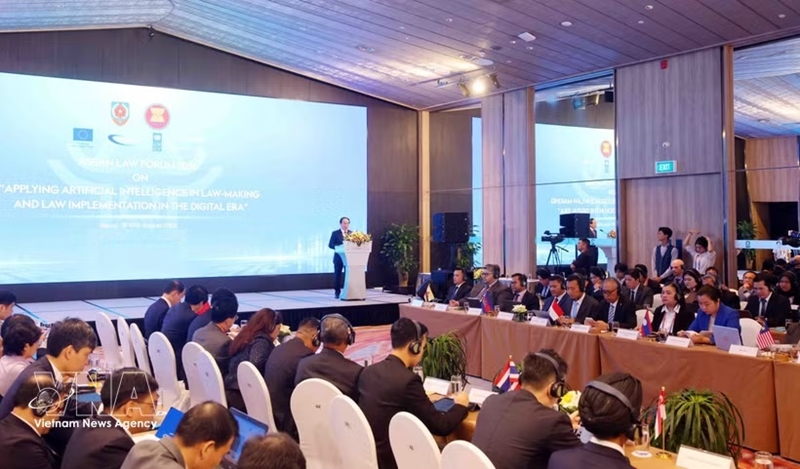
A view of the ASEAN Law Forum 2026 |
Plenary sessions offered a comprehensive overview of AI application in lawmaking and law enforcement, covering Vietnam’s experience, practices in ASEAN countries and lessons from the European Union and international organizations. Discussions highlighted the use of AI in legal research, policymaking, development of national legal databases, and helping citizens and businesses access legal information.
Thematic sessions of the forum, themed “Applying Artificial Intelligence in Lawmaking and Law Implementation in the Digital Era," also explored strategic issues including national AI sovereignty, AI governance in ASEAN, arbitration in the digital era, human-centered approaches to AI development and application, and opportunities and challenges posed by AI for smart governance.
Contributions from experts from ASEAN, the Economic Research Institute for ASEAN and East Asia (ERIA), the EU, the UN Commission on International Trade Law (UNCITRAL), the Organization for Economic Cooperation and Development (OECD) and other international partners underscored that there is no single AI governance model suitable for all countries.
Tinh stressed that AI is not only subject to legal regulation but is increasingly becoming an effective tool throughout the process of developing, improving and enforcing laws.
Given the rapid pace of technological development, countries need to shift from a management mindset to a governance approach, building flexible and adaptive legal frameworks based on risk management while fostering innovation, he said.
In a diverse region such as ASEAN, he emphasized the importance of sharing experience, strengthening policy dialogue, developing digital legal human resources, and promoting cooperation among judicial agencies, research institutions, technology businesses and international organizations to narrow development gaps and strengthen AI governance capacity of each country.
He noted that AI development must ultimately serve people, with technology helping improve access to justice, enhance quality of legal public services, strengthen State governance and promote inclusive and sustainable socio-economic development.
The two-day forum contributed to deepening ASEAN cooperation in legal and judicial affairs while opening new approaches to digital transformation and innovation in lawmaking and law enforcement, Tinh said.
Looking ahead, ASEAN countries should translate the forum’s shared messages and common perceptions into concrete cooperation priorities and actions through ASEAN mechanisms, while strengthening cooperation with international partners. Particular attention should be paid to developing appropriate regional legal frameworks to ensure that AI is developed and used safely, securely, responsibly, transparently and in a human-centered manner.
Vietnam will continue to actively promote legal and judicial cooperation within ASEAN and with international partners, while the Ministry of Justice will remain an active, constructive and responsible partner in the ASEAN community and of international organizations, the official affirmed.
Tinh expressed his hope that the ASEAN Law Forum 2026 would lay the foundation for a broad network of digital legal cooperation, with initiatives put forth at the event soon translated into regional cooperation frameworks and concrete actions toward a modern legal ecosystem for a resilient, innovative and prosperous ASEAN Community.
Source: VNA