Ton Thi Ngoc Huong, Ambassador and head of the Permanent Mission of Vietnam to ASEAN, attended the event.
Participants highly valued the significance of the fifth anniversary of the ASEAN – China Comprehensive Strategic Partnership and the 35th anniversary of the ASEAN – China dialogue relations, affirming that their flourishing relationship has been contributing to peace, stability, cooperation and development in the region.
    |
 |
|
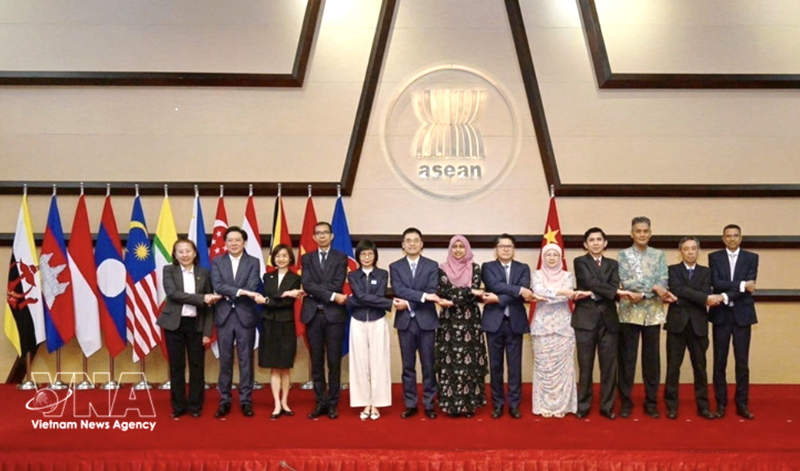
Delegates to the 27th meeting of the ASEAN – China Joint Cooperation Committee pose for a photo. |
Both sides welcomed the practical, comprehensive and effective cooperation results achieved across multiple areas, which has supported the building of the ASEAN Community.
They noted that the implementation of the ASEAN – China Plan of Action 2021–2025 reached 97%, while more than 23% of the targets under the 2026–2030 plan have been achieved in the first three months of implementation.
For many years, China has remained ASEAN’s largest trading partner, a leading contributor of funding to development cooperation with ASEAN, a country maintaining the most cooperation mechanisms with the bloc, and also the largest source of tourists to ASEAN countries.
Amid increasingly complex global and regional developments, both sides agreed to further strengthen the Comprehensive Strategic Partnership on the basis of mutual understanding, respect and win-win cooperation while upholding international law, multilateralism and a rules-based international system with the United Nations at its center.
Chinese Ambassador to ASEAN Wang Qing reaffirmed that China attaches importance to ASEAN and firmly supports the bloc’s centrality as well as the implementation of the ASEAN Community Vision 2045, in alignment with China’s new five-year development strategy.
The two sides also reiterated their commitment to fully and effectively implementing the Declaration on the Conduct of Parties in the East Sea (aka South China Sea) and striving for the early finalization of an efficient and substantive Code of Conduct in the East Sea consistent with international law and the United Nations Convention on the Law of the Sea (UNCLOS) 1982.
Participants exchanged views and reached consensus on strengthening cooperation in various fields, including defense and security, maritime cooperation, combating transnational crimes, disaster response, green transition, digital economy development, expanding trade and investment, effectively utilizing the upgraded ASEAN – China Free Trade Area (ACFTA) 3.0 and the Regional Comprehensive Economic Partnership (RCEP).
Other areas under discussion included infrastructure connectivity, digital connectivity and people-to-people exchanges, as well as cooperation to ensure energy security and maintain stable supply chains.
Ambassador Wang highlighted opportunities to strengthen logistics infrastructure connectivity between the Greater Bay Area and the Hainan Free Trade Port with ASEAN countries, and noted China’s efforts to further open its market, particularly in services, to foreign businesses and investors, including those from ASEAN.
Sharing Vietnam’s views, Ambassador Huong underlined the importance of the ASEAN – China Comprehensive Strategic Partnership. She stressed the importance of responsible contributions from countries, particularly major powers such as China, in maintaining a peaceful and stable environment conducive to regional cooperation and development.
She also proposed further cooperation in maritime affairs in line with the spirit of the DOC; combating high-tech crime; helping businesses make better use of the ACFTA 3.0 and RCEP; promoting science – technology and innovation, including emerging technologies such as artificial intelligence, quantum technology and battery technology; improving road and railway connectivity; and developing renewable energy and sustainable energy infrastructure in the region.
The ambassador also suggested that China continue to actively participate in and contribute to the ASEAN Future Forum 2026.
Source: VNA