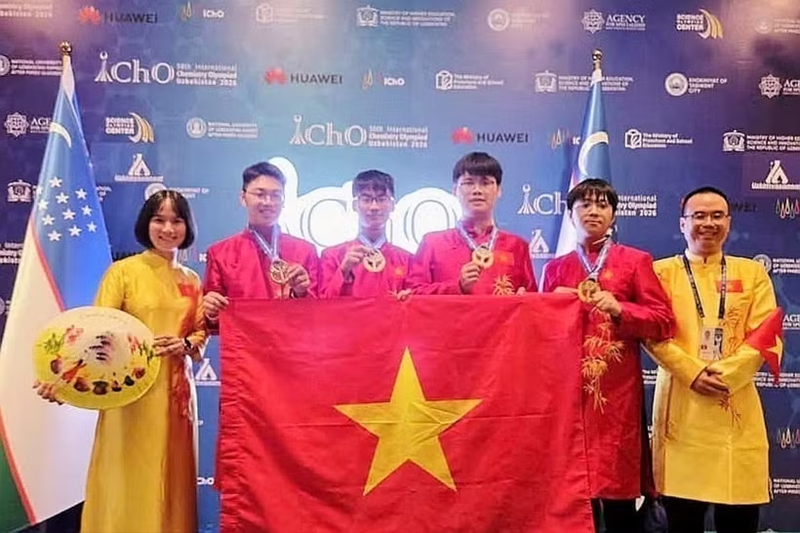
At the 58th IChO, all four Vietnamese students secured gold medals, placing the country joint first with China and India in terms of the number of golds awarded.
The gold medalists are Nguyen Manh Tuan, Nguyen The Minh and Tran Hoang Nam, all 12th-grade students from the Hanoi-Amsterdam High School for the Gifted, and Dinh Xuan Phuc, a 12th grader from the Vinh Phuc High School for the Gifted in Phu Tho province.
    |
 |
|
Vietnam’s team wins four gold medals at the 2026 International Chemistry Olympiad, tying with China and India for the highest number of gold medals. |
The achievement further consolidates Vietnam’s position among the top-performing nations at the prestigious chemistry competition. Between 2020 and 2026, Vietnamese contestants won 25 gold medals and three silver medals.
Hosted in Tashkent, Uzbekistan, from July 10 to 19, the 58th IChO brought together 368 students from 93 countries and territories. Contestants competed in both theoretical and practical examinations, each lasting five hours, with questions covering advanced topics of materials science such as ammonia production, nuclear chemistry, carbon dioxide utilization.
Meanwhile, Vietnam’s four-member team at the 37th IBO earned four silver medals, with three students ranking among the top seven silver medalists. The team also maintained its position among the top eight overall in terms of total score.
The silver medalists are 12th graders, namely Than Duc Chinh and Phung Quang Hung, from the Bac Giang High School for the Gifted in Bac Ninh province, Nguyen Thanh An from the High School for Gifted Students under the Vietnam National University, Hanoi, and Nguyen Luong Thai Duy from the Hanoi-Amsterdam High School for the Gifted.
Held in Vilnius, Lithuania, from July 12 to 19, the competition attracted nearly 300 contestants from 86 countries and territories.
The IBO consisted of two theory examinations and four practical laboratory tests. The theoretical papers addressed global challenges including environmental pollution, green growth, carbon neutrality, climate change, public health and disease diagnosis. Meanwhile, the laboratory tests covered biochemistry and molecular biology, human and animal physiology, animal anatomy and taxonomy, and computational plant biology.
Source: VNA