Prioritizing STEM education
With Viet Nam seeking to develop high-tech industries such as semiconductors, artificial intelligence (AI), big data and renewable energy, demand for skilled workers is rising. This requires not only expanding the workforce but also improving its quality and capacity to master and develop new technologies.
Minister of Education and Training Hoang Minh Son said Politburo Resolutions No.57-NQ/TW and No.71-NQ/TW set strategic orientations for science and technology development and education and training. Universities play a key role in training scientists and technology professionals, making STEM education fundamental to advancing high-tech fields and strategic technologies.
    |
 |
|
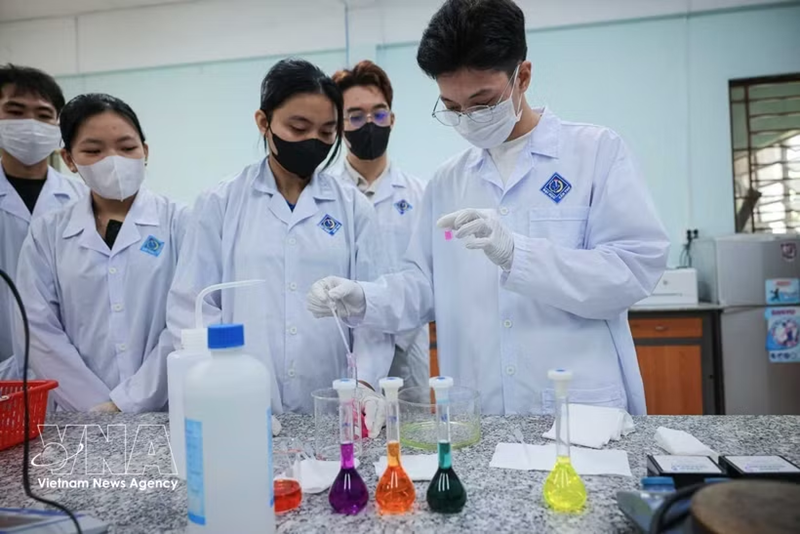
Research and laboratory activities at the University of Science, Viet Nam National University, Hanoi. |
Prime Ministerial Decision No.1002/QD-TTg, issued in 2025, approved a project on training human resources for high-tech development (Project 1002), aiming to build a skilled STEM workforce to meet demand from high-tech industries. The project focuses on nurturing talent for research and development in priority strategic and high technologies, helping Viet Nam attract investment from global technology corporations while supporting economic restructuring and sustainable growth driven by science, technology, innovation, digital transformation and green transition.
Preferential credit policies for STEM students and scholarships in basic sciences, key engineering disciplines and strategic technologies have also helped boost enrollment. Localities and universities have invested in STEM classrooms, digital laboratories and innovation spaces, while introducing integrated STEM education models.
Nguyen Tien Thao, Director of the Department of Higher Education, said enrollment trends showed growing interest in STEM, basic sciences and strategic technology disciplines.
In the 2025-2026 academic year, the education sector carried out seven tasks related to Project 1002 and STEM talent development, 10 on energy workforce training, four on railway-related human resources and 23 on STEM, strategic technologies and key engineering.
The Ministry of Education and Training (MOET) also approved 103 STEM talent programs leading to engineering or master’s degrees at 23 higher education institutions and established 13 networks of training centers of excellence.
By the end of August, 212,601 of the 633,415 candidates who confirmed university admission chose STEM fields, accounting for 33.56%. Nationwide, learners in eight STEM fields totaled 848,286, or about 30.3% of all learners.
From quantity to quality
Despite growing interest in STEM, expanding enrollment is only the first step. Training quality and the capacity to meet technological development needs remain key challenges.
Incoming students’ preparation varies, while higher education infrastructure, teaching staff, laboratories and learning environments are insufficient to support advanced training, research and technological development. The shares of students in STEM and at the postgraduate level also remain below 2030 targets, while some disciplines are not closely aligned with labor market demand or universities' training capacity.
At Vietnam National University-Ho Chi Minh City, four member universities have proposed investing about VND 535 billion (USD 20.6 million) in laboratories for STEM talent training. Such programs require smaller classes, higher academic standards and substantial operating and infrastructure costs, posing challenges without appropriate funding mechanisms.
Experts say developing high-quality scientific and technological personnel requires training reform, talent development and stronger research environments, rather than simply opening more courses. STEM programs should closely integrate education, research and innovation.
Professor Le Anh Tuan, President of Hanoi University of Science and Technology, said STEM development should begin in general education to ensure a strong pipeline of qualified university students. An ecosystem linking education, research, innovation and businesses is also needed to translate university research into products that benefit society. He held that attracting outstanding lecturers and scientists, including overseas talent, requires special mechanisms and financial support. Training engineers, master's students and doctoral candidates should also be linked with strong research groups in strategic and high-tech fields, with closer business cooperation to ensure graduates meet labor market needs, he continued.
The MOET said STEM and strategic technology disciplines would be prioritized without lowering admission or graduation standards, while universities, research institutes, technology enterprises and international scientists would be encouraged to participate.
By 2030, the sector aims for STEM students to account for 35% of enrollment at each education level, with around 20,000 learners in STEM talent programs and 6,000 doctoral candidates pursuing STEM disciplines.
Source: VNA