In his opening remarks, Standing Vice Chairman of the provincial People’s Committee Lo Van Cuong said that under the National Strategy on Gender Equality for the 2021-2030 period, Dien Bien has gradually incorporated gender equality targets into its socio-economic development tasks; paid attention to supporting livelihoods and assisting disadvantaged women and children; and stepped up efforts to prevent domestic violence, human trafficking and child abuse.
    |
 |
|
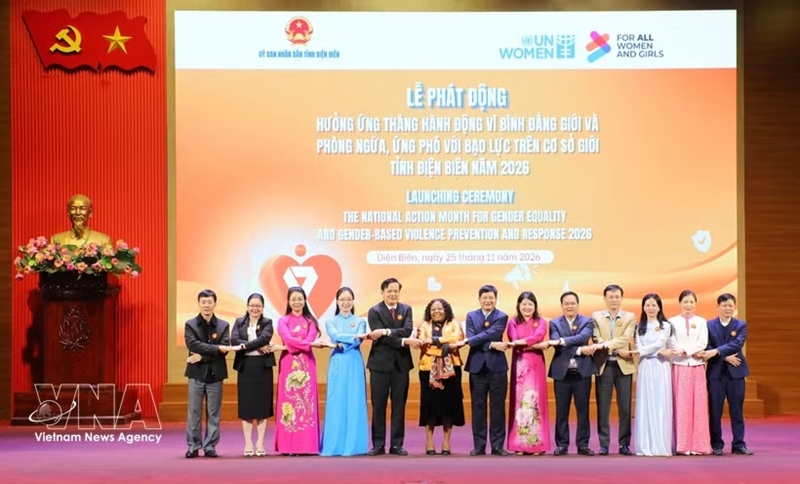
Officials pose for a group photo at the launching ceremony of the 2026 Action Month for Gender Equality and Gender-Based Violence Prevention and Response in Dien Bien province on November 25. |
To ensure tangible progress during the action month, lasting until December 15, Cuong called on provincial departments, agencies and commune-level authorities to expand vocational training, employment and livelihood development opportunities for women, and strengthen grassroots capacity to prevent and detect violence and provide support for victims at an early stage.
He urged localities and agencies to step up communication activities targeting different population groups.
Meanwhile, the education sector was required to provide students with more opportunities to experience science and technology and receive career guidance suited to their abilities and interests.
Caroline T. Nyamayemombe, U.N. Women Country Representative in Vietnam, praised Dien Bien's efforts to fulfil its commitments to promoting gender equality and the progress of ethnic minority women and girls.
She affirmed that U.N. Women will continue working with the province to effectively implement programs, projects and practical activities to advance gender equality, prevent and ultimately end violence against women and girls.
By the end of 2025, all 45 communes and wards in Dien Bien had implemented domestic violence prevention and control models. The province has also established more than 600 clubs of families for sustainable development, nearly 700 anti-domestic violence groups, and over 800 community-based trusted addresses providing support for violence victims.
Local authorities have also organized training courses to improve professional skills for officials, civil servants and grassroots workers involved in gender equality and the advancement of women.
However, in many remote, mountainous and border areas, long travel distances and limited access to vocational training and employment continue to constrain opportunities for some women, particularly those from ethnic minority communities. Family care responsibilities and occupational stereotypes also narrow the choices available to women and girls, local authorities reported.
Source: VNA