The mobilization must be based on the principle of “harmonized interests and shared risks,” aiming for non-state resources to account for around 35%, PM Pham Minh Chinh affirmed while chairing a meeting of the Government Party Committee’s Standing Board and permanent Cabinet members to review the scheme on preventing subsidence, erosion, flooding, drought and saltwater intrusion in the Mekong Delta to 2035, with a vision to 2050. The meeting also looked into a report, to be submitted the Politburo, on progress in addressing outstanding issues related to Ho Chi Minh City’s flood-control efforts and other projects concerning urban environmental protection and air-pollution prevention.
    |
 |
|
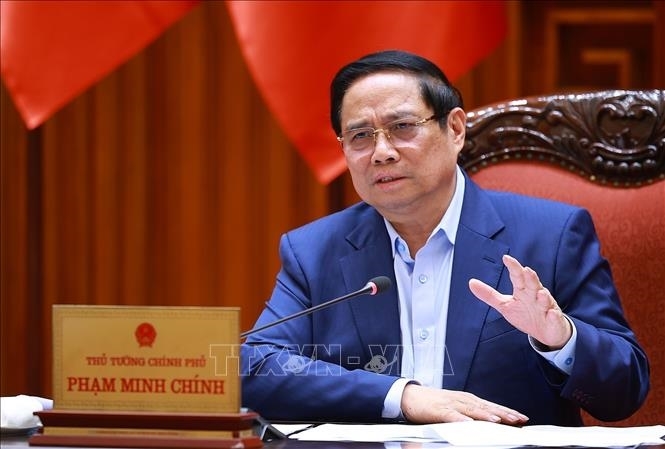
Prime Minister Pham Minh Chinh speaks at the event. |
The PM, who is a Politburo member, Secretary of the Government Party Committee, noted that, given the Mekong Delta’s strategic position and the real challenges unfolding there, the Party Central Committee, the Politburo, the National Assembly and the Government have given special attention to the prevention work.
Numerous resolutions, decisions and directives have been issued, along with major resource investments for the Delta’s development, he elaborated.
The above-said issues have directly affected the livelihoods and daily lives of people in the Mekong Delta that accounts for 12.8% of the country’s area and nearly 18% of its population, and contributes 95% of the nation’s rice exports, 60% of its aquatic exports, and 65% of its fruit exports.
Emphasizing the principle of flexible, effective and nature-based climate adaptation, the leader requested that all feedback from the Government Party Committee’s Standing Board and attending delegates be thoroughly considered, and the documents to be submitted to the Politburo be quickly finalized as required.
|
|
 |
|
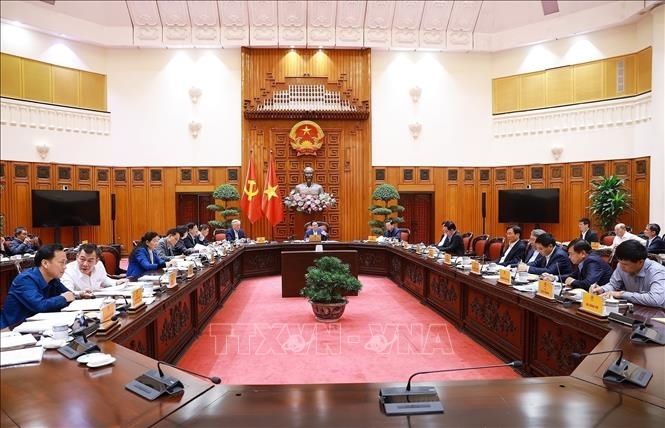
An overview of the meeting |
Highlighting the critical role of science and technology, especially new technologies, PM Pham Minh Chinh called for maximizing effective solutions already in place; expanding non-structural measures alongside structural ones; and aligning population planning, production organization and economic restructuring with the region’s conditions. He also stressed the need for transport solutions that adapt to the Delta’s riverine landscape, and for clear prioritization to ensure resources are allocated effectively.
The Government leader requested strong engagement from ministries and agencies, particularly those directly involved such as the Ministry of Construction, Ministry of Finance, and Ministry of Science and Technology, as well as research institutions, experts and scientists at home and abroad, and local Party committees and authorities across the Mekong Delta, so as to soon finalize the scheme for submission to the Politburo.
The PM requested the completion of the report on progress in addressing several outstanding issues, including HCM City’s flood-control project. He directed relevant bodies to consider, if necessary, developing a separate scheme on environmental protection, quality management, pollution prevention and air-quality improvement in major urban centers, especially Hanoi and HCM City, for submission to the Politburo. He emphasized that any proposals must include feasible, practical and effective mechanisms, policies and solutions.
Source: VNA