The Party Central Committee's Resolution No.19-NQ/TW, dated July 28, 2026, on renovating Viet Nam’s development model, calls for special mechanisms to attract multinational corporations, research organizations and international talent to participate in science and technology programs in Viet Nam.
Amid the implementation of Politburo Resolution No.57-NQ/TW on breakthroughs in science and technology, innovation and national digital transformation, and Resolution No.59-NQ/TW on international integration, international partnerships will expand and strengthen Viet Nam’s scientific and technological capacity.
    |
 |
|
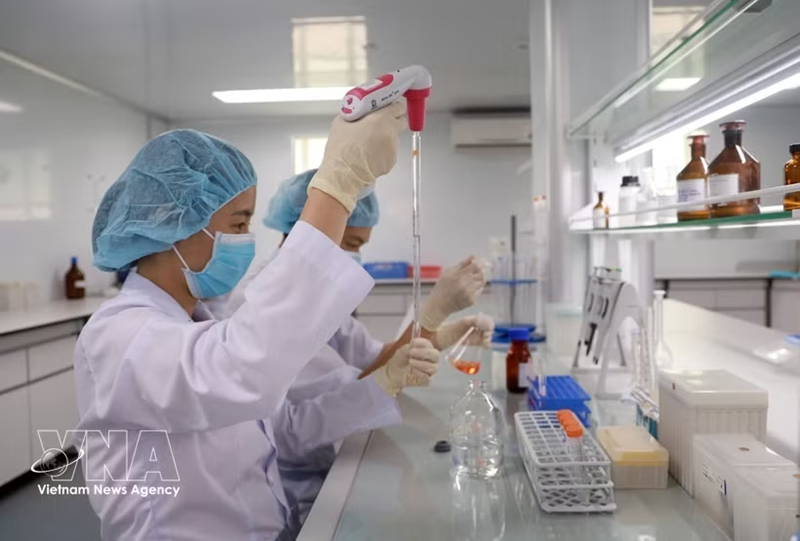
Researchers at the Institute of Vaccines and Medical Biologicals under the Ministry of Health conduct research and testing on vaccines |
Building, connecting, and effectively leveraging international scientific networks will enable Vietnamese science to reach the world while bringing global expertise to Viet Nam to jointly conduct research and address major national development challenges.
In recent years, Vietnamese research institutions have stepped up international cooperation and achieved notable results. In 2025, the Viet Nam Academy of Science and Technology (VAST) signed 51 international cooperation agreements at academy and affiliated-unit levels, focusing on such key areas as space technology, materials science, energy, data science, and environmental science.
VAST is also implementing 45 cooperation tasks and preparing 57 new ones for 2026-2029. These programs have enabled Vietnamese scientists to access advanced research directions, improve their expertise, and gradually acquire and master new technologies.
In 2025, VAST hosted 27 international delegations, helping promote scientific cooperation and technology transfer, particularly in strategic technology fields. It also actively participated in international scientific organizations, contributing to Viet Nam’s greater engagement in global scientific programs.
Meanwhile, Viet Nam National University, Hanoi (VNU) organized 93 international conferences, seminars, forums and lectures in 2025, attracting nearly 700 leading experts and scientists from around the world. These academic activities helped strengthen staff capacity, improve the quality of education and research, and raise VNU’s international standing.
VNU has also been invited to join leading international alliances and networks in artificial intelligence and digital transformation, recognized as an equal partner in the global scientific community. One example is the AI Alliance Network, which brings together 17 international AI associations from 14 countries, with more than 7,000 members and partners.
Despite these achievements, experts say international science and technology cooperation still falls short of current requirements. Many programs and projects remain focused on academic exchanges and have yet to be closely linked to market needs. Financial and intellectual property protection mechanisms remain fragmented, while procedures for bringing in foreign experts and research equipment can be cumbersome.
International cooperation should therefore shift decisively from signing agreements to building genuine domestic capacity in research and development (R&D), talent, data, computing infrastructure, technology transfer and markets.
Prof., Dr. Tran Hong Thai, President of VAST, said the development of international scientific networks should be pursued through four closely linked lines of action.
Vietnamese scientists should have more chances to work directly at global hubs where new knowledge and technologies are created. To truly master advanced technologies, Viet Nam can’t just receive finished products; it needs to get involved early in major international programs, labs, and research facilities. This way, Vietnamese scientists can become active members of the global community shaping the technologies of the future.
Vietnamese scientists should also be encouraged to join international scientific organizations and gradually take on leadership roles, contributing to agenda-setting, research priorities, initiatives, standards and decisions on the allocation of international scientific resources.
Alongside sending Vietnamese researchers abroad for training and collaboration, Viet Nam should create favorable conditions for international scientists to work in the country, train local talent and jointly address specific scientific and technological challenges.
This requires attractive funding mechanisms, research facilities and working conditions, as well as resources to recruit leading experts, ensure adequate laboratories and research teams, and streamline administrative procedures.
Viet Nam should also take the initiative in organizing international conferences, forums, scientific schools and specialized workshops. These events should focus on areas where Viet Nam has strengths or strategic needs, with the aim of developing joint research programs, collaborative teams and long-term scientific initiatives, said the expert.
Source: VNA