In an interview granted to the Vietnam News Agency, Pradhan noted that the Vietnamese N.A., established through the first nationwide general election held on January 6, 1946, laid the constitutional legitimacy of the Vietnamese State at a critical moment amid the struggle for national independence and unity.
    |
 |
|
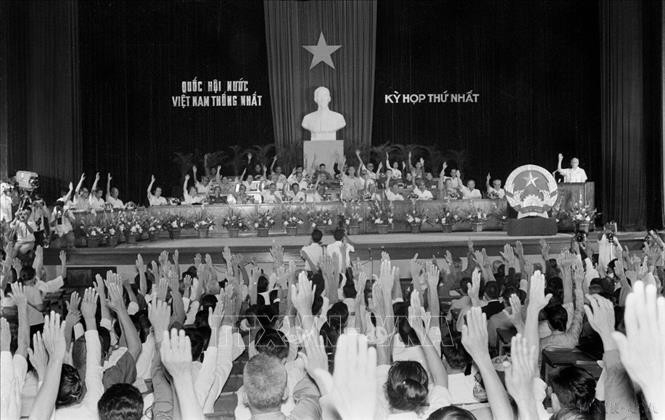
An overview of the first session of the 6th National Assembly |
Since the launch of the Doi moi (Renewal) process in 1986, the N.A. has undergone a fundamental transformation, evolving from a revolutionary institution into a central pillar of the rule-of-law socialist state. Its role in legislation, supervision and decision-making on major national issues has steadily expanded, alongside improvements in professionalism, law-making capacity and supervision of the executive. These developments demonstrate Vietnam’s pragmatic and adaptive approach to the perfection of governance institutions under the leadership of the Communist Party of Vietnam, he commented.
Pradhan noted that the Vietnamese legislature has also played an important role in safeguarding the people’s right to mastery by promoting public participation, enhancing representativeness, and protecting citizens’ rights and lawful interests within the socialist framework.
In the context of deeper international integration, its active engagement in parliamentary diplomacy and ratification of international treaties has contributed to elevating Vietnam’s prestige and standing globally. Overall, the N.A.’s development offers an instructive example of how a socialist state can balance political stability, the rule of law and popular representation, he stated.
Commenting on the upcoming elections of deputies to the N.A. and People’s Councils at all levels scheduled for March 2026, Pradhan stressed their importance in maintaining political stability, improving governance efficiency and strengthening public trust amid a volatile international environment. Regular and synchronized elections at central and local levels help ensure administration coherence, enhance policy coordination and reaffirm the principle of popular sovereignty through broad voter participation, he asserted.
From a comparative international perspective, he observed that the expanding role of the N.A. and People’s Councils mirrors a common trend in well-governed countries where representative institutions contribute to higher governance quality while preserving political stability. Stronger legislative functions improve the quality and predictability of laws and align policies more closely with international standards, thereby supporting economic modernization and international integration, he added.
The former Indian official underlined that the consolidation of the role of the N.A. and People’s Councils provides a solid foundation for Vietnam to achieve its targets to 2030 and realize its vision for 2045, through governance based on the rule of law, reinforced public trust and long-term policy stability.
Source: VNA