The Ministry of Foreign Affairs’ Patriotic Emulation Congress for the 2025–2030 period, held in November 2025, highlighted that the most prominent hallmark of Vietnam’s diplomacy over the past five years has been the effective and coherent institutionalization of the foreign policy line set out by the 13th National Party Congress. This includes maintaining an independent and self-reliant foreign policy; promoting multilateralization and diversification of external relations; pro-actively advancing comprehensive, deep, and effective international integration; safeguarding a peaceful and stable environment; and steadily enhancing Vietnam’s position and prestige in the international arena.
    |
 |
|
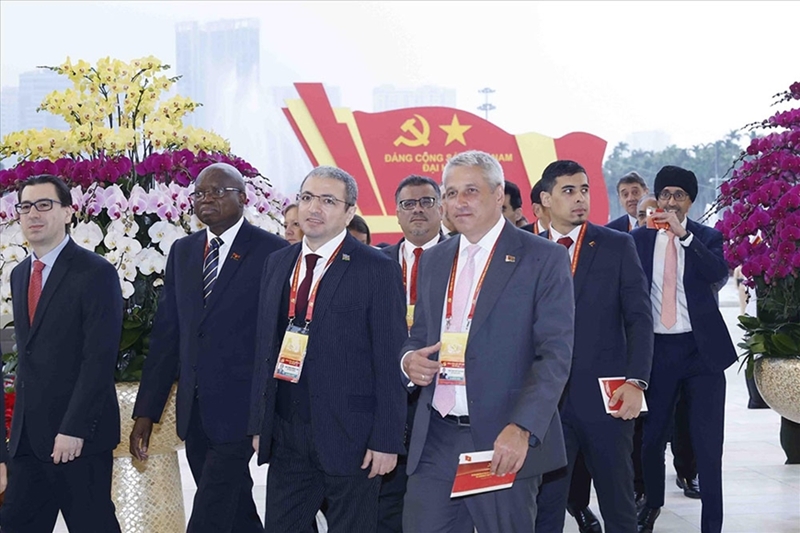
International delegates attend the opening session of the 14th National Party Congress. |
These achievements are reflected in concrete outcomes. First and foremost, diplomacy has continued to contribute to firmly safeguarding national independence, sovereignty, unity, and territorial integrity, while helping maintain a peaceful, stable, and favorable environment for development and gradually improving people’s livelihoods. Both bilateral and multilateral diplomacy have been actively promoted and consolidated, with a wide range of important external activities carried out.
Notably, Vietnam has deepened and stabilized its relations with partners, especially neighboring countries, regional partners, major powers, and other important and high-potential partners. Alongside overseas working visits aimed at expanding international cooperation by leaders of the Party, State, and central and local authorities, Vietnam has welcomed numerous heads of state and government, including leaders from major global powers such as China, Russia, the United States, Japan, and the Republic of Korea.
In parallel, Vietnam has continued to upgrade or establish strategic partnerships, comprehensive partnerships, and comprehensive strategic partnerships with many countries, while consolidating relations with major powers and international organizations. These developments have been widely viewed as clear evidence of Vietnam’s expanding international relations and its steadily rising position and credibility on the global stage.
Beyond safeguarding national interests on the basis of the fundamental principles of the United Nations Charter and international law, Vietnam has also made active contributions to the international community over the past five years. These include assuming responsibilities in regional and international organizations and participating in activities such as United Nations peacekeeping operations and disaster relief and rescue efforts. Through such engagement, Vietnam has demonstrated a pro-active and constructive role in contributing to a fair, equitable, and rules-based international order.
It would also be incomplete not to note the diplomatic sector’s role in promoting international cooperation across economic, cultural, scientific and technological, healthcare, education and training fields, as well as work related to overseas Vietnamese communities. These efforts serve national development goals and support Vietnam’s deeper integration into the global economy.
Taken together, these achievements reaffirm the pioneering role of foreign affairs in safeguarding national sovereignty and territorial integrity, further consolidating a peaceful and stable environment, facilitating socio-economic development, and enhancing Vietnam’s international standing.
Looking ahead, regional and global developments are expected to face unpredictable fluctuations and challenges that could have broad and profound impacts on Vietnam and its external environment. This context places new tasks and missions on foreign affairs and international integration. The draft documents of the 14th National Party Congress identify the promotion of foreign affairs and international integration, alongside national defense and security, as a key and regular task. This represents recognition of diplomacy as a strategic pillar in national construction and defense.
At the same time, these requirements underscore the heavy responsibilities facing the diplomatic sector and its cadres, as they strive to contribute even more to the country’s overall achievements. The goal is to build a comprehensive, modern, professional, civilized, and humane diplomacy in line with the guidance of the Party leadership.
As Vietnam enters a new era of breakthrough development, its diplomacy is expected to continue demonstrating professionalism, adaptability, creativity, and effectiveness in fulfilling its role as a key and regular pillar of national strategy.
Translated by Tran Hoai