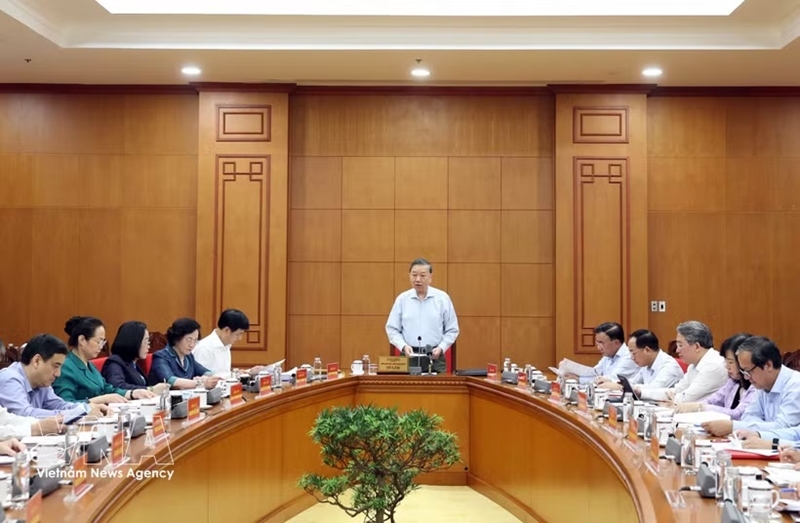
He made the statement at a working session on October 2 with the Government Party Committee, the Party Committee of the Ministry of Culture, Sports and Tourism, and relevant agencies on implementing Resolution No.08-NQ/TW and Conclusion No.70-KL/TW of the Political Bureau on the development of physical education and sports in the new period.
    |
 |
|
General Secretary of the Communist Party of Viet Nam Central Committee and President To Lam chairs the working session. |
The top leader applauded the efforts of ministries, sectors, localities, social organizations, coaches, athletes, experts in developing physical education and sports in recent times, stressing that Resolution No.08 has provided an important political foundation for sports development over the past 15 years, while Conclusion No.70 set important orientations for the new period.
He noted that the 15-year implementation of Resolution No.08 should be fully reviewed while Conclusion No.70 must be effectively implemented under new development conditions.
Sports should not be viewed merely as a socio-cultural activity, but as part of the strategy for human development, population and human resources quality, he said, noting that the core spirit of Resolution No.08 is to improve people’s health, physical fitness, stature and quality of life.
He asked for special attention to school sports, including facilities, equipment and teachers, and research into sharing public sports facilities outside school hours. He said that schools should help students develop lifelong exercise habits while identifying sports talents early. Exercise spaces should also be incorporated into planning for industrial parks, urban areas and new residential areas.
The Ministry of Culture, Sports and Tourism was tasked with coordinating with the Ministry of Health and the Ministry of Education and Training to develop indicators on physical fitness, physical activity and access to sports, initially for children, students, workers and the elderly.
For high-performance sports, General Secretary and President Lam requested a shift in investment, focusing on long-term investment and a continuous talent-development system from schools and localities to training centres and national teams. Investment should target sports, events and athletes with international competitiveness while developing reserve forces.
SEA Games results should not be the sole measure of investment in elite sports, he stressed, saying that training should be supported by science, medicine, nutrition, recovery, psychology and international competition, with clear responsibilities for athletes and teams.
He also underlined the importance to ensure that identified talents do not have to struggle to secure basic conditions for their development.
The leader directed that science, technology and data underpin sports training and management, with hospitals, universities, research institutes, training facilities and experts forming networks in sports science, medicine, nutrition and recovery.
The Ministry of Culture, Sports and Tourism must rebuild the high-performance sports development model around a long-term cycle of early talent identification, proper selection, systematic training, targeted investment, international competition, comprehensive support, regular assessment and successor development, he said.
He asked the ministry to develop the sports economy as a complete ecosystem, shifting from a model in which “the State builds and operates” facilities to one where “the State creates conditions, society invests, the market operates and the State supervises.”
The leader also called for clearer roles between the State and sports federations and associations, annual assessments of their capacity, and greater professionalisation.
He requested stronger implementation capacity, with each key task assigned a responsible agency, coordinating agency, individual, deliverable, timeline and necessary conditions. He said progress should be regularly monitored and assessed, with the ultimate goal being not simply task completion but visible, measurable and sustainable changes in practice.
Source: VNA